
ED 103 can identify an application to finance a Victorian school building, but it does not name a school’s pupils or prove that a proposed building was finished. The starting point is the historic school, town and sponsoring body—not an ancestor’s surname.
What the Grant Application Actually Establishes
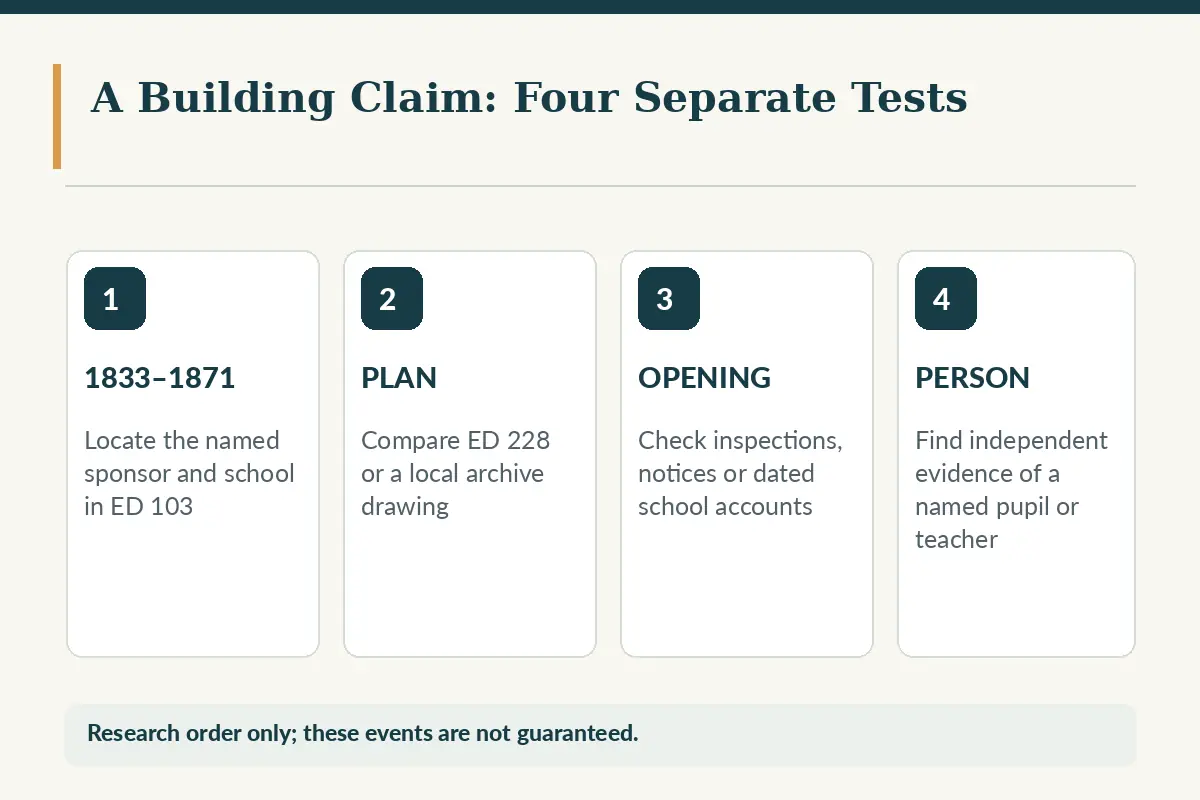
An ED 103 record may establish that a patron or charitable sponsor requested public money to build or enlarge a school in England or Wales during the nineteenth century. It does not, by itself, establish that the proposed building was completed, that every feature of a drawing was constructed, or that a named ancestor studied there. The National Archives dates school-building grant applications to 1833–1871 and advises searching by school name or town. Put the documented name and locality ahead of a surname: these are institutional records.
Begin with a specific question such as “Was a schoolhouse proposed beside the parish church in 1854?” Gather variants of the school name, nearby hamlets, denomination, sponsor, and possible opening date. Sponsors rather than head teachers may appear prominently in grant correspondence. A modern school with the same name can occupy an entirely different building, so record both historical and present locations as separate hypotheses.
Locate ED 103 and Its Related Plan
Use The National Archives elementary and primary schools guide and search Discovery within ED 103. Run separate searches for the village, original town, school title and sponsoring charity. Read each catalogue entry for the record date and its held-by field before ordering. A collection-level description may name the institution without indexing every correspondent or plan inside the file. Record the full piece reference rather than only a search result.
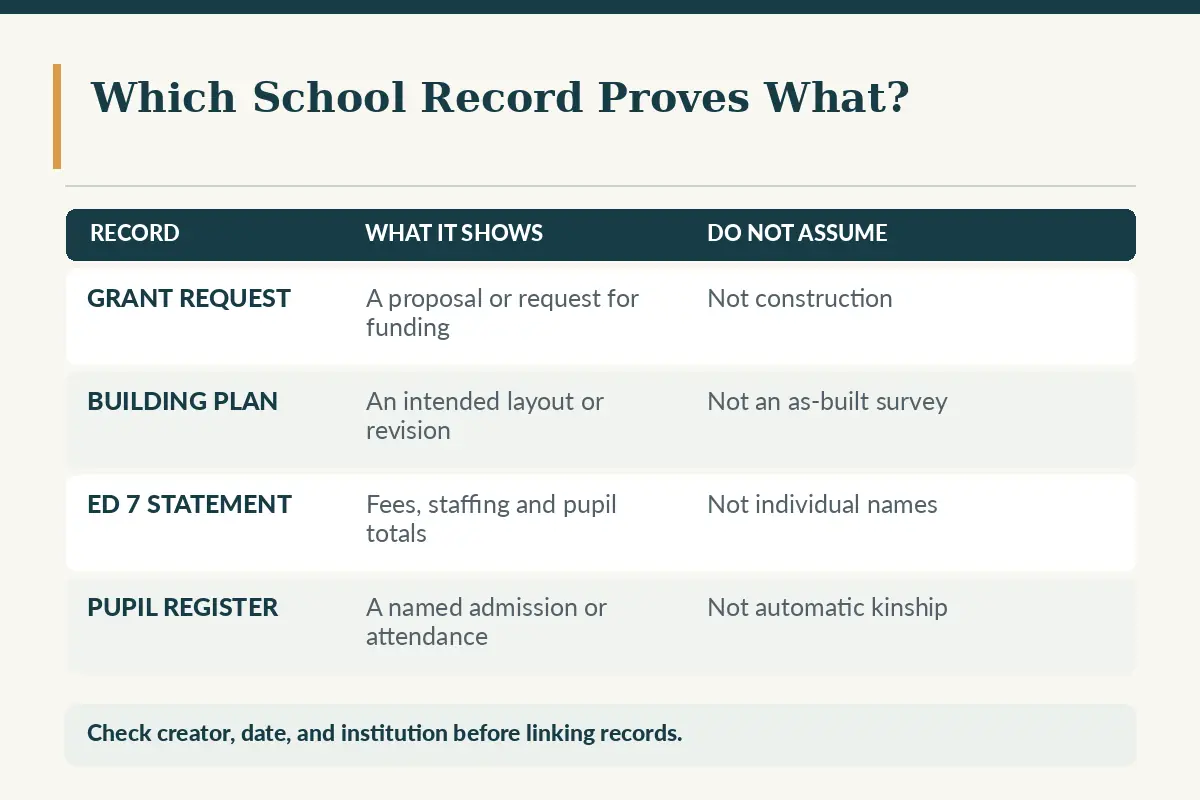
The original grant applications could include detailed plans, but most plans are now in local record offices, with a small number in ED 228. Build a two-repository checklist: ED 103 correspondence at Kew, and county or charity archives for the associated drawing. Ask whether the local catalogue describes a proposed plan, a revised design, an as-built survey or an unrelated later extension; visual resemblance alone is not sufficient provenance.

Separate Sponsorship, Funding, and Construction
Read the application as a sequence of possible administrative steps: a sponsor proposes a school; funding may be considered or awarded; land is acquired or donated; work may begin; a building may open. No one item proves every step. List each dated statement verbatim with its author, purpose and archive reference. A drawing with rooms and dimensions measures an intended design only unless completion evidence supports it. The difference matters to anyone trying to locate an ancestral street or the house beside a schoolyard.
Corroborate construction with school log books, trustees’ minutes, local newspapers, maps and parish or municipal accounts. An ED 103 request naming an estate owner as a supporter does not demonstrate that the owner taught or was a parent of a pupil. A grant amount is not the total project cost; private subscriptions, donations and later repairs may have changed the financial story.
Find the School in Later Administrative Files
For schools that later received annual grants, ED 21 files contain departmental correspondence about premises, trust arrangements, inspection and organisation. ED 161 later digests may help with a twentieth-century continuation. These files were created by government offices and are not, as a rule, class registers of children. Compare each file’s title and dates with the historic school to avoid silently joining a successor institution to an earlier building.
The same official guidance identifies ED 7 preliminary statements, starting in 1846, as a separate route to information about school income, expenditure, staffing, accommodation, fees and pupil totals. Such totals are counts rather than names. Use them to assess whether the institution was operating, and seek an original attendance register at the school or local archive if the real question is whether a particular child attended.
Test a Claimed Pupil or Teacher Connection
To investigate a named child, use household residence, school-age dates, surviving admission or attendance registers, and the religious or geographic catchment area. Where no register survives, a grant application is context, not evidence of enrollment. Similarly, a named contractor, clergyman or donor is not automatically an employee. Mark “named in school file” separately from “teacher,” “pupil,” “builder,” and “trustee,” and support each relationship with a document explicitly stating the role.
If a family story names only “the old school,” compare old and new school sites on dated maps. Schools can change premises, denominations and legal titles. Record the year of each map and whether the building footprint and road alignment match. A photograph taken decades after the grant does not establish when the pictured facade was erected. Keep incompatible location claims visible until a dated independent source resolves them.
What Missing Records Can and Cannot Mean
If the ED 103 search returns nothing, consider alternate spellings, different sponsors, a new village boundary, or a school that never applied for a Treasury building grant. The institution may have been financed without the type of grant documented in ED 103, or the surviving file may be described broadly. An empty name search is not evidence that there was no school. Log which series, exact words, year limits and repositories you searched.
The National Archives school research guide explicitly points researchers to local archives for individual school records. Preserve this custody distinction when sharing citations. A Discovery link for a central departmental file and a local archive catalogue link for a pupil register support different claims even when both mention the same school.
More Records and Archives Guides
How We Research a Victorian School Site
We first transcribe the school’s historically documented name, parish, denomination and approximate years. Next we search ED 103 by town and sponsor, read the catalogue scope, and request the original application where appropriate. We separately search ED 228 and local repositories for plans, then compare administrative milestones with maps, inspections and any extant school log. This sequence deliberately separates proposals from execution and attendance from building history.
Our evidence ledger records the source creator, its date, the exact statement, an alternative explanation, and the next independent record. We flag surviving-but-unavailable files rather than treating an inaccessible image as a negative result. For disclosure about site funding and research links, see our affiliate disclosure; the archival questions on this page do not require a paid service.
No. It documents a request and possibly subsequent administrative action; completion or opening needs independent dated evidence.
Most detailed grant-related plans are in local record offices; a small selection survives in ED 228 at The National Archives.
Usually not. Look for admission or attendance registers at the school or local archive and prove the identity separately.
Search older names, sponsors, parish and locality, then build a dated continuity trail rather than assuming one name identifies one building.
No. They report institutional totals and finances, not a verified roll of named students.