
A nineteenth-century name in a debtor index is a lead to a court proceeding, not a certificate of release. The National Archives identifies B 8 as the index route for insolvent debtors’ petitions and B 6 as the related registers. For petitions dated 1820–1861, the most important first decision is geographical: was the case indexed as “town,” meaning London, or “country,” meaning elsewhere?
Begin with a precisely stated question, such as whether a named person sought relief from imprisonment in a given decade. Collect the name as spelled in a contemporary source, an approximate year, a known residence or prison and any occupational description. Keep these identifiers in separate columns. The records can involve people with similar names, and an index match on surname alone is not proof of identity.
Select the Town or Country Index Before Looking for a Petition
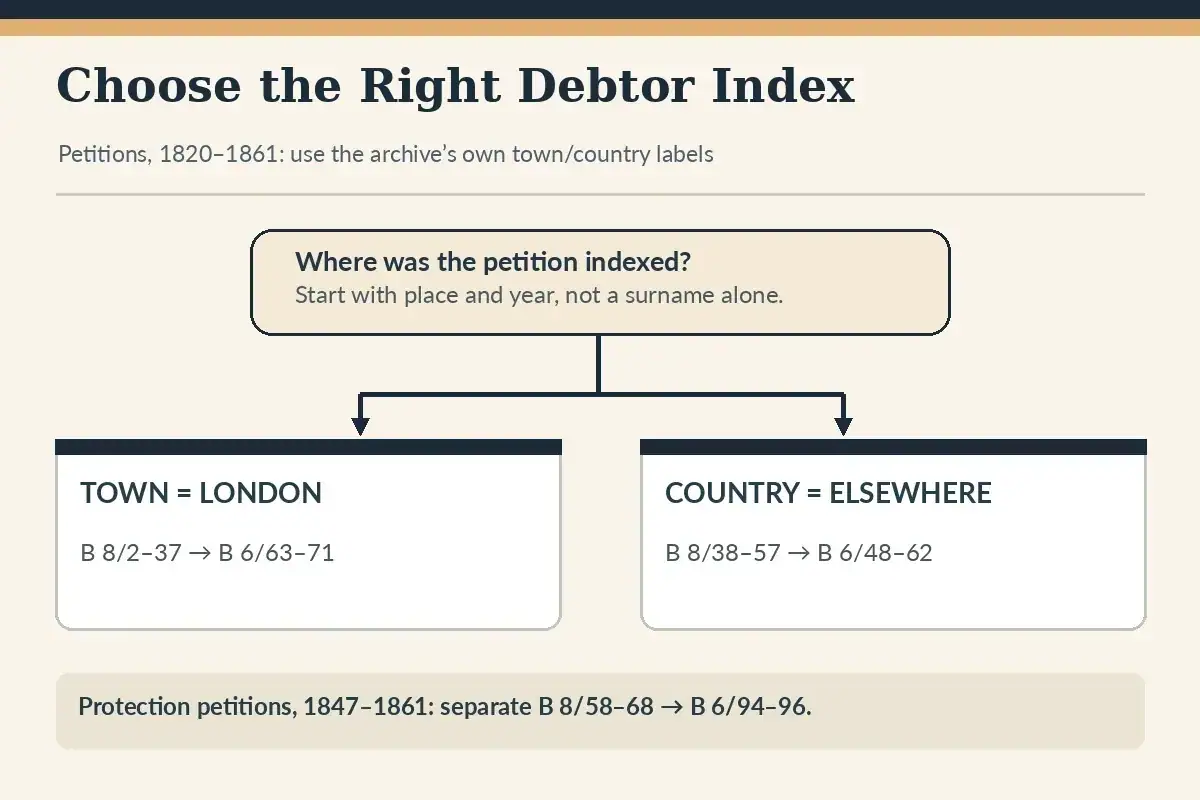
For London cases, inspect B 8/2–37, the indexes for town prisoners. For cases treated as country, inspect B 8/38–57 instead. These are index ranges, not a promise that each person has a complete surviving case file. The corresponding petitions for 1820–1861 are recorded in B 6/63–71 for town and B 6/48–62 for country. Use the exact reference and register number found in the index rather than transferring a similar-sounding surname across series.
The National Archives also describes a different route for protection cases in 1847–1861: B 8/58–68 indexes petitions, while B 6/94–96 contains numbered registers. Do not quietly use that protection route for an ordinary prisoner petition. Record which category a contemporary entry uses, because the legal procedures and potential outcomes were not identical. If the locality is uncertain, search both branches and label every candidate as unconfirmed until matched against independent details.
Read a Register Entry as an Event in a Legal Process
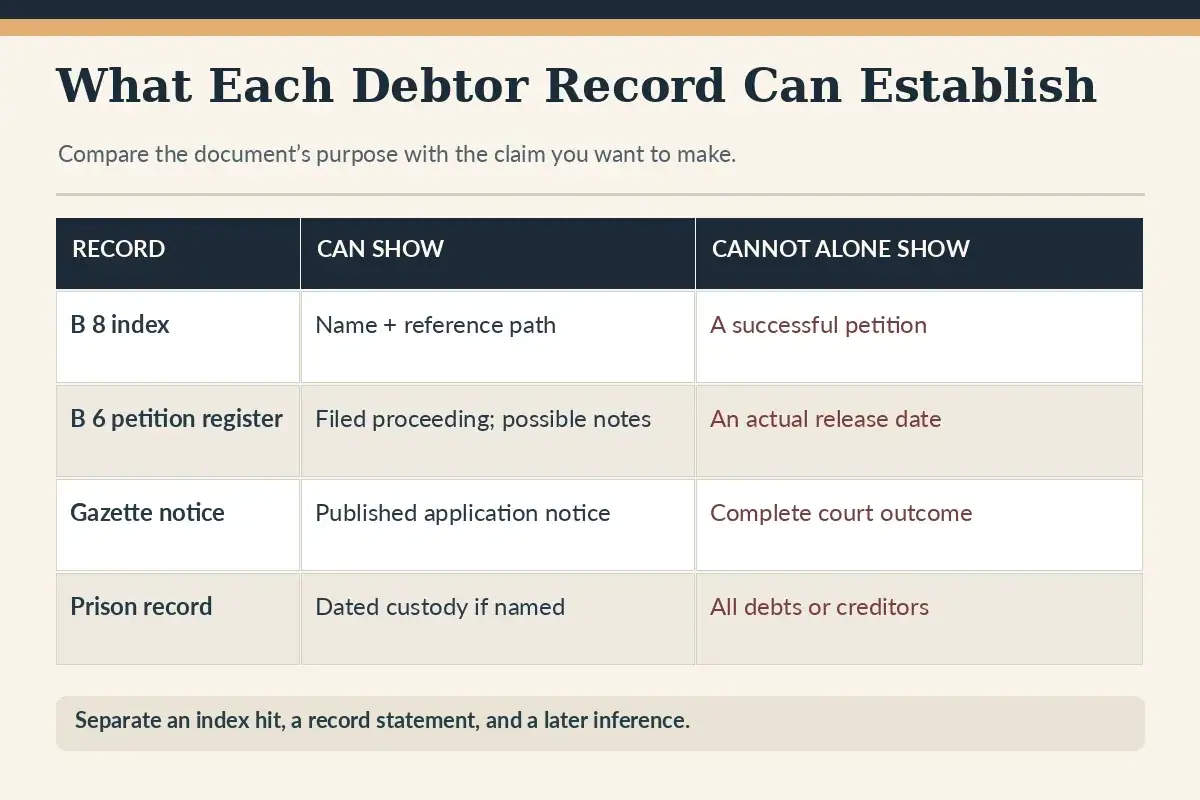
Copy the complete index entry, including spelling, any reference number and notes about locality, without normalizing ambiguous handwriting. Then trace the register entry in the specified B 6 piece. The archive guide says the registers may briefly record debtors, creditors, sums, deeds or sometimes an action’s result. It does not say that every entry contains the prisoner’s sentence, all debts or evidence of a discharge. The record type itself sets the ceiling on what can be asserted.
Distinguish the date a petition was presented from an order date, the date a notice appeared and the date someone actually left custody. A later register annotation could indicate progress, but it must be transcribed rather than translated into an outcome the words do not support. If no result is noted, write “outcome not recorded in this consulted entry,” not “the petition failed.” The same discipline applies to a blank line or a damaged page.
Use the Gazette and Prison Records Without Conflating People
The Gazette published lists of insolvent prisoners applying for release. Search by variants of surname and prison or locality, keeping the notice date alongside the period in which the petition would have been processed. A Gazette item is a published official notice, not necessarily the full pleading. Match the case by more than a surname: county, stated occupation, names of creditors or a date cluster may help, but independent court and prison evidence is preferable.
If actual detention is the question, search the relevant local or London prison records rather than treating a court index as a prison admissions register. The National Archives points to PRIS records for several London debtors’ prisons, and notes that surviving records are not uniform. The absence of an individual from the prison book you consulted may reflect coverage or identification problems. Record the prison, surviving years, reference and the specific nature of the unsuccessful search.
Keep a Four-State Evidence Ledger for One Named Debtor
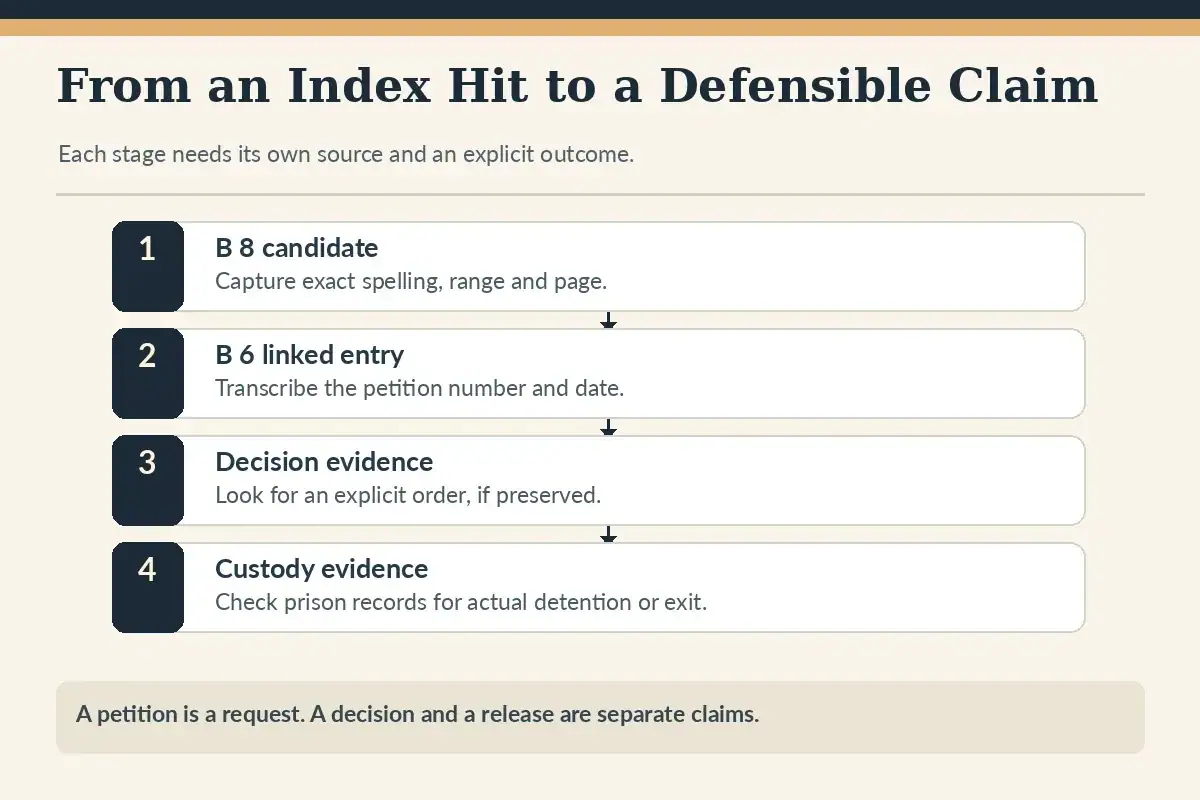
A practical worksheet uses four separate rows: indexed candidate; petition or register entry; formal decision; independent custody or release evidence. In the first row preserve the exact index citation. In the second, write the petition number and what B 6 actually says. Reserve the third for an explicit court order and the fourth for a dated prison record or another trustworthy record of release. Leave unproved rows blank rather than filling them with presumed events.
Imagine two fictional John Bakers whose applications appear in the same county decade. One has a matching occupation but no prison named; the other has a different town and a notice the following year. A surname and county do not settle this choice. Compare dated addresses, creditors and prison references, and keep both provisional until the conflicts are resolved. Do not manufacture a relationship between either person and a household in a parish register.
Explain Missing Cases, Jurisdiction and Changing Legal Categories
The archive guide distinguishes historical bankruptcy, traditionally associated with traders, from insolvency proceedings for debtors; people unable to pay their debts could also be imprisoned. These categories and the law changed over time. Do not read a modern definition of bankruptcy into a document describing a prisoner’s petition in 1825. Nor should a mention of “country” be mistaken for an overseas territory: here it means cases outside London.
The court index is a finding aid, not a census of everyone who owed money. Coverage can be partial, names can be hard to read and a petition may not have survived as a full narrative. If a regional court is indicated, search the catalogue of the local holding archive as well. A documented no-result search is useful only when you specify exactly which volumes, years and spellings were examined; it is not evidence that the debt or detention never happened.
More Records and Archives Guides
How We Research Insolvency Petitions and Their Limits
The location and date boundaries in this article come from The National Archives’ guide to bankrupts and insolvent debtors, particularly its sections on petitions and B 8. For contextual notices the guide directs researchers to The Gazette. The Discovery advanced search is the appropriate catalogue control for narrowing by reference and date.
The Baker scenario is fictional and is not evidence of an actual case. The central rule is to cite each separately documented legal event and resist inferring discharge from a request. Copies and commercial research services may involve charges; review our affiliate disclosure before using external services.
Town means London in this index arrangement, not simply a place described as a town.
Use the B 8/38–57 index range and follow the matching entry into B 6/48–62.
Not automatically. An application or reference number is not a discharge or an independently documented release.
No. The archive guide assigns 1847–1861 protection-case indexes to B 8/58–68.
Retain both candidates and compare places, chronology and other identifying details before linking either to an ancestor.