
The most useful first question about ED 152 is not whose name might appear, but what the record was created to document. ED 152 concerns postwar development plans submitted by local education authorities in England between 1945 and 1966, following the framework of the Education Act 1944. This guide turns that archival description into a reproducible search and evidence test. Record the historical place, original wording, document date, and reference before connecting an institution or policy to a particular person. The distinction between official intention, recorded administration, and independently demonstrated results matters at every stage.
Identify the Historical Education Authority First
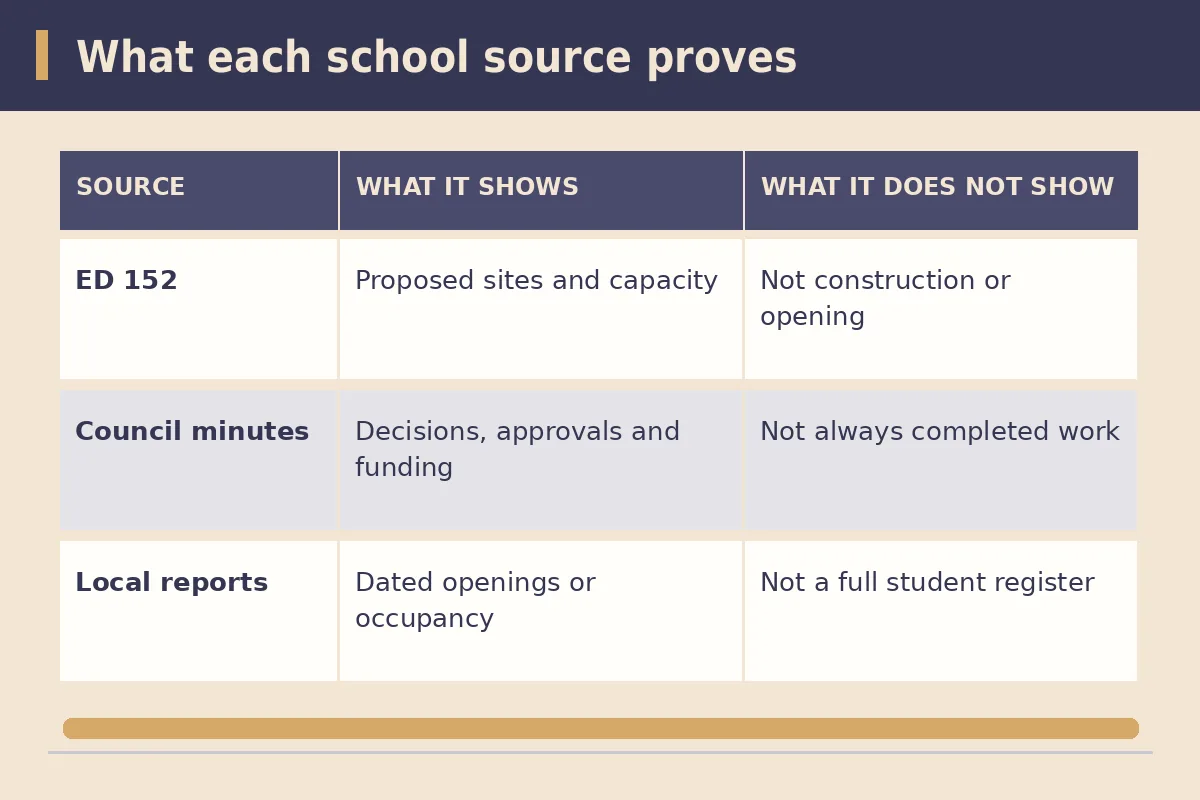
ED 152 concerns postwar development plans submitted by local education authorities in England between 1945 and 1966, following the framework of the Education Act 1944. The National Archives recommends searching by county. Such plans reveal what an authority intended to build, enlarge, reorganize, or provide; they do not by themselves establish that a proposed school eventually opened. For family or neighborhood history, the decisive first step is identifying the correct authority at the time of the proposal.
Create a place card with the settlement name, historic county, local authority, approximate period, and any known school name. A modern county or metropolitan district may not match the postwar body responsible for education. Search both the proposed site and the authority, as plans may group several settlements into one service area. Note whether the entry describes an entirely new school, replacement premises, an extension, or the redistribution of pupils between established schools.

Read a Planning Entry as a Proposal
For each plan, copy the exact language: intended site, school type, projected places, relevant population estimates, anticipated date, and qualifiers such as “proposed” or “subject to approval.” Do not silently promote an estimated completion year into a documented opening year. A planned school can be canceled, moved, reduced, merged with another scheme, or built under a different title. Even a drawn footprint does not guarantee ground was broken.
The planning date, approval date, building date, and first teaching date may differ by years. Use four separate columns in an evidence ledger. If an authority projected hundreds of school places, that tells you something about projected provision, not the names of the children who would occupy them. Statements about future enrollment are expectations shaped by the authority’s assumptions. They cannot prove that an identifiable child was educated at the proposed institution.
The 1944 reform context is not a shortcut to a school-specific history. A national policy may explain why authorities drew up schemes, but the implementation of a rural school might have depended on land acquisition, finances, building materials, transport and changing population projections. Note which explanation is supported by the actual authority minutes; do not insert a generic postwar reconstruction narrative where local documentation says otherwise.
Use the England and Wales Archive Split
The National Archives identifies ED 152 for English LEA development plans and points researchers to BD 7 and ED 216 for Welsh authorities. A site near a historic border demands attention to which authority actually administered it at the date in question. It is unsafe to assume all Welsh or English proposals were deposited in one national sequence. Record the official geographic coverage given by the catalogue before deciding that a missing result means no plan existed.
School names and categories also changed in the postwar transition. A plan may use different terminology for elementary, primary, secondary modern, grammar, or technical provision, reflecting the period’s administrative language. Preserve that wording in your transcript; explain it for readers instead of replacing it with the modern school’s branding. If a school has been rebuilt on another site, confirm the relationship between old and new premises in local minutes and contemporary maps.
Find the Decision and Then the Physical Evidence
To establish whether a proposal went forward, search education committee minutes, council papers, capital expenditure records, planning permissions where surviving, and local newspapers. Those sources can show approval, revised costs, tenders, or a dedication ceremony. Different acts must remain distinct: permission to build is not a building contract; a contract is not completion; and a building standing today does not establish when it first opened as a school.
Compare successive historical maps and dated aerial photographs to locate construction, but understand that map survey dates may not match publication dates. A school may begin teaching in temporary accommodation while permanent buildings are unfinished. A contemporary inspection report, opening announcement, or school log can sharpen the timeline. Where sources conflict, cite the exact dates and event types rather than choose the most attractive date for a family narrative.

Protect Individual Attendance Claims
The central government plan is about educational provision, not an admission register. Its estimate for the children to be accommodated never constitutes evidence that a particular ancestor attended. Begin any child-level inquiry with family documents and an address at a specific time. Then seek local admission registers or education authority records, subject to relevant access restrictions. Even a named teacher in a press report does not demonstrate that every neighborhood child was taught by that person.
A useful hypothetical example is a proposed 1952 replacement school shown near a railway line. The plan gives the intended location, but a 1957 newspaper describes pupils moving into temporary rooms on another street. Only a later opening notice confirms the permanent building. The three records address different stages; none should be discarded simply because it challenges a simplified local tradition. State which claim is established and which remains untested.
Where a development plan lists several phases, follow each separately. A first-phase extension might have opened while a second-phase replacement was abandoned. Compare the exact parcel shown on a plan to title or local authority land records before naming owners. A site identified as reserved for educational use does not prove purchase or transfer of legal title.
More Place and Jurisdiction Guides
How We Research This Record Series
We start with the official series description and keep three things apart: the catalogue summary, the surviving document, and our interpretation of it. The National Archives’ research guide identifies the relevant ED 152 record route and its limits. Its Discovery search instructions explain how to move from a catalogue result to a properly identified record. Every example on this page is a research exercise unless it cites a specific piece; none represents a newly discovered ancestor or institution.
For each candidate we log search query, historical place, date interval, record creator, full series and piece reference, access status, exact useful words, and a reason to accept or reject the claim. The National Archives’ citation guidance helps make this trail reproducible. If the item cannot be inspected, we write ‘catalogue only’ and do not invent its contents. Missing material is handled as a coverage question, not as proof that the event did not happen. For legal and commercial transparency, read the affiliate disclosure; this guide does not assert a sponsorship or paid relationship.
Use the final checklist before citing a result: have you identified the original creator and repository, established the applicable period and jurisdiction, separated a proposal or summary from a completed action, matched the necessary person or site independently, and preserved the precise reference for another researcher? An answer of “not yet” is a legitimate outcome. A carefully dated uncertainty makes a stronger history than a plausible story assembled from unrelated archive descriptions.
No. Development plans record proposed educational provision; look for dated implementation and opening evidence.
Start with the historical local education authority or county at the time, not just the modern administrative district.
The National Archives guides researchers to BD 7 and ED 216 for Welsh LEA development plans.
No. Planned places are capacity estimates, not individual admission or attendance evidence.
Correlate committee decisions, construction records, successive maps and contemporary opening reports rather than assume the planning year.