
For the 1907 Jamestown Tercentennial Exposition, the National Archives Record Group 107 guide identifies a diagram of the exposition grounds and War Department correspondence dating from 1906–1909. This is a place-first source for the Department’s participation in a major exhibition, not a guest book. A diagram can provide evidence of a represented arrangement if inspected; it cannot by itself prove that every labeled structure was built, every display operated or a particular ancestor attended. Distinguish drawing, administrative decision and observed event before constructing a history of the site.
The War Department filed letters, telegrams and endorsements sent and received, as well as other correspondence. These materials may give context for planning or administration if individual documents can be found, but the NARA guide does not enumerate specific exhibitors or name visitors. A family letter claiming a visit to Jamestown in 1907 is a separate source that must be tested against time, place and any evidence of travel. The value of RG 107 is the opportunity to check what the federal agency recorded, not to replace personal evidence with an attractive plan.
Choose Between the Diagram and the Letters
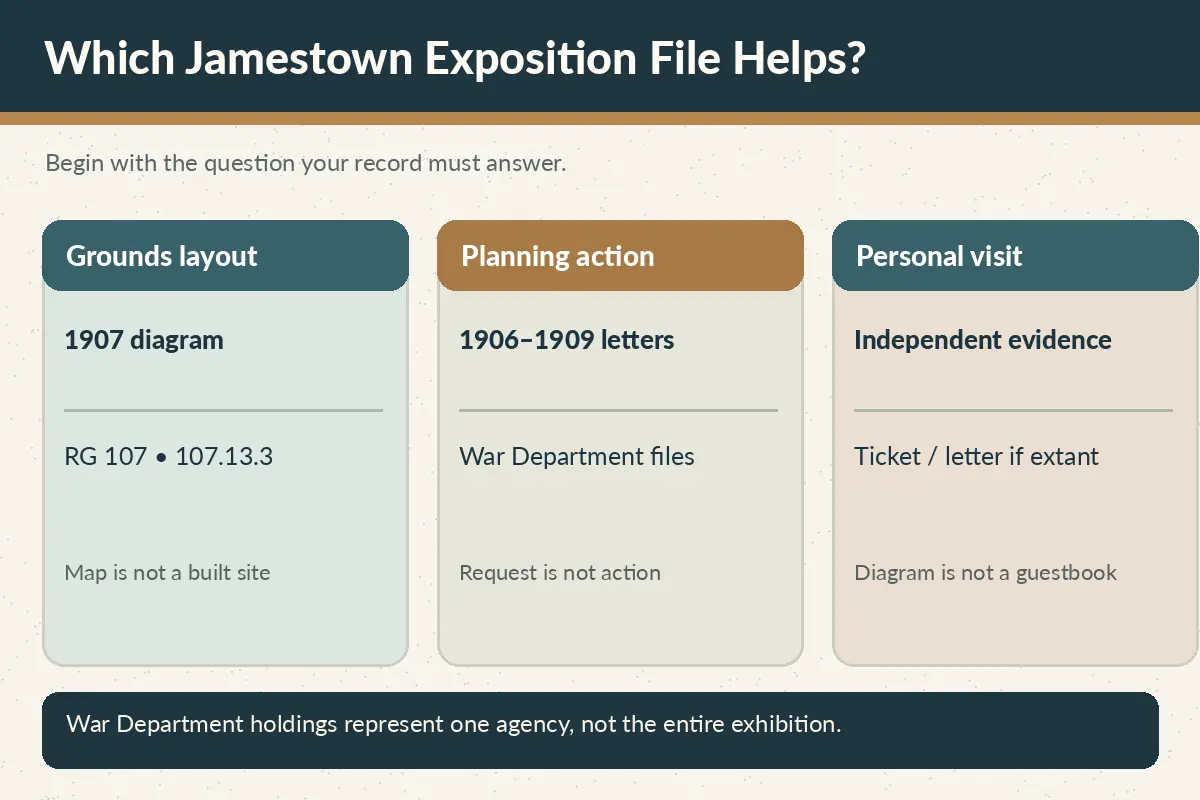
Start by naming the fact in question. To investigate where an exposition feature was drawn, look for the 1907 grounds diagram. To investigate what the War Department considered or communicated about its participation, seek the 1906–1909 letters and telegrams. A physical exhibit’s opening or a contractor’s completion needs further evidence such as dated photographs, opening notices or construction accounts if those exist. These document classes represent different questions rather than a guaranteed sequence from proposal to completed building.
The guide places the holdings under section 107.13.3, within records about War Department exhibits at expositions and fairs. Do not mistake this subdivision for the exposition company’s complete archive or assume it preserves accounts from every state pavilion. Other exhibitions have neighboring subsections, including the 1904 Louisiana Purchase Exposition and 1909 Alaska-Yukon-Pacific Exposition; use the 1907 year and specific Jamestown name to avoid mixing similarly labeled fair records.
Read the Grounds Diagram as a Dated Representation

Once the diagram is available, establish its title, scale, orientation, annotations and date from the actual image. Ask whether a feature is labeled as proposed, reserved, under construction or existing; if the document does not distinguish those states, do not assign them. Track buildings, roads, entry points and boundaries with the coordinates or relative layout the plan actually supports. A drawn walkway is evidence of its representation on a map, not a guarantee it was open to pedestrians on the day a relative supposedly arrived.
Compare the 1907 diagram to any independent dated photograph, newspaper report or exhibitor account, noting changes in viewpoint and date. Buildings can be altered between planning and opening, and temporary fairs can have different layouts during construction and operation. A later commemorative map can be useful but is not automatically contemporary with the archival diagram. Preserve the original labels and cite the version used. The map-to-site comparison should make uncertainties visible, not erase them.
Interpret Telegrams and Endorsements Precisely

Correspondence may document that an official asked for a service, sent a proposal, questioned expenses or acknowledged a message, depending on what the surviving text says. A sent telegram is not by itself proof its requested action was performed. An endorsement may transmit a letter rather than approve the substantive proposal. Copy the date, sender, recipient, named office, file reference and exact operative verbs. If a chain of letters includes a later response, keep both citations and indicate which statement changed the documented status.
Avoid treating correspondence collections as complete chronological records. The guide describes broad dates 1906–1909, which include preparations and possible after-the-event administration, but this span does not mean every decision or event is covered. A document written in 1908 can summarize the previous exposition and must not be presented as a firsthand note written during a specific 1907 ceremony unless its content warrants that. The date of the paper and date of the event belong in different fields.
Trace the Government Exhibit Without Inventing Staff
A federal office’s involvement does not create a staff roster for the exposition. If a document names a contractor or clerk, identify the capacity in which that person is mentioned; a business signature or routing initial cannot be turned into proof of daily service on the grounds. For someone researching an employee, find independent personnel records, payroll or family correspondence that places that individual with an exhibitor during the relevant dates. Likewise, an official invited to a ceremony is not shown to have attended unless actual attendance evidence survives.
Distinguish sponsoring agency, operating organization and vendors. Correspondence that orders supplies does not establish who installed them or that the order was filled. A building on the grounds may be a state, commercial or federal exhibit, and the War Department record does not automatically speak for all of them. Create separate columns for what the diagram places, what the letter authorizes and what external material confirms. This prevents a supposed visitor’s family story from inheriting the certainty of an administrative file.
Find the 1907 Item and Cite Its Evidentiary Limit
Search the National Archives Catalog for “Jamestown Tercentennial,” 1907, exposition grounds and RG 107. A broad guide entry is not an item image; inspect record-group, series and item levels and note the exact identifier. If a map scan is unavailable, use NARA’s copying guidance for a request citing section 107.13.3, the 1907 diagram and the War Department correspondence from 1906–1909. Ask how the material is arranged rather than inventing a folder number.
In a publishable research note, separate the diagram’s observed features, letters’ recorded actions and later evidence of buildings, visitors or events. Cite the diagram with its title, date, physical or digital reference and relevant labeled area; cite each letter with date and sender. If no visitor evidence is found, say only that the grounds were mapped and correspondence preserved. The archival record can illuminate a historical setting without falsely placing a relative inside it.
More Place and Jurisdiction Guides
How We Research These Federal Holdings
Our starting authority is the National Archives RG guide, especially section 107.13.3, which supports the specific dates and record categories described above. We then use NARA’s Catalog instructions to distinguish record-group, series, file-unit and item descriptions, and consult its reproduction guidance if an item is not available online. The guide is an inventory, not a complete transcript, digitization guarantee, individual name index or certification of a family connection. Each statement about a named person needs independent support and a traceable document citation. The site’s affiliate disclosure explains our editorial and relationship policy; the public archive links here are not claimed as paid partnerships.
No. A plan’s label must be corroborated by a dated source documenting the actual structure.
No. RG 107 section 107.13.3 describes War Department files, not a complete archive of all exhibitors.
Not alone. A message describes communication; inspect additional execution or opening evidence.
The NARA guide does not describe a visitor register in this subsection.
RG 107, section 107.13.3, the 1907 diagram of the grounds and, as relevant, 1906–1909 War Department letters.