
The National Archives guide to Treasury records, RG 56, lists 41 photographs of government exhibits at the 1909 Alaska–Yukon–Pacific Exposition, marked YE. It separately mentions two architectural or engineering plans related to the exposition. These are useful sources for the appearance and location of official displays in Seattle, but a photograph of a booth does not identify the people who visited it or prove that every illustrated object remained on display throughout the fair.
Use the RG 56 archival description as a starting map, not as a substitute for looking at a particular print. Determine whether your question concerns a federal exhibit, building design, a named visitor, or an exhibitor’s employment. The photograph group and the related plan are different kinds of evidence, and a family story about attending the fair requires another route entirely.
Start With the YE Photograph Group and Its Scope
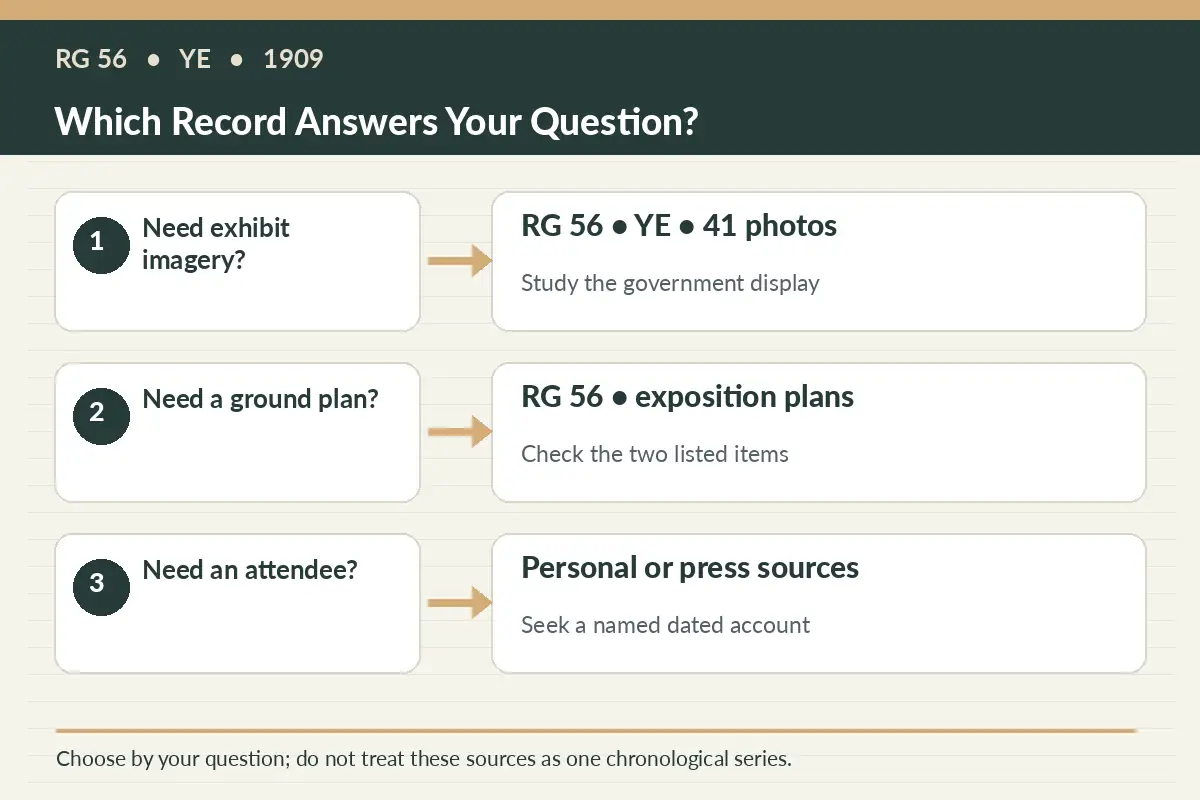
The YE designation refers to the photographs of government exhibits; it is not an admission ticket sequence or a general photographic record of every part of the exposition. Search the NARA Catalog with “Alaska Yukon Pacific,” the year 1909, “government exhibits,” RG 56, and YE. Note the exact series and item labels returned. A description of 41 images gives the scale of the group, not an assurance that every print is online.
Capture each original caption, mount notation, or image identifier. These can distinguish a close-up of a federal display from a distant view of a building. Do not turn the broad phrase “government exhibits” into a claim that the photograph represents every Treasury display or the entire event. When a caption is missing, write a neutral description of what is visually identifiable and keep the subject tentative.
Keep Temporary Exhibit Plans Separate From Actual Buildings
The same NARA guide lists two architectural and engineering items for the exposition. A drawing may show a proposed arrangement, an intended entrance, or an exhibition structure before construction. It does not necessarily represent the finished site. Compare a plan to a dated photograph only when their labels and landmarks support a link. Do not infer the order of construction from the order in which images appear in a catalog.
If a site on the plan seems absent from a surviving photograph, consider camera angle, cropping, revisions, or a temporary structure removed before photography. Seek fair maps, program books, contemporary newspapers, or site photographs from another collection as cross-checks. A plan and a photograph can support a cautious spatial reconstruction, but neither one alone establishes what visitors saw on a specific day.
Describe an Exhibit Without Claiming Universal Public Access

An interior display photograph may show cases, labels, models, machinery, or decorative panels. Read the legible original text carefully and distinguish it from a modern caption. A photographed display could have been staged for documentation, photographed before final opening, or altered later. Without a dated operating record, do not state exact opening hours or continuous public access throughout 1909.
For educational or family-history writing, note the object class, agency identification, physical setting, and evidentiary limits in a simple table. Record whether the information comes from a label visible in the picture, from a contemporaneous guide, or from modern catalog metadata. These are three different claims. If the label is unreadable, avoid guessing what it said from the surrounding decoration.
Do Not Turn Crowds Into Named Family Members
Historic exposition photographs often attract family stories: an ancestor lived near Seattle, so perhaps they attended the fair. Residence near the grounds does not establish attendance. An unidentified person at the edge of a frame could be a visitor, employee, photographer’s assistant, or exhibitor. The YE group was described by subject, not as a systematic list of ticket holders or fair workers.
A defensible individual connection might come from a named diary entry, dated letter, work contract, newspaper notice, or photograph with reliable provenance. Keep the external evidence alongside but separate from the image. Where no such item survives, it is still useful to describe the kind of federal exhibit a contemporary Seattle resident could have encountered—clearly as context, not proof of a personal visit.
Compare Exhibit Photographs With Later Site Changes

Temporary fairgrounds are repeatedly altered, and modern park or campus geography can mislead. An avenue’s current name, building footprint, or landscaping may differ from its 1909 appearance. Work from contemporary site maps first, recording orientation, entrances, building numbers, and dated revisions. Then place any surviving exhibit photograph within the spatial model only if a distinctive landmark or caption supports that placement.
If two surviving images appear to show the same booth, compare pillars, case shapes, lettering, and light direction rather than relying only on a topical title. The difference between a building exterior and an interior exhibit can also explain why titles seem inconsistent. Record uncertain matches as provisional to avoid passing a modern guess into other researchers’ family histories.
Cite the Photographic Print and Its Separate Context
For each selected view, cite National Archives, RG 56, YE photograph group, the item-level identifier and original caption if known, plus the 1909 date context. If discussing an architectural plan, give it its own citation; it is not a frame in the YE photograph group. Preserve a note about any cropped reproduction or modern colorization because such alterations can conceal what a print originally showed.
NARA’s catalog guidance distinguishes the record-group, series, file-unit, and item levels. A researcher should not invent an item number from the count of 41 photographs. If the picture is not digitized, gather enough identifying information for a targeted still-picture inquiry or reproduction request. A precise archival trail is more valuable than a vivid but unsupported anecdote about an unknown attendee.
More Place and Jurisdiction Guides
How We Research the Original Records and Their Limits
Our research begins with the National Archives guide for RG 56, which supports the existence, general scope, and date range of the YE material. We then distinguish that broad description from the more exact item title, physical form, annotations, and any digital object found through the NARA Catalog. An archival series description is not itself an inspection of all 41 photographs, and an item may not have a digitized copy available.
For claims about a person, location, outcome, or date, we prefer a separate contemporary and name-bearing or event-bearing record over a plausible visual inference. We log variant titles, later catalog notes, uncertain identifications, and the difference between an original object and a modern reproduction. NARA’s reproduction guidance explains why a specific citation matters. This page is informational; our affiliate disclosure explains any relevant site relationships without implying that NARA is a partner.
The RG 56 photographs of government exhibits at the 1909 Alaska–Yukon–Pacific Exposition.
NARA lists 41 photographs.
Yes. Its guide separately lists two architectural or engineering items for the 1909 exposition.
No. Look for independent named and dated evidence of attendance.
No. A record-group description does not guarantee an attached digital image for each item.