
The National Archives RG 26 guide identifies 179 photographs from the 1895 cruise of the U.S. Revenue Cutter Bear to Alaska and Siberia. This makes the voyage a valuable source for visual place history: a ship, shoreline, harbor, camp, or community may appear under a caption related to the cruise. But a photograph of the vessel does not identify every person aboard, and a coastal view does not establish that an ancestor resided at that exact place.
Use three separate questions to organize the search. Where was the scene? Find the original caption and photograph identifier. Where did the vessel travel? Compare the caption with independent voyage chronology. Was a named person aboard or on shore? Seek service or other person-level records before assigning a name to a face. Keep these columns separate even when an image is visually persuasive.
Find the 1895 Bear Series Before Searching Faces
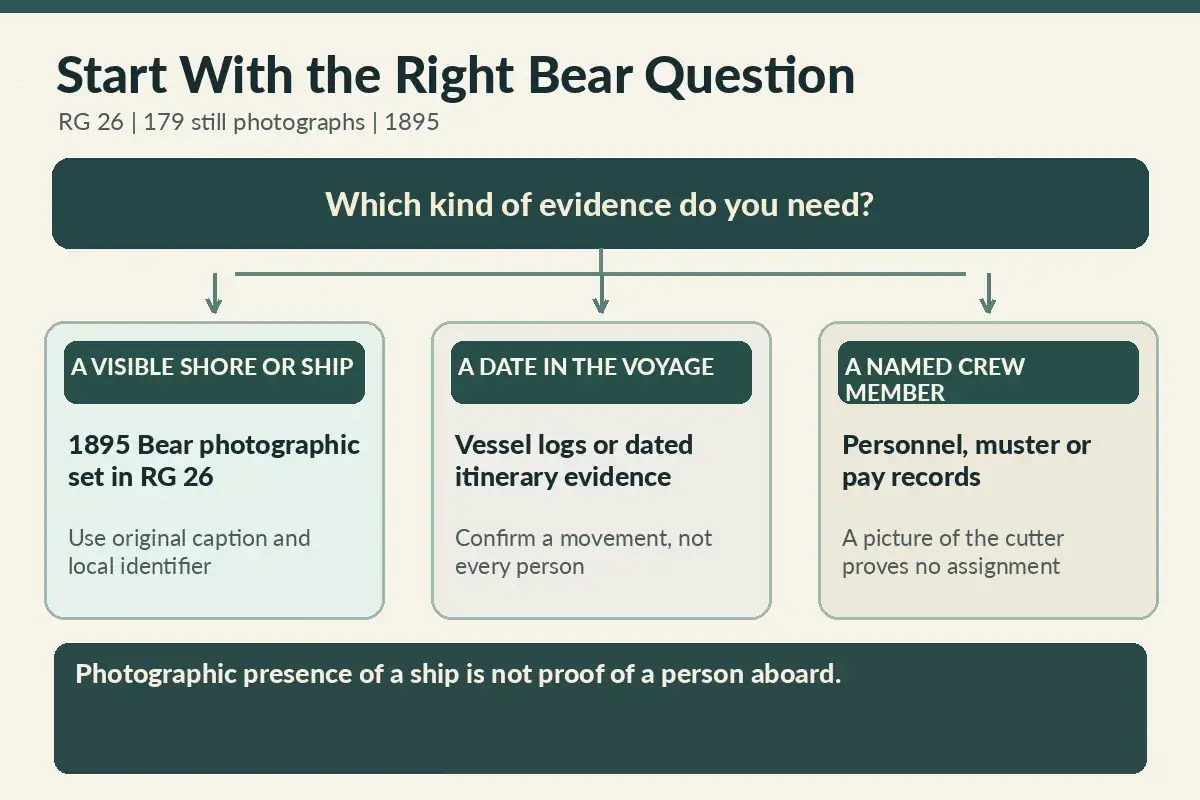
Start with RG 26, the 1895 Bear cruise, and the still-picture description. The number 179 comes from NARA’s holdings guide and should not be interpreted as 179 digitized item pages, distinct port calls, or portraits of the crew. Use the National Archives Catalog to identify any separate local identifiers, original captions, and the form in which each image survives. Search place-name variants carefully: an English caption might reflect the terminology used by a photographer or later cataloger rather than today’s local name.
Copy the exact record group, series reference, caption, local identifier, and any album or negative information. Then make a location table containing the captioned place, the evidence visible in the image, and the uncertainty that remains. Coastal terrain alone seldom yields a unique identification. An image showing the Bear beside shore can establish the photographic subject, not automatically the date of arrival, the number of people aboard, or whether a nearby building belonged to a particular family.
Keep Vessel Identity Separate From Crew Identity
A photograph labeled with a cutter name establishes an attribution to the vessel, assuming the caption is sound. It does not constitute a crew list. If a researcher has a sailor’s name, independent muster, service, assignment, or pay records are better suited to establishing whether that person served on that cutter in 1895. Check exact dates because service may have begun before or after the photographed voyage. Do not infer military rank, position, or presence from uniform type alone.
The Revenue Cutter Service and later Coast Guard record systems span different periods and functions. Refer to NARA’s RG 26 description for administrative context, then request the particular vessel-related series that bears on the person-level question. A ship log might establish a dated movement if an appropriate original survives, but does not necessarily list passengers or identify everyone pictured. Maintain a separate citation for a photograph, log entry, and personnel record; they answer different questions even when they concern the same ship.
Identify a Shore Scene Without Inventing Residents

Photographs of Alaskan or Siberian shores may show houses, boats, shore installations, or people whose identities are absent from the catalog description. Start with features that can be checked independently: coastline shape, harbor, a named settlement in a caption, visible vessel, and other dated geographic records. The image should be described first as a visual observation. State “a building appears” rather than “the family’s house” until deeds, local descriptions, oral histories with identifiable provenance, or other records support the personal connection.
Historical place labels can flatten complex Indigenous communities into outsider terms. Keep the original wording in the citation and use accurate contemporary names when securely known, without erasing the source’s historical terminology. A photograph can document material culture, transport, and the social setting in a limited frame; it cannot by itself supply the identities, languages, consent, or perspectives of everyone depicted. Research local and community sources when discussing people rather than treating a federal government photograph as the only account.
Request the Correct Print or Reproduction
NARA’s still-picture ordering guidance advises researchers to supply a record group, series, box or folder where relevant, and an individual item number. A local identifier from the catalog is especially helpful. Ask whether the item you found is a contact print, later reproduction, or original photograph; captions can travel between formats and occasionally change. Keep the archival citation with any downloaded copy used in a family history.
If only a reproduced print is available online, do not treat digital sharpness, colorization, or cropping as new evidence. Check whether edits have obscured a caption or removed the harbor context. Record the date of the source you accessed and save the stable catalog identifiers. NARA’s still-picture research guidance explains reference inquiries and the importance of the item-level citation. Availability varies, so the existence of the collection is not a promise of immediate image access.
Use the Cruise as Context for a Family Story

An ancestor may have lived in Alaska in 1895, served on a federal cutter, traded at a coastal settlement, or heard about the voyage without being recorded in the photograph set. Keep the supported link modest: a picture documents a place or vessel associated with the expedition; a separate document identifies the individual; an additional dated source connects the person to that location or voyage. This approach allows the picture to enrich the narrative without making it a false portrait of an unidentified relative.
For a photo labeled only “Alaska,” search the original negative or album sequence and related descriptions, but do not assume adjacent photographs share the same town or date. If several possible locations remain, present them as alternatives rather than choosing the most attractive. A good caption in a finished story may read: “An archival photograph attributed to the Bear cruise of 1895; the identity of the people shown is unconfirmed.” That is accurate, useful, and respectful of the source.
More Place and Jurisdiction Guides
How We Research This Archive Series
We distinguish the specific 179-photo holding described in RG 26 from separate vessel logs and personnel records. NARA’s still-picture guidance governs item identification and access; no person is named from visual resemblance or an unsourced online caption. We preserve original and modern place names where justified, mark undigitized or missing item descriptions as unknown, and require independent proof for crew assignment or residence. Read our affiliate disclosure for transparency; this guide does not assume any paid archive relationship.
The RG 26 guide lists 179 photographs of the cruise to Alaska and Siberia in 1895.
No. A dated muster, service, or pay record is needed to support a crew assignment.
Usually not with confidence. Use original captions and corroborating geographic evidence.
The guide lists a holding, not guaranteed item-level scans. Search the NARA Catalog and inquire by series and local identifier.
State what is actually visible and mark their identities as unknown unless separate reliable sources establish names.