
NARA’s RG 107 guide describes military field telegrams collected by the Office of the Secretary of War, covering 1860–1870, alongside other telegrams sent and received during 1861–1882. Its Civil War microfilm guide distinguishes M473, bound telegrams dated 1861–1882, from M504, unbound telegrams dated 1860–1870. A message can document that information or a proposal reached an office; it cannot alone prove that the requested movement, payment, arrest, or military operation occurred.
First decide whether you are looking for the text of a specific telegram, the official order that followed it, or an individual’s service. These are separate record questions. Search by date, named sender or recipient when known, subject, command, and distinguishing words in the dispatch. Treat time stamps, routing notes, copy numbers, and endorsements as part of the documentary trail rather than assuming that a single telegram represents the final government decision.
Choose Bound M473 or Unbound M504 by Date and Format

NARA lists M473 as bound telegrams collected by the Secretary of War, 1861–1882, and M504 as an unbound group, 1860–1870. These dates overlap; do not draw a false timeline in which the message automatically migrates from M504 to M473. They are descriptive groupings requiring separate searches. Start with the form of the citation already supplied by a book or family note. If it says “bound dispatch,” consult M473 first; if it cites unbound field telegrams, start with M504. For a vague 1863 date, both may need consideration.
When you locate a candidate, copy the exact publication, roll, item or page citation, as available, and record whether you read a microfilm image or a derived transcription. Do not treat a modern database index as the same object as the original collected message. A text printed in later official correspondence may repeat a dispatch without containing all routing marks visible on an earlier copy. Preserve separate citations for multiple versions; spelling changes, abbreviated words and uncertain initials can materially affect identification.
Read Sender, Recipient and Message Context
A telegram may be authored by an officer, directed to the Secretary, or forwarded through an intermediary. Identify who actually sent the words and who was intended to receive them, rather than converting everyone named in the heading into an eyewitness. Note the date and any time or location stated on the original, and mark whether those details appear in the text itself or in a later endorsement. The phrase “orders received” is evidence of reported receipt, not necessarily evidence that the order was carried out.
Abbreviations and damaged handwriting can create false names. If a correspondent surname resembles an ancestor’s name, compare rank, office, geographic location and other contemporary records before deciding they are the same person. A military office title is not automatically a unit assignment. One dispatch may refer to “your men” or “our detachment” without listing them; such collective language should not be expanded into a roster. For a named soldier, use official service or unit records as the primary identity link.
Distinguish Information, Requests and Executed Orders
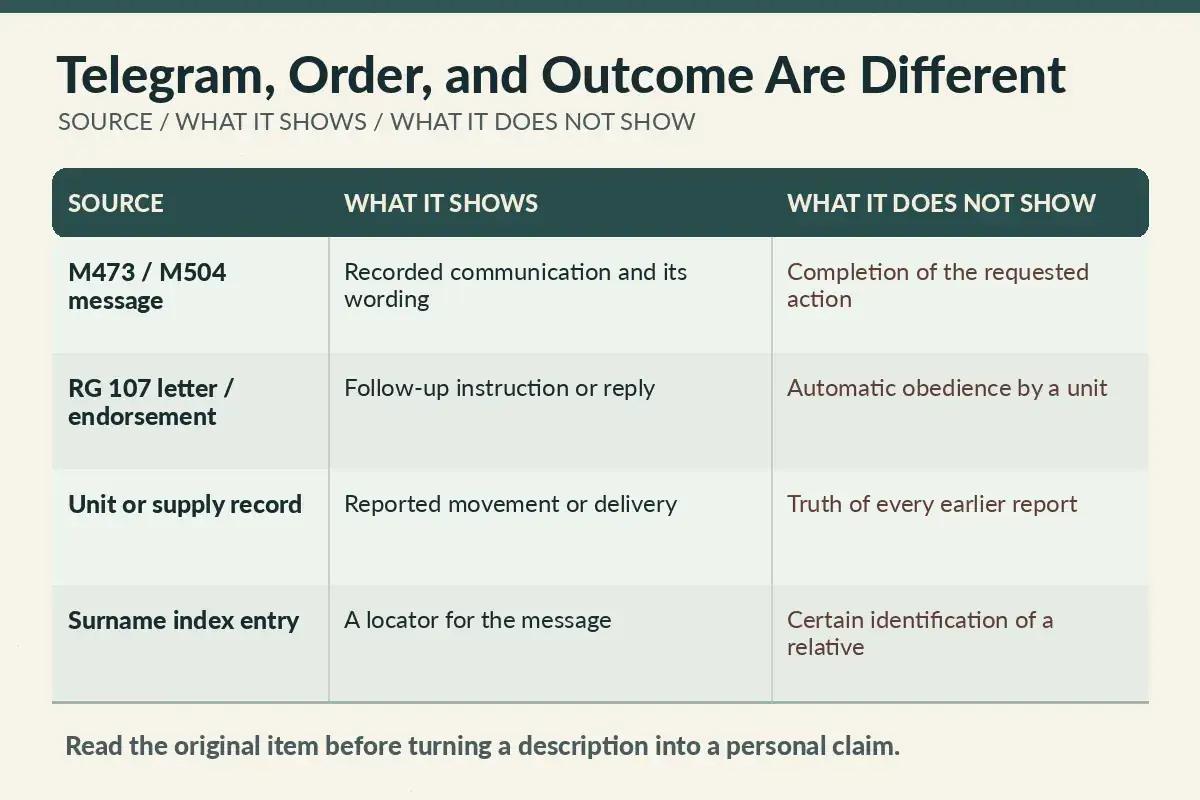
Sort the message by speech act: report, request, warning, instruction, acknowledgment, or proposed action. A request for troops is not proof of their dispatch; a telegram approving a plan is not proof of the plan’s successful completion. Save exact verbs and conditional clauses in a short transcription. Then look for the next administrative step in letters sent or received, endorsements, official orders, and the relevant unit’s operational records. In the same file, a subsequent reply may correct or cancel an earlier message.
The RG 107 guide describes letters sent, letters received, registers, indexes, and endorsements alongside telegrams. Use those as possible corroboration, but do not assume every dispatch has a matching letter. Different record series reflect different stages of communication and recordkeeping. Make a sequence with separate columns for document time, action described, reported result, and verification status. A date that appears only in an index should be labeled an index assertion until checked against the message.
Reconstruct a Message Without Guessing Chronology
Suppose a researcher finds a message ordering supplies to a particular post. The first proposition is simply that the order appears in a collected telegram. To demonstrate shipment, seek quartermaster records or subsequent acknowledgments; to demonstrate delivery, seek a dated receiving record or comparable source. A supplier’s invoice might document a different transaction and should not be joined merely because its date is close. The same caution applies to requests for reinforcements, prisoner transfers, or military movements.
In a timeline, annotate the provenance of each step: “M504 telegram,” “RG 107 sent letter,” “unit report,” or “local newspaper account.” Note if one document quotes another; a repeated quotation is not independent confirmation. If a telegram is undated or the place cannot be identified, record the uncertainty and avoid sorting it into an exact day by inference. Historical calendars, spelling conventions and nonstandard place names can confuse later indexers; check the original heading and content whenever possible.
Ask for the Correct Film or Textual Series

If the National Archives Catalog does not expose a readable image, use the NARA ordering and research guidance to ask for the correct microfilm publication or textual series. Provide M473 or M504, the relevant date, sender and recipient where known, and an existing roll or page reference. Do not ask for “all Civil War telegrams” without a scope; the separate series and formats make the request unnecessarily broad. Availability of a finding aid is not evidence of complete online digitization.
For citation quality, preserve the record group, publication number, roll, and an internal locator if available. Quote only enough of the original to establish the claim, and retain uncertain readings in brackets in your private notes. The final family narrative should distinguish “the War Department received a report” from “the regiment acted.” Where the result is unconfirmed, a careful statement of the recorded message is more reliable than a dramatic story assembled from what a commander might have intended.
More Research Method Guides
How We Research This Archive Series
We checked the separate bound and unbound microfilm entries for M473 and M504 against the RG 107 correspondence guide. We do not assume these overlapping date ranges represent consecutive processing stages, and we distinguish a copied dispatch from an executed order. Dates, sender-recipient roles, and any claimed result are checked against original wording and separate operational records when available. Read our affiliate disclosure for transparency; this guide does not assume any paid archive relationship.
NARA lists M473 as bound Secretary of War telegrams, 1861–1882, and M504 as unbound telegrams, 1860–1870.
No. The message proves an instruction or report was recorded; actual movement requires subsequent evidence.
Yes. A collected dispatch may be quoted or copied elsewhere, and copies are not automatically independent witnesses.
Not without matching rank, office, place, date, and independent identity records.
Their listing in a microfilm guide does not establish complete online scans. Consult NARA access information for specific rolls.