
The National Archives guide to RG 165 lists 165 postcards of damaged French buildings from the First World War, dated 1918, in series FC. The cards may be valuable images of streets, churches, houses or public buildings as represented by their photographers and publishers. They do not constitute a casualty register, proof that a family lived in the pictured building, or a record of when every wall was damaged. A postcard is an object with its own captioning, printing and circulation history.
A reliable investigation begins with the specific card, its original title and full verso, not merely a cropped online reproduction of the front. Make three distinct notes: what physical damage is visible, what the publisher or caption states, and what is actually established about the time and place. The archival grouping’s year does not prove that the destruction occurred in 1918. If your goal is to reconstruct an ancestor’s street, look for contemporaneous municipal records, maps and named documents to connect a household with the pictured site.
Identify the FC Postcard Before Dating the Damage
The letters FC identify the RG 165 grouping of 165 postcards showing damaged French buildings. They are not an address code, military grid reference or designation of a particular village. Search a place spelling and a building subject alongside the FC series. Before citing a card, capture all writing, printed captions and any archival annotations on both sides. Publisher information, numbering or a postmark may help distinguish printing and circulation from the date of the original photograph. Do not automatically infer that a postmarked card depicts a scene from the day it was mailed.
Postcards circulated for different audiences and purposes, including remembrance, wartime communication and public interest. Some views could be selected or reproduced long after a scene was first photographed. Check whether the image is a photographic print, halftone or artistically altered reproduction, as the visual medium affects how much detail can be trusted. The series range of 1918 describes an archival group, not continuous coverage of every month of the war or every town affected by shelling.
Find the Exact Street or Building Without Guessing
Begin with legible street signs, distinctive towers, doorways, bridges or building outlines in the original image. Historic French place names and local boundaries can differ from modern map labels, so record the spelling exactly before matching it with a present-day town. A cathedral or town hall may be identifiable, while a generic ruined façade may not be. If the caption names a community but no street, the correct location claim may remain town-level. Do not place an unknown private home at a guessed address on the strength of masonry style alone.
Compare a prewar street map, a period plan and a carefully dated later view if the research question concerns architectural change. Streets could be rebuilt, renamed or realigned after the conflict. A modern satellite image may omit the old footprint entirely. Distinguish photographic perspective from cartographic orientation, and explain uncertainties of camera location and field of view. Where only a partial building survives in the picture, ask whether a second independently captioned image or local heritage record identifies it.
Separate Damage Date, Photograph and Publication

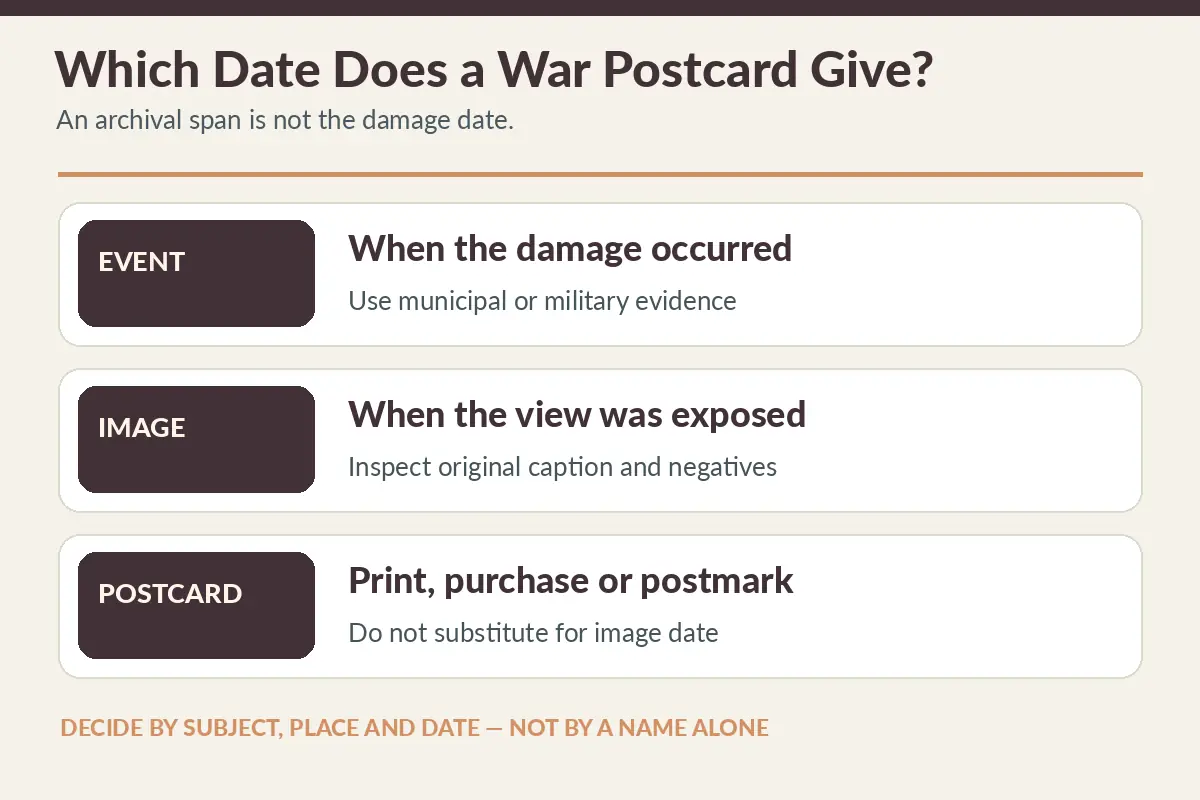
A ruined building may have been hit before the photograph was taken; a printed card could appear still later. Keep a three-date ledger: documented event or damage date, exposure date if available, and publication or postmark date. The National Archives RG 165 description gives 1918 for this group, but does not establish all three dates for each card. Do not claim a bombardment occurred in 1918 solely because of the series date. Check dated municipal reports, church records, newspapers or military documents for an independently documented event.
If the postcard depicts rubble and rebuilding equipment in the same view, it may reflect a recovery phase rather than the immediate aftermath. Descriptions such as “after the attack” sometimes refer broadly to a condition and not a verified day. Distinguish direct visual observations from a publisher’s narrative. One image may show that a roof was absent at exposure; it cannot establish how long the building had been uninhabitable or whether anyone died inside. These limits matter when a family’s survival or displacement is at stake.
Connect a Family to a Street, Not Merely a Picture
An ancestor’s connection to a building should come from a named address record, civil registration, correspondence, property or tenancy document, or another direct source. A surname appearing in a local directory does not prove the household occupied the exact damaged structure, particularly if street numbering changed. Compare dates and legal or municipal boundaries with care. A postwar compensation application may address a claim about property, but an application alone does not establish that every allegation was accepted or paid.
When recording a family story, separate the person’s last known residence, an independently documented disaster or military incident, and the view on the postcard. If all three are compatible but one link is missing, say that the card illustrates destruction in the relevant locality, not the family house itself. Be especially cautious with casualty or evacuation assertions. A photograph of empty ruins gives no direct evidence about the fate of the inhabitants.
Build a Citation That Preserves the Postcard

Search the National Archives Catalog for RG 165 FC, the French town and any original publisher line. Save the local identifier, full caption and details of the postcard’s reverse if available. When asking NARA for a copy, specify the FC grouping and the exact item number or caption rather than requesting all 165 cards at once. The guide does not promise an online scan for every postcard. Ask about image availability and reproduction conditions before planning publication.
For a local-history report, put the historical caption in quotation marks if necessary, followed by your own note distinguishing confirmed facts from uncertain interpretations. Do not erase printed borders, postmarks or marginal marks from the archival reference copy. If you create an annotated map, keep it separate from the original source image. A precise caption such as “FC postcard depicting a damaged building in the town, cataloged 1918” is defensible even when a particular bombardment or family residence has not been established.
Worked Example: A Ruined Street in a Family Letter
Suppose a family letter mentions that a relative left a French town in 1917 and you find a 1918 FC postcard of a damaged street there. First compare the old street name, postcard caption and the relative’s dated address evidence. The card may show a recognizable landmark but still lack a precise damage date. This is a hypothetical case, not an attribution of a particular FC postcard.
If you can independently document the family’s address, use a prewar map to ask whether that address is visible in the photograph. If it is only near the photographed area, say so. Do not conclude that the relative witnessed the destruction or that their home was hit. A caption that carefully distinguishes town, street and individual address is valuable without becoming a dramatic unsupported story.
More Place and Jurisdiction Guides
How We Research These Archival Collections
We verified the FC designation, 165-card count and 1918 dating in NARA’s RG 165 guide. The inventory establishes a group of postcards, not a list of residents or a timeline of each attack. NARA’s photographic guidance supports preserving image format, caption, margins and original identifiers during research.
Our method separates the card as an artifact from the scene it reproduces and the personal history being investigated. Municipal and named records are required before making household or casualty claims. See the affiliate disclosure for site policy; a paid image database is not necessary to interpret an item carefully.
FC is the series designation for 165 postcards of French buildings damaged during World War I.
No. It is the catalog span for the postcard group; event and image dates must be established separately.
Possibly, but the exact address and identity require independent location and family records.
Not necessarily. Mailing, printing and photographic exposure may have occurred at different times.
The series summary does not guarantee online images; check item-level descriptions with NARA.