
To trace a tenant in Irish Encumbered Estates rentals, locate the relevant estate, follow PRONI MIC/80/2 into D/1201, and match a rental lot to a map without inferring ownership.
Start With the Townland and Likely Estate
To find a family in Ireland’s Encumbered Estates Court papers, begin with a documented county, parish or townland and determine which estate held land there around the mid-nineteenth century. PRONI’s Encumbered Estates guide explains that surviving sale rentals contain tenants’ names and may include maps and older lease details.
The crucial first step is locating the relevant estate rather than typing a surname into a presumed national alphabetical database. The estate owner’s name, townland boundaries and date can provide a stronger route than a common farmer surname. Multiple estates sometimes existed in one locality.
Understand Why These Rentals Were Produced
Irish legislation in 1848 and 1849 permitted the sale of heavily mortgaged estates. The Encumbered Estates Court established in 1849 facilitated transfers and distribution of proceeds to creditors; its successors assumed the broader work over time. Auction particulars and bound rentals documented property being sold, the lots involved and the condition of tenancy interests.
A recorded name therefore often reflects an administrative sale context, not the creation of a personal household list. PRONI’s explanatory leaflet links this material to the Great Famine era and indicates that many rentals also refer to leases originating earlier in the eighteenth or nineteenth centuries. Read the sale date separately from a lease date.
Use PRONI D/1201 and MIC/80/2 Together
According to PRONI’s collection leaflet, the Irish Encumbered Estates Court rentals are held in bound volumes referenced D/1201. An index to these rentals is MIC/80/2.
PRONI describes the material as covering the whole island of Ireland, though that must not be mistaken for every property being sold or every inhabitant appearing. Use MIC/80/2 as a way into the relevant estate volume. Record the county, estate name, index reference, book and page or lot number. If a name appears only in a modern searchable abstract, find the exact printed or original rental before drawing genealogical conclusions.

Read Tenant and Leaseholder Fields Literally
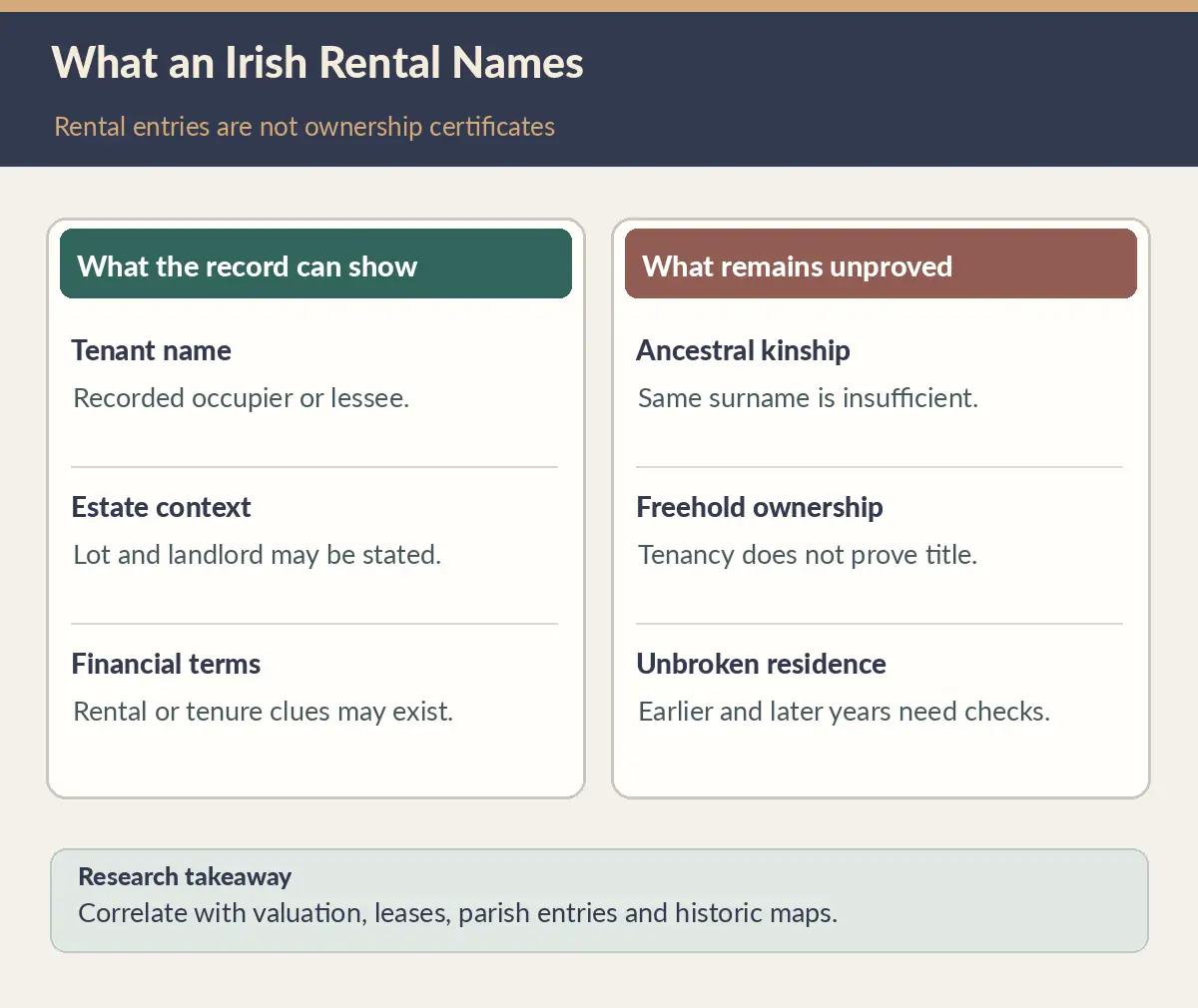
An estate rental may name a tenant, describe an occupier, state rental amounts, summarize tenancy type or identify an earlier lease. Those are not all equivalent relationships. A person with the legal lease could have subtenants; the estate owner could be an entirely different person.
Read column titles and footnotes before transcribing “tenant” as “proprietor.” Where the rental provides a lease commencement date, treat it as a clue to a separate legal instrument, not proof that the same person lived at the site continually. A surname repeated across plots may represent one occupier with several holdings or multiple relatives or namesakes. Each entry needs its own source line.
Attach the Lot to the Estate Map
Some D/1201 rentals include maps of estates or parcels that help connect a townland name and lot number to a geographic location. Maps vary in scale, quality and labeling; a parcel outline is not evidence that a particular family owned its freehold title. First identify the printed lot or map key in the rental, then match it to the same estate sheet and the date of the sale.
Record adjoining townlands and prominent features only when the map actually shows them. Do not place an old numbered lot onto a modern property boundary without checking intervening changes and a proper georeferencing method. Historic locality names may differ from current forms.
Separate a Sale of the Estate From a Tenant Purchase
A court sale transferred interests in an estate, usually to a purchaser of a lot or estate property. The tenants listed in a rental did not automatically become owners because their names appear in the auction particulars. Distinguish the seller or encumbrancer, the estate purchaser, a tenant or lessee, and any agent in the record.
A purchaser’s name may appear in a later order or deed that is not in the rental itself. The National Archives of Ireland estate guide explains how rental books, leases, correspondence and maps answer different historical questions. A credible account keeps those roles separate.

Correlate a Hypothetical Two-Tenant Problem
Suppose an estate rental lists Patrick Byrne on lot 14 and another Patrick Byrne on lot 28 in the same county. The two entries need not identify a single tenant, nor can they establish a father-son relationship. Create separate candidate rows with the estate, townland, acreage if recorded, tenancy language and rent.
Then compare Griffith’s Valuation, local parish records and any earlier lease associated with the lots, paying close attention to dates. If a rental names a “widow Byrne,” preserve that exact description rather than inventing her first name. An unresolved pair of similarly named tenants is still a useful, honestly documented research result.
How We Research the Rental-to-Map Chain
We search by the historical locality and estate, follow MIC/80/2 to D/1201, then independently read the rental and any map or lease it refers to. For each record we annotate the document type and question answered: occupancy, rent, estate sale or property title. We verify the interpretation against PRONI’s own guidance and the National Archives of Ireland description of estate collections.
No tenant kinship is inferred from a surname or neighboring lots. Our affiliate disclosure explains how editorial content is separated from external services. When a volume is not online we make that access gap explicit.
Record Negative Searches and Geographic Gaps
Failure to find a person in the rental index may mean the relevant estate was not sold through the court, the property was held under a different landlord, the surname appears only inside a volume, or the relevant lot does not survive in the accessible extract.
Search alternative historical townland spellings and verify which landlord owned the holding near the date in question. Do not turn a negative index search into evidence that a farmer lacked a tenancy or had emigrated. The next action may be a request to PRONI with D/1201 context, a consultation of estate correspondence, or a comparison against the Primary Valuation and its maps.
More Records and Archives Guides
Build a Source Citation and Next-Record Plan
A reusable citation names PRONI, the D/1201 rental volume and page, estate and county, printed lot number and any linked map sheet. If MIC/80/2 is all you have seen, cite that index separately and label the original rental not yet consulted. Record tenant wording, dates and any acreage or rent exactly, including uncertain units.
The best follow-up depends on the claim: use a lease for tenancy terms, a title document for purchase, a civil or parish act for a relationship, and sequential valuations for changing occupation. An estate sale can lead to family evidence, but it cannot replace it.
No. It contains estate sale rentals, not a complete national household census.
PRONI identifies MIC/80/2 as an index to Encumbered Estates Court rentals.
PRONI describes the bound court rentals as covering the whole island of Ireland.
No. A tenancy entry does not by itself establish legal ownership.
Sometimes. Descriptions and leases may refer to earlier periods, which should be checked independently.