
Identify the Specific Métis Scrip Record Before Searching
For a historical Métis scrip claim in what was then the North-West Territories, first determine whether you need an application, a receipt, a cancelled money or land scrip note, a power of attorney or a subsequent land record. Library and Archives Canada preserves related but distinct Department of the Interior RG15 series. Its Indigenous documentary heritage listings name these different document classes. A successful name search in one is not proof that a particular parcel was received or occupied. Begin with an ancestor’s documented residence, name variants and approximate application period, then identify the source type before interpreting an outcome.
Use the 1885–1906 North-West Applications as a Defined Series
LAC’s catalogue describes North-West Territories Métis scrip applications broadly dated 1885–1906, under archival references including RG15-D-II-8-b and RG15-D-II-8-c. Most applications were made between 1886 and 1906 to one of the North-West Half-Breeds Claims Commissions, in the terminology used by the administration at the time. The same catalogue description also identifies an 1885 group concerning residents present before July 15, 1870. These are administrative categories with particular eligibility questions, not labels to apply uncritically to people today. Check the specific subseries and date rather than generalizing the whole RG15 range.

Search Alphabetical Application Arrangement, Then Read the File
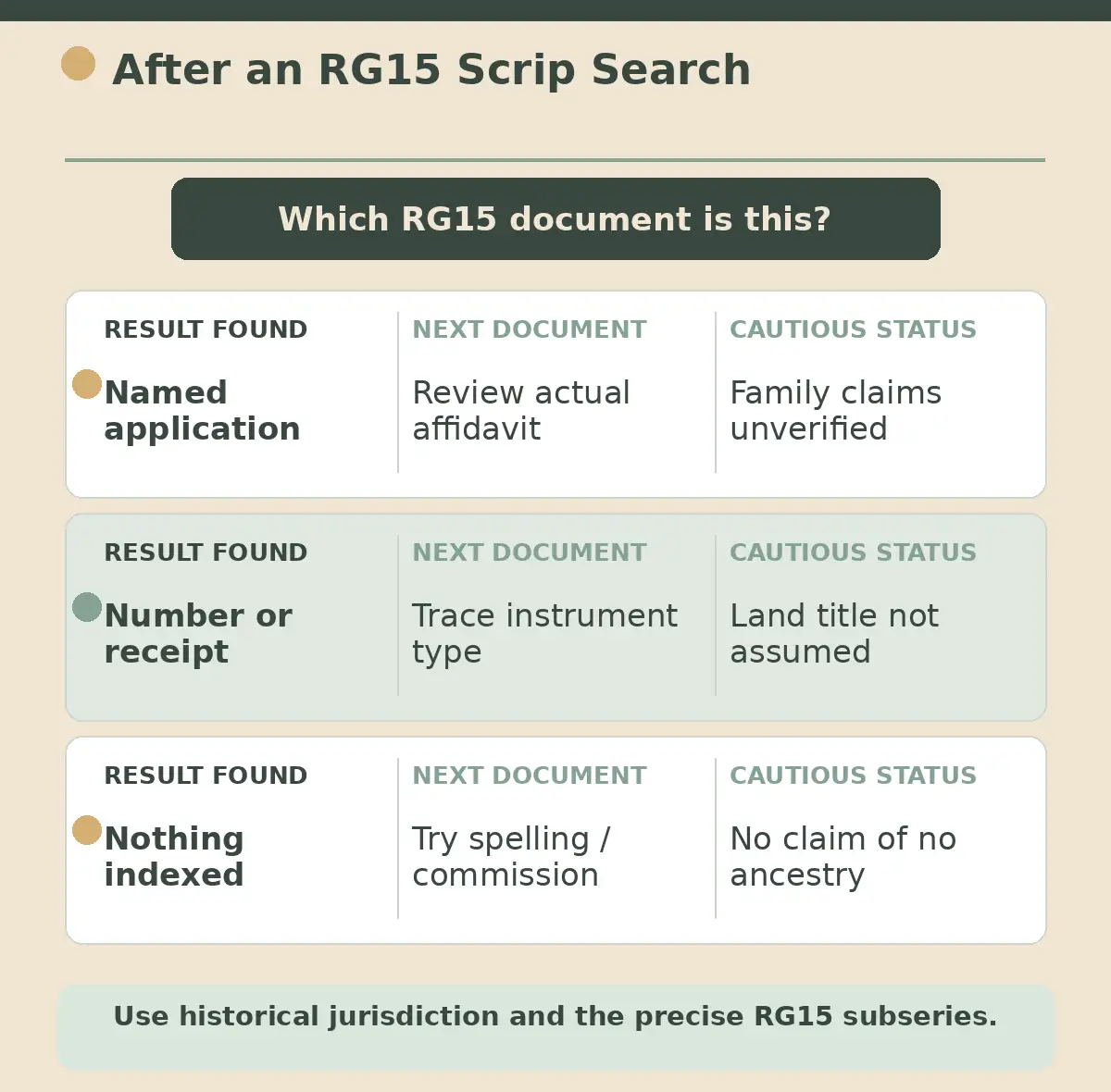
LAC states that the North-West Territories application subseries is arranged alphabetically by applicant name. Search documented spelling variants and record the full item reference, series designation, volume or microfilm location where given, and the name as cataloged. Do not equate an indexed claimant with an approved or redeemed scrip. If the result opens only a catalogue description or a few digitized pages, ask whether additional linked objects or archival volumes are part of the same record. Read accompanying affidavit pages and endorsements, identifying when each portion was made and by whom. An application index is a map to documents, not an evidence conclusion.
Transcribe the Family Information as a Historical Statement
The LAC record description says these applications may report an applicant’s name, residence, birthplace and birth date, parents and their origins, marital status, and in certain forms a spouse and children. This can offer unusually valuable context where other civil records are scarce. But the form was completed for an administrative land or money entitlement and may rely on the claimant’s memory, local interpreters or commissioned testimony. Preserve the exact language, original name spellings and whether each family detail was self-reported or supplied by an agent. Do not project one form’s field list onto every application without inspecting its actual headings.

Do Not Combine Land Scrip and Money Scrip Records
LAC separately lists land scrip notes, money scrip notes, receipts for delivery, and powers of attorney within the Department of the Interior collection. An approved application or a scrip number can be an intermediate stage rather than final proof of land title or continuing occupation. If investigating a land claim, follow the exact document identifiers through subsequent transfer or patent records. If the claim involved money scrip, do not insert a land parcel into the story merely because the word scrip appears. Record the issue date, nature of instrument, endorsements and surviving evidence of receipt or redemption as separate transactions.
Locate the Right Historical Jurisdiction and Commission
The historic North-West Territories did not have today’s provincial boundaries. Before making an application search, establish a documented nineteenth-century settlement, date and political jurisdiction. LAC lists Métis-related RG15 holdings for present-day Manitoba, Saskatchewan and Alberta but these geographic descriptors are broad discovery aids. Search the applicant’s historical place and the commission or administrative district responsible during the claim period. A family moving between settlements may appear in more than one record category. Keep place-name changes in a locality worksheet and cite the archival jurisdiction used on the actual document, not an assumed modern county.
Treat Community Identity Separately From Government Scrip
Métis communities, kinship and nationhood cannot be reduced to one Canadian government’s historic land-claims procedure. A person’s scrip application is a statement within a particular colonial administrative system; neither approval nor rejection is a universal judgment of modern Métis citizenship or identity. Family testimony and oral history can be important but should be understood in their own contexts, with community authority respected. Avoid assigning Métis ancestry to another historical person solely through a similar surname or a reference to mixed parentage. Protect private information of living descendants, and do not publish the names of potentially living relatives unnecessarily.
Reconstruct the File Chain and Cite Every Distinct Record
A sound research log should separate the application or affidavit, any commission decision, instrument number, issuance or receipt, power of attorney and, where relevant, a later land patent. Cite each using Library and Archives Canada, RG15, subseries, item or volume reference and image or microfilm details where supplied. A related LAC administrative series also contains files about procedures and some family grants; administrative correspondence is distinct from a person’s individual application. If access to a digitized record is unavailable, state that and retain the public finding aid as a locator rather than pretending the page was inspected.
A Hypothetical Scrip-to-Title Crosswalk
Suppose an RG15 affidavit provides the claimant’s parents and birth locality, while a separate catalogue entry lists a similar surname and an instrument number. Do not link them merely because both concern scrip. Compare given names, application dates, settlement, claim or certificate numbers, and the actual record types. If the second item is a receipt for money scrip, there may be no land description to trace. If it concerns land scrip, request the related transfer or patent record before stating that a parcel was acquired. Record all unresolved relationships as hypotheses, and avoid treating the government paperwork as an exhaustive account of a Métis community.
More Records and Archives Guides
How We Research Métis Scrip Records With Context
We use LAC’s series descriptions to identify whether the research question concerns an affidavit, instrument, receipt or land transaction; then search the relevant RG15 subseries by applicant and historical locality. We preserve the applicant’s exact assertions and test dates and relations against separately created sources. We do not treat a historical claim result as proof of modern Métis citizenship or a land patent without its later chain of documents. We disclose access gaps and avoid publicizing living-family details. The GenHis affiliate disclosure sets out commercial transparency without implying any relationship to Library and Archives Canada.
Library and Archives Canada catalogs them within RG15, including series RG15-D-II-8-b and RG15-D-II-8-c.
The named subseries broadly spans 1885–1906, with different commissions and a distinct 1885 component.
Applications may report parents, birthplace, residence, marital information and in some cases spouse and children.
Not by itself. Follow the instrument, any receipt, transfers and patent or separate title record.
No. It documents a historical administrative process; community identity and citizenship have different authorities.