
You can begin an England census search without paying, but ‘free census records’ can mean three different things: a volunteer transcription, a free searchable index, or an original page viewed without a fee at a particular location. Those are not equivalent. Start with FreeCEN and FamilySearch indexing, confirm which county and year have data, then use The National Archives census guide to locate an original return or a library viewing option. England and Wales individual census records are available from 1841 through 1921; the 1939 Register is a separate wartime population record, not a substitute census. This guide gives a method for deciding which result is worth pursuing.
Choose a census year before searching a surname
Build a short event timeline first: a known marriage, address, baptism, or later census residence narrows the likely search county. England and Wales censuses were taken at roughly ten-year intervals from 1841 to 1921, and a person can be missed if you assume their county of birth is where they lived. The National Archives census guide also includes Wales, the Channel Islands, and the Isle of Man within its relevant returns. It treats Scotland and Ireland separately, so do not interpret a missing English record as evidence that the person never lived in Britain. Our guide “1939 Register of England and Wales” adds more detail on this.
Choose two neighboring enumerations, not an unrestricted all-years query. If a child was probably born in the 1870s, compare 1881 and 1891, then search for the household rather than one exact name. Note the enumeration year in the research log and avoid translating a stated age into a precise birth date. A calculated birth year is approximate, and adult ages in the 1841 census were normally rounded down in five-year groups. The return documents reported presence on one census night; it does not establish a person’s residence throughout the decade.
Use FreeCEN and FamilySearch to search without payment
FreeCEN offers volunteer-produced census transcriptions and provides county, place, and census-year choices. Its own help pages describe county-by-county and piece-by-piece coverage statistics. Check those statistics before treating zero search results as meaningful. Enter a broad surname and county, then narrow cautiously by year and locality; aggressive filters can hide genuine variants. The transcription follows writing in the return, so phonetic variants and enumerator spellings matter. A FreeCEN entry is useful as a locator and a working transcription, but an untranscribed piece is not an absent ancestor.
The National Archives says FamilySearch has free indexes for census returns up to 1911, commonly linking to images on a partner site that may require payment. Create a research-log line for the index provider, exact collection year, name variant, residence, household associates, and reference when supplied. Do not promise all census images are freely viewable from home. If an image link requests payment, look for an authorized free on-site viewing location or obtain the page from a local library’s subscription access rather than copying a result you cannot inspect.
Find the original page or an authorized free reading-room view
The National Archives states that the 1841–1921 censuses can be viewed free on site at Kew; 1841–1911 returns can be accessed without charge at many libraries, record offices, and FamilySearch Centres. The 1921 return also has named additional free viewing locations, though arrangements and opening hours should be confirmed before traveling. In a reading room, retrieve the household image, not just the person-index display, so you can inspect neighboring entries, crossing-out, separate dwellings, column instructions, and details lost during transcription.
Copy the collection citation from the original image. Typical references identify an archival series and piece, then folio and page, while the 1841 census also needs a book number and 1911/1921 use different schedule structures. Capture the image or page identifier if the institution permits, and distinguish a transcription from your own reading. If the handwriting is unclear, retain a question mark in your transcript and include a note about who supplied the alternative reading. A low-confidence word must not silently become a definite family surname.

Decide whether a missing person is a search gap or genuine evidence
A failed name search can mean a surname was transcribed differently, the county changed, a page survived imperfectly, the household moved, or the volunteer website does not yet cover that census piece. Test these possibilities in sequence: swap given name and initials, remove an exact age, search a spouse or child, move to neighboring parishes, and examine the county coverage page. If the index yields several people with the same name, shortlist them using other known facts rather than choosing the record with the most appealing birth year.
Document each negative search precisely: platform, record set, years, geography, spelling variants, and whether the underlying piece was indexed. ‘Not found in my FreeCEN search for Berkshire 1861’ is an honest statement; ‘not in the 1861 census’ usually is not. A clue from one year should be cross-checked with a different independent record, such as a marriage certificate, parish baptism, probate notice, or later census household. Do not attach a household to your family tree on a name match alone.
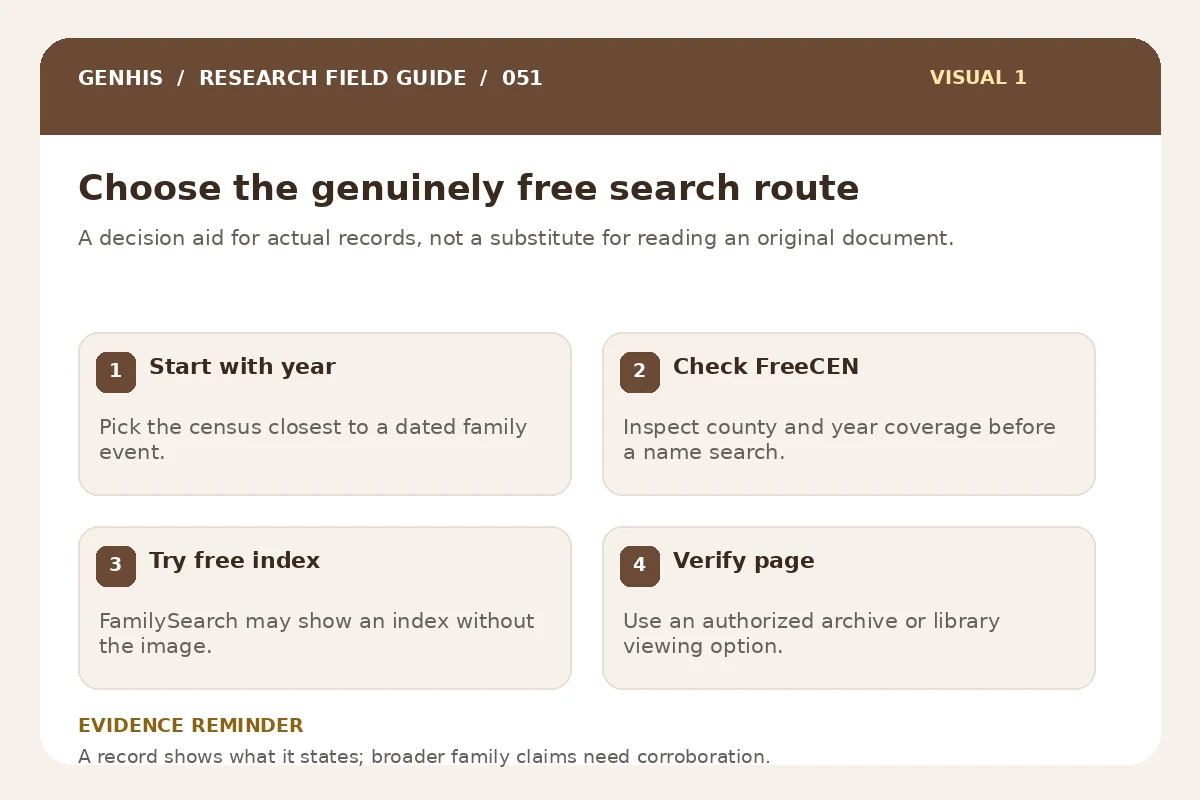
| Decision point | Recommended research action |
|---|---|
| Start with year | Pick the census closest to a dated family event. |
| Check FreeCEN | Inspect county and year coverage before a name search. |
| Try free index | FamilySearch may show an index without the image. |
| Verify page | Use an authorized archive or library viewing option. |
Apply a practical free-first route to an example household
Imagine, hypothetically, that a family letter names a Thomas Reed working near Norwich in the 1880s. First locate the neighborhood and known relatives from the letter; then search FreeCEN for Reed variants in Norfolk in 1881 and verify the relevant piece has transcription coverage. If a plausible household appears, compare the ages of all household members with the letter and a second dated source. Search a different free index for a competing transcription rather than treating two copies of one image as independent proof.
If the best candidate remains uncertain, identify the original 1881 census reference and plan a library image review. Your finished note should distinguish the reported household, the inferred connection to the letter writer, and what remains unresolved. A useful research outcome may be two candidates and one discriminating task, not a premature family-tree attachment. Record alternate results even when they prove inconvenient. This is the distinct value of a free-first approach: the question is what the free result justifies, not how many matches the search box returns.

Keep citation details and census privacy boundaries visible
Store the census year, page reference, institution, website or reading room, access date, original spelling, and all uncertainty alongside any transcribed fields. The National Archives uses series HO 107 for 1841/1851, while later years have separate RG references; relying on an index page URL alone makes a discovery fragile if collections change. Note whether you saw the image or only a derivative index. Keep personal household information from still-closed modern returns out of public profiles even if someone else claims access.
The 1931 England and Wales census was destroyed in a fire, and no census was taken in 1941. The 1939 Register has different origins and sometimes restricted details, so it must be cited by its own name. If a later census is closed, do not try to bypass a privacy rule by inferring data about living people from protected records. Instead build a responsible trail with open historic documents and explicitly indicate where evidence ends. Revisiting a changing free transcription project is sensible; representing its present coverage as complete is not. If you are starting from scratch, read Why There Is No 1930 UK Census.
How We Research: map dates, documentary scope, and uncertain conclusions
We compared the National Archives census coverage and original-image access rules with FreeCEN’s own description of changing volunteer piece coverage. We did not treat a free index hit as an inspected original; each step specifies which level of evidence it produces.
Authoritative sources and collection-specific limitations
www.nationalarchives.gov.uk — institutional source. TNA defines census dates, household fields, citation series, paid online images, and free reading-room access.
www.freecen.org.uk — institutional source. FreeCEN describes volunteer coverage by county, surname variants, and access limitations.
www.freecen.org.uk — institutional source. FreeCEN provides free census transcription searches with place and year filters.
www.nationalarchives.gov.uk — institutional source. TNA distinguishes the 1939 Register from the census and explains its context.
More Records and Archives Guides
Privacy, disclosure, and responsible interpretation
Census entries are reports of a household at one point in time, not verified pedigrees. Historical availability varies by collection and location; avoid sharing protected data about living people or implying that a commercial image is free from home. These archives and public services are cited independently; none is a paid partner or an endorsed affiliate. Read the GenHis affiliate disclosure for site policy.
Not necessarily. FreeCEN offers volunteer transcriptions and FamilySearch offers free indexes for many years, but an original image on a commercial partner may require payment; selected reading rooms provide free viewing.
The 1841 census is the first generally useful return naming individuals; earlier population counts do not provide comparable name-by-name household evidence.
The piece may not yet be transcribed, spellings may differ, or search filters may exclude the entry. Check county coverage and alternative names before interpreting the absence.
It offers a different population snapshot compiled for wartime administration. It is useful evidence but is not the 1931 census and should not be described as one.
Capture the year, archive reference, place, household details, website or custodian, and whether you inspected the image or only a transcription.