
California Census of 1852: Search Surviving County Schedules. The California Census of 1852 is a distinct state enumeration, not the federal 1850 census with a new label. California State Archives describes two schedules: one names inhabitants; the other summarizes production and capital. That distinction determines whether a search can identify a person or only give community economic context. The archive also documents missing counties, amended page numbering and language that reflects discriminatory nineteenth-century categories. Begin with the original county and the actual form before interpreting a name.
Choose the historical county and relevant census schedule
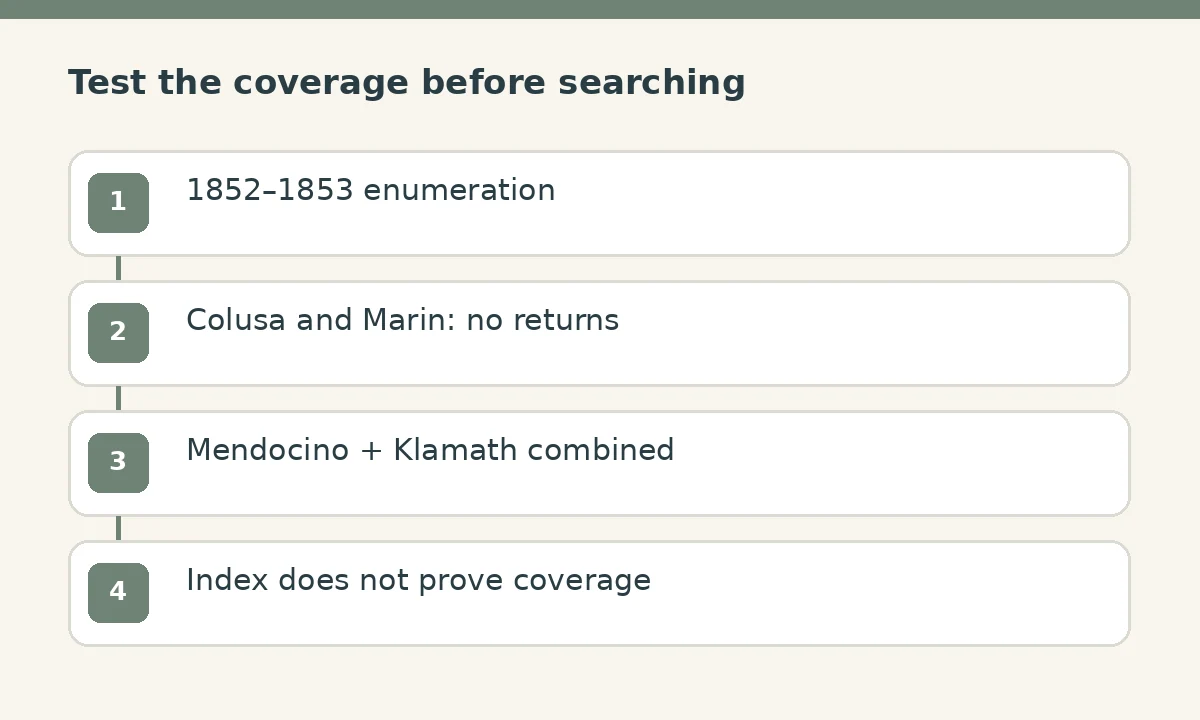
California State Archives says the census was ordered in 1852 and completed across 1852–1853 by county agents. The searchable collection is arranged by county and then by Schedule I or Schedule II, although small counties may have both in one volume. Start with a dated residence clue from the federal 1850 census, a deed, a newspaper, a church record or a mining notice. Find the county that governed that location at the time, rather than using a present-day county map without checking changes. A modern search box cannot tell you that the person was enumerated in your chosen district.
Schedule I, called Inhabitants, is the correct starting point for a named person. Schedule II, Productions and Capital, gathers numbers about farming, livestock, mining and other local economic activity, and cannot be treated as a second list of named household members. Write the county, schedule and available volume numbers in a research log. If a county volume has several parts, note which pages or images you examined. This source-level distinction prevents a search for a surname from producing an artificial negative result in a non-personal statistical schedule.
Search the archive volumes without assuming a complete index
Open the California State Archives collection description and its collection-item search, not an unrelated site that merely advertises an 1852 census. The archive explains that names in Schedule I show no apparent original arrangement. A surname or first-name index may help you identify a candidate volume, but a failed index search is not proof that the person was absent. Browse the likely county volume, note the original headings, and look for phonetic spellings and occupational clues. Different people with the same name may have lived in different mining camps or towns. For a related choice, see our guide “Louisiana State Censuses of 1853 and 1858”.
The collection description names Colusa and Marin as counties without surviving enumerations. This is a preservation fact, not evidence that the county had no residents. It also explains that Mendocino and Klamath appear together in one volume and that Klamath later ceased to exist. Before reporting a search failure, inspect the county list and note whether your proposed district was merged, missing, renamed, or present in a neighboring jurisdiction. An ancestor’s move between 1850 and 1852 can explain a genuine discrepancy without any failure in the records. For a related choice, see our guide “Nevada Territorial and State Censuses”.

Interpret the fields and historical wording with care
For a person in Schedule I, transcribe the name, age, sex, occupation, birthplace and last residence as they appear. The collection contains racial and citizenship categories whose wording is now offensive and whose classification practices were neither neutral nor consistent. Quote such a term only when necessary for an accurate transcription, clearly attribute it to the historical source, and do not convert it into a modern identity claim. Birthplace and last residence are different fields; a previous place of residence is not automatically the birthplace, arrival date or immigration route.
Imagine a hypothetical candidate named Rosa Martin, recorded with a mining-camp location and an earlier residence elsewhere. This fictional example shows the right reasoning: compare age range and locality with deeds or directories, then seek another independently dated source. Do not assume a shared surname proves a marriage or parent-child relationship, or that a count of citizens identifies every citizen individually. Census information may have come from an informant other than the named resident. Mark each assertion as transcribed, independently corroborated, or unresolved, preserving spelling and ambiguity.
| What you found | What it supports | What needs independent testing |
|---|---|---|
| Catalog or index match | A possible source location | Person identity and original text |
| Original record entry | Information actually written on the form | Accuracy, family links and exceptions |
| Second dated source | An independent comparison | Any unresolved conflict or missing coverage |
Use economic schedules as context rather than identity proof
Schedule II records items such as livestock, cultivated acreage, crops, mining operations and capital employed. These figures can help frame the local economy of a county where an ancestor was documented, but they cannot by themselves prove a particular occupation or acreage owned by that ancestor. A county with extensive quartz mining does not establish that a named miner worked at a specific quartz mill. If a family history book makes that leap, identify the missing connecting document: a land claim, payroll, newspaper announcement or business assessment.
Keep two evidence columns in your notes. One should contain directly named facts about the individual from Schedule I or other name-bearing sources; the other should contain community context from Schedule II. The resulting narrative can say a person lived within an area whose census recorded certain activities, but it must not turn aggregate data into a personal biography. This separation is especially valuable when reconstructing California Gold Rush movement or work. Economic categories do not reliably locate a family, and a comparison with later county tax or assessment books may be necessary.

Cite the correct page and resolve conflicting evidence
The archive warns that numbers added at the top right of the pages were applied after the original census and that some books contain copy pages marked with an added A. Record both the visible page and the archive’s volume identifier rather than guessing which numbering is original. For a reproducible citation, capture the schedule, historic county, volume, page or image, person, custodian, stable collection URL and access date. If a digital item shows page damage or an unreadable entry, describe that limitation instead of silently expanding an unclear surname.
After recording the page, compare the 1852 entry with the 1850 and 1860 federal enumerations, any available local registrations and documentary evidence of movement. A difference of a few years in reported age does not require creating two separate individuals; a change in occupation is plausible but not self-verifying. When two candidates remain, build a comparison table of neighbors, birthplaces, last residences and independent deeds. The research conclusion should explicitly state whether the identity is supported, tentative or unknown. This is more useful than treating an index hit as a completed family link.
How We Research California State Census
We checked the original California State Archives collection and exhibit rather than relying on an index description, separated the two schedules, and noted its county omissions and historically discriminatory terminology. The sample identity test is fictional; it does not quote an ancestor or reproduce an authentic form.
More Records and Archives Guides
Official archives and record coverage sources
California State Archives documents both schedules, original fields, county omissions, volume arrangement and page-number caveats. The California State Archives original inventory is the authority for the two schedules and missing counties.
California Secretary of State identifies census and complementary county records available for genealogical work. The family-history guide identifies complementary county records for documentary comparison.
California State Archives exhibit explains the contrasting purposes and recorded fields of Schedules I and II. The exhibition describes the language and original fields of the Inhabitants and Productions schedules.
T No referral commission is verified for this California guide. The GenHis affiliate disclosure explains our wider link policy.
No. It was a California state enumeration separate from the federal population schedules.
No. California State Archives identifies Colusa and Marin as having no enumerations in the collection.
Schedule I, Inhabitants. Schedule II records production and capital rather than being a second name list.
No. Each is a reported clue to be checked against passenger, naturalization and other dated records.
Give the historic county, schedule, volume, visible page or image, custodian, collection link and date accessed.