
Hawaiʻi Historical Census Records: Island Search, 1878–1896. Hawaiʻi’s surviving nineteenth-century censuses require a different search method from the federal household censuses usually used in U.S. genealogy. The Hawaiʻi State Archives says census returns survive for 1866, 1878, 1890 and 1896, but none is complete. Its named surviving sections vary by island, district and year. A partial searchable index can help, yet browsing the archive’s original geographic microfilm may be essential. This guide starts with an island and date, distinguishes the historical Kingdom period from later U.S. territorial records, and shows how to test a possible identity without inventing a family connection.
Choose the right political period and available census year
Start by identifying whether the person lived in Hawaiʻi before or after it became a U.S. territory. The surviving 1878 and 1890 enumerations belong to the Kingdom period; the 1896 census was taken under the Republic of Hawaiʻi, before U.S. annexation in 1898. All differ from later U.S. federal returns. Hawaiʻi State Archives lists returns for 1866 as well, but the University of Hawaiʻi guide notes that early named coverage is patchy. The first U.S. decennial population census including Hawaiʻi begins in 1900. Thus a result for 1890 Hawaiʻi is not the same record type as a surviving federal 1890 population schedule from the mainland, and it must not be described that way. For a related choice, see our guide “Oregon Census Records”.
Build a date line from independent family material such as an earlier church record, a letter naming a district, a land record, an occupation notice or a later 1900 federal entry. Record the island and likely district before choosing a year. If the ancestor lived in Honolulu in 1896, that suggests a different search than one for a rural Hawaiʻi Island resident in 1878. Avoid projecting modern district names backward without checking the place on the dated source. A broad phrase like “Hawaiʻi census” hides those essential distinctions.
Map survival by island, district, and actual reel
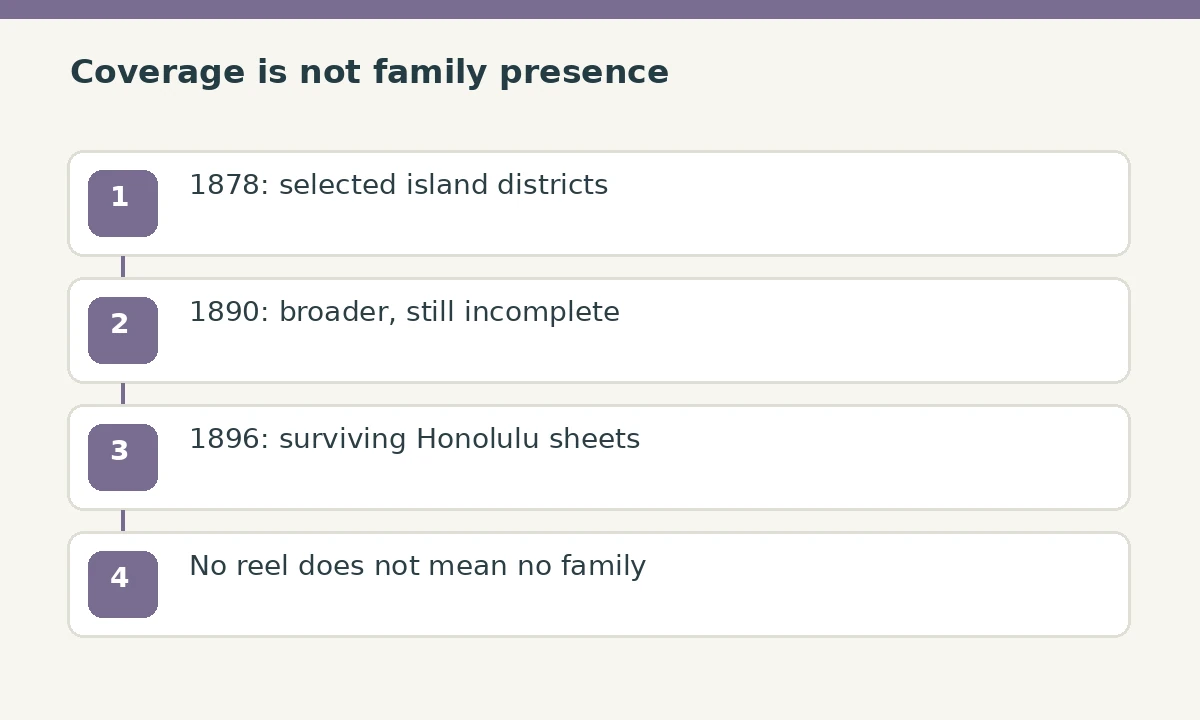
According to Hawaiʻi State Archives, the surviving name-bearing sections are partial for 1878 on Oʻahu, Maui and Hawaiʻi, broader but still incomplete for 1890, and concentrated in Honolulu for 1896. The University of Hawaiʻi at Mānoa library guide gives detailed microfilm listings for these areas. A family that never appears in the 1896 Honolulu records may simply have lived in a different district. Before typing a name, locate the relevant island in the guide and check whether the district is represented in the surviving reel.
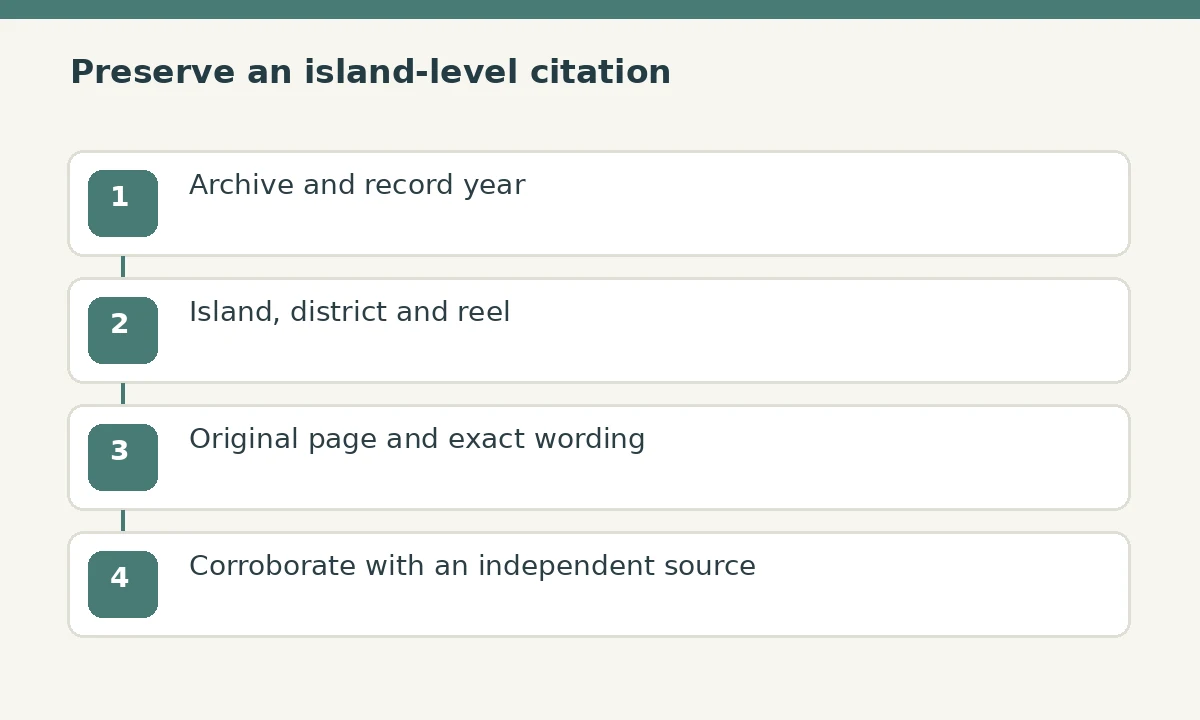
Draw a coverage grid with rows for 1878, 1890 and 1896 and columns for the family’s documented places. Mark a cell “record exists,” “not represented in this inventory,” or “not yet checked.” Do not write “person absent” in a cell where no sheet survives. Microfilm arrangement may use historical island and district names, not present-day municipal boundaries. If an entry does exist, cite that microfilm or archive item and its page. A general database collection title that contains multiple islands is not a page citation.

Use partial name indexes without confusing them with the archive
FamilySearch hosts the “Hawaii, Census records, 1878–1896” collection with an inventory of specific film and digital group numbers. That database does not promise coverage of every island, town and district for all three years. Its own description lists sample 1878 material from Hilo and later records from particular areas of Hawaiʻi, Kauaʻi and Oʻahu. Begin with likely surname variants, but treat any match as a pointer to an image. When no name is indexed, open the Hawaiʻi State Archives digital collection by island and year rather than concluding that the family was never enumerated. Our guide “Arizona Territorial Census Records” covers a related question.
The University of Hawaiʻi guide explicitly recommends manual page-by-page browsing for missing names because an index can fail even in a surviving district. Read adjacent households and headings, especially when names are abbreviated or rendered differently in English-language indexes. Transcribe the entry as written, preserving diacritics where the source actually provides them. Do not invent a Hawaiian spelling or assume that two similarly named residents belong to the same genealogical line. A person may have been recorded by a shortened or alternate name, but that is a hypothesis to test elsewhere.
Read household and property details within the correct form
The Hawaiʻi State Archives describes information that can appear in these returns, including household occupants, age, sex, marital status, occupation and citizenship or nationality, plus some property and livestock data. Not every surviving sheet necessarily has the same arrangement or has each field completed. First photograph or save the image of the actual heading, then transcribe the line. A form’s use of nationality language is not a modern determination of ethnicity or Indigenous Hawaiian identity. Landholding does not by itself establish who lived in a dwelling throughout a year. For a related choice, see our guide “South Carolina State Censuses”.
A fictional example demonstrates the method: imagine a household name in an 1890 district return and a person with a similar name in an 1896 Honolulu listing. To argue they are the same individual, compare ages if given, occupation, other household names, the exact district and independent dated evidence of a move. The six-year interval allows children to age and households to change. Do not convert a repeated first name into a proven marriage or parent-child relationship. Mark which fields come from the census and which deductions require external records.
| Source state | What is supported | Next necessary test |
|---|---|---|
| Original name-bearing entry | Wording on this exact census page | Compare another independent dated source |
| Index hit or transcript | A candidate locator, not proof of a relationship | Obtain and transcribe original source |
| Coverage limitation or abstract | What holdings or totals are documented | Choose a different record series |
Respect the historical context and community names
Nineteenth-century Hawaiʻi census materials were created within changing political institutions and may use administrative vocabulary that no longer reflects how people identify. When a potentially sensitive category appears, attribute it to the source and avoid turning it into a definitive claim about a person’s ancestry, nationality or cultural membership. Histories of colonial rule, immigration and Native Hawaiian family relationships deserve careful treatment. Record local place names precisely and use standard Hawaiian diacritics in modern explanatory prose without silently rewriting the original manuscript.
The University of Hawaiʻi’s guide to the 1878 sheets organizes its browsable images by island, district and place and sometimes supplies corrected place names in brackets. That helps orient a search, but the archival transcription and any editorial correction must remain distinguishable. A library finding aid may be an excellent access tool; it is not the original enumerator. When comparing two sources, maintain a distinct citation for each. Avoid displaying names of living relatives in public example tables simply to illustrate a historical search.
Explain a missing match and preserve an auditable citation
State exactly what search was performed: year, island, district, reel or digital group, index query, spelling variants and page range. If the district is absent from the archival inventory, classify the result as a coverage limitation. If pages survive but have not been browsed, say the search is unfinished. Also, if all relevant pages were examined with no entry, report a negative search confined to those pages, not to all of Hawaiʻi. The possibility of missed enumeration or name variation remains, even after careful browsing. For a related choice, see our guide “Tennessee Census Substitute”.
Then choose the closest independent evidence: a church or civil register appropriate to the place and period, land or taxation material, port notices, directories, probate or a later U.S. census. Form a narrow question such as whether a particular adult lived in one documented district between two dated events. Keep source images and citations alongside your transcription so another researcher can repeat the route. A careful statement of archival limits is far more useful than an unsupported assertion that no record of the family exists.
How We Research This Census Collection
We reconciled Hawaiʻi State Archives’ survival summary with University of Hawaiʻi island-and-district guides and the narrower FamilySearch digital group inventory. This article does not imply uniform census forms or coverage. All illustrated households are fictional and no present-day identity is inferred from a historical nationality field.
More Records and Archives Guides
Official archives and source documentation
Hawaiʻi State Archives identifies surviving years, incomplete island coverage, arrangement and image access. This archive guide controls the island-year survival question, not a general surname database.
University of Hawaiʻi guide explains manual browsing, island-level coverage and changes from Kingdom to Republic and later U.S. territory. The university guide shows how original rolls are arranged and when manual browsing is necessary.
FamilySearch lists the partial 1878–1896 indexed film inventory and possible recorded fields. The indexed database provides film identifiers for a subset of surviving island materials.
University of Hawaiʻi 1878 browsing guide organizes surviving images geographically and distinguishes corrected place labels. The university browsing tool clarifies place grouping and editorial corrections to location labels.
The text-free image is conceptual illustration, not an original Kingdom census. Modern explanatory spellings and a document’s historical wording are kept distinct. The island-by-island research path does not depend on paid placement or a Hawaiian archive partnership. See the GenHis affiliate disclosure.
Frequently Asked Questions
No. Hawaiʻi State Archives explicitly says that no surviving nineteenth-century census is wholly complete.
The original collections are held by Hawaiʻi State Archives; University of Hawaiʻi guides also explain online and microfilm access.
No. Its film inventory covers specified islands and districts and may omit people visible on other surviving images.
No. It is a distinct local historical census with different jurisdiction and incomplete geographical survival.
Identify which island-year-district pages were inspected and whether the relevant district is present in the surviving material.