
The 1901 England and Wales census was taken on the night of March 31, 1901, and its enumerators’ books are in RG 13 at The National Archives. A household entry can place someone in a parish and report an occupation, age, birthplace and relationship to the head. The 1901 form is especially useful for distinguishing employer, worker or own account and whether an occupation was carried on at home. Those are answers on a census night, not a payroll document, business registration, evidence of inherited property or conclusive proof that household members were biologically related.
Find an RG 13 household from name, address and district clues
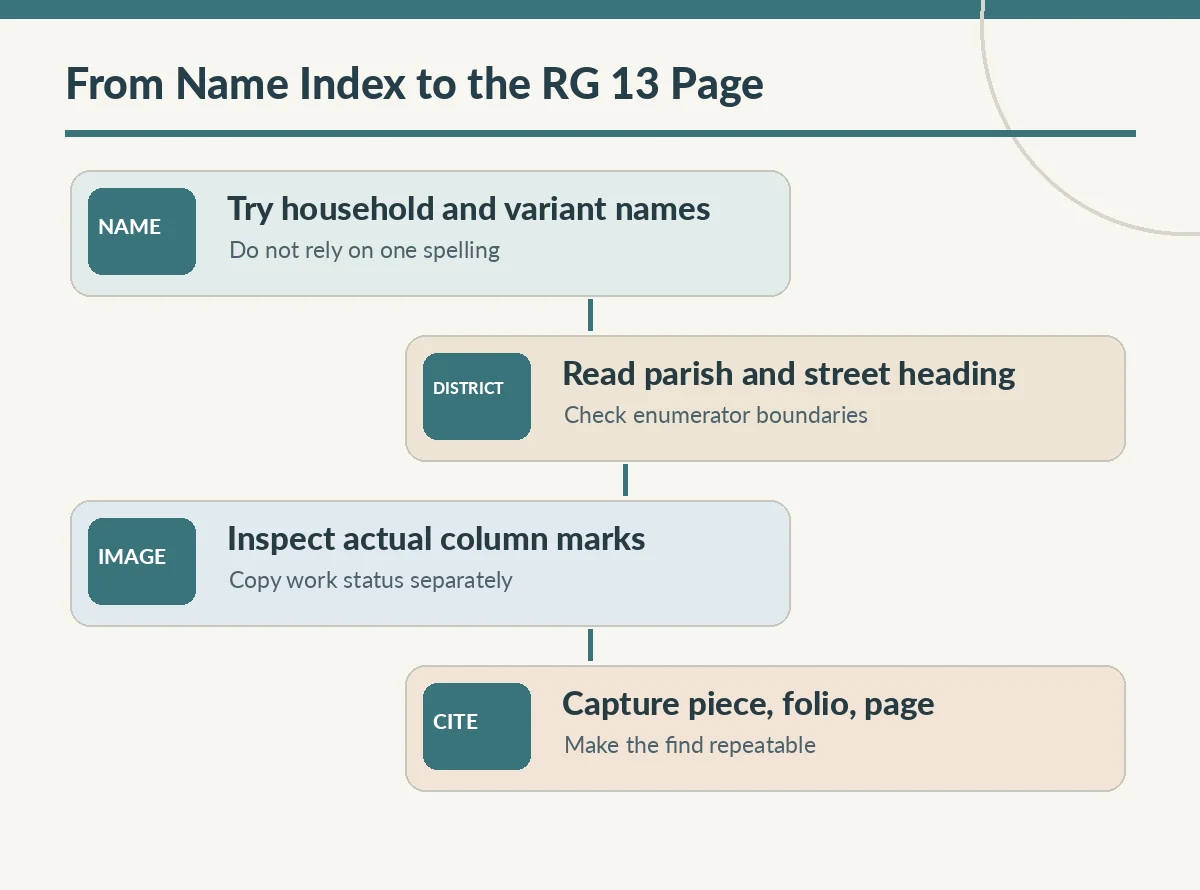
Search a household name with approximate age, spouse or birthplace, then open the original page rather than relying on a searchable snippet. The National Archives’ census research guide identifies RG 13 as the 1901 series. Record county, civil parish, registration district, sub-district, street or hamlet and the address exactly as written. If a street number is missing, do not substitute the consecutive household schedule number as a house address.
Read the enumerator’s description of the district. A household may span pages; an abbreviated surname, lodging house or institution may confuse the index. Test name variants, a spouse’s name and nearby addresses when a direct surname search yields no result. Keep scans of relevant neighboring pages and mark your search boundaries. A family absent from one provider’s indexed names is not necessarily absent from the surviving RG 13 books. Our guide “1901 NSW Census Collectors’ Books” goes into more detail.
Read the changed 1901 employment status columns
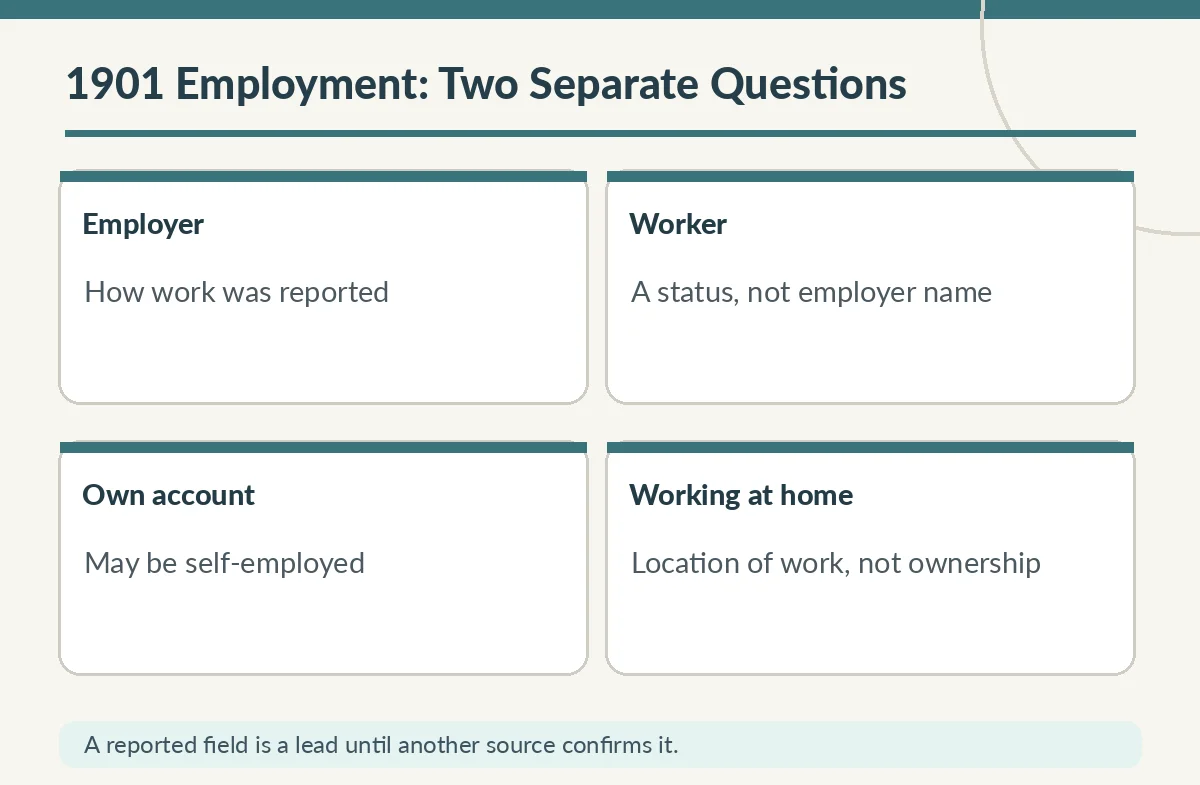
The 1901 census changed the occupation status choices to Employer, Worker and Own account; it also introduced an indicator for working at home. The status column is separate from the written occupation. Copy the mark in its original position and the trade wording; do not read a blurred mark as a confident business role. A self-employed or own-account entry does not automatically demonstrate ownership of the property where the person lived.
For example, a person described as “dressmaker” may be a worker for a shop, may operate on their own account, or may work at home. These are separate questions; one alone does not answer the others. Compare trade directories, advertisements, rate books or later certificates if you are testing the nature of the work. If an indexed database leaves status blank, inspect the paper columns before claiming that the occupation is unknown.
| Original column | Safe reading | Not established |
|---|---|---|
| Employer | Reported employment status | Legal firm ownership |
| Worker | Classed as a worker | A named workplace |
| Own account / at home | Status and workplace clues | Deed or continuous business |
Do not transplant the 1901 Isle of Man language field to Wales
The National Archives specifies that the 1901 question about language spoken applied to the Isle of Man only. A Wales-only language question belongs to the 1891 census, not the standard 1901 Welsh household pages. This distinction matters when online transcription forms reuse field labels across years or places. Read the actual printed heading on the image rather than assuming every household supplied a language entry. To go further, our guide “1891 England and Wales Census” shows how to read RG 12 work and Welsh language clues.
The absence of such a printed field on an English or Welsh page proves neither language loss nor English monolingualism. Even where a language answer was asked, it is a historical report with limited interpretive scope, not a direct measure of ancestry, fluency or ethnicity. For a migration question, compare a reported birthplace and family naming patterns with civil and parish evidence instead of overinterpreting language categories.

Use relationships, ages and birthplace as identity comparisons
Write the relationship-to-head entry exactly: son, daughter, servant, boarder and visitor have different meanings, but none alone proves an independently documented biological relationship. A married person’s relationship in the census may describe their place in the household, not the marriage date. For several people of the same name, compare a partner, children, age, birthplace and neighborhood across 1891 and 1911, allowing ten-year gaps and potential enumerator error.
“Where born” is what was reported to the enumerator. The 1901 place may be a broad county, a town name or a different spelling from civil registration. Make a birthplace hypothesis and then use local birth indexes or baptism volumes to test it. Do not average conflicting ages into a fictitious exact birthdate. If a disability, occupational or marital field appears unclear, retain the original handwriting in your notes and mark uncertainty rather than filling a modern database field with a guess.
Understand household schedules, rooms and crowded addresses
Different schedules may share a building, and a boarding house can be written on contiguous lines with a family. Occupancy is distinct from legal ownership. In this period a question about rooms was tied to dwellings occupied in fewer than five rooms; treat a blank with care, especially if the form’s instructions or handwriting are unclear. A line marked as a visitor may represent a person temporarily there on census night, without proving a permanent move.
If the apparent household changes drastically between 1891 and 1901, test death, marriage, employment or travel with independent records. Do not assume everyone at one address stayed together for the next decade. A missing child might have entered domestic service or been recorded with relatives. Compare neighbors, occupations and householder details to discriminate competing candidates but be explicit that neighborhood context is only one line of support.
Cite RG 13 with archival piece, folio and page
A reliable reference is more than “1901 census.” Save RG 13, the piece number, folio and page, plus county, parish, household or address and the image provider. Folio numbers can cover two sides of a leaf while page numbers appear on individual sides. An online scan count is not interchangeable with the archival page number. Use the actual image for transcription, especially where a database index has silently normalized a trade name or a birthplace. Our guide “1921 England and Wales Census” shows how to read RG 15 and employment clues.
Try to retrieve the same record using your citation before finalizing it. If a line is illegible, explain what cannot be read and what evidence might recover the detail. When the target is absent, note all inspected pieces, dates, variant names and district ranges. A bounded, repeatable search is more useful than an untestable statement that an ancestor “did not appear in the census.” To go further, our guide “1911 England and Wales Census” shows how to read household schedules and RG 78.
More Records and Archives Guides
How We Research the 1901 RG 13 Census
We checked The National Archives’ year-by-year field list and series table, including the RG 13 reference, employer/worker/own-account statuses, working-at-home indication and the Isle of Man language distinction. We also checked the relevant historical census discovery path. The hypothetical occupation examples show how to classify census reports without creating real evidence for a named family.
We distinguish archival facts from indexed interpretation and independent inference. No paid access, partnership or exclusive record discovery is promised; see the affiliate disclosure. Access conditions vary, so confirm that the current provider displays the original page and not solely its transcription.
The enumeration date was March 31, 1901; a recorded residence is a one-night observation.
It is the National Archives series containing the surviving 1901 census enumerators’ books for England and Wales.
No. It is a reported way of working, not proof of title to a workshop or residence.
Do not assume so. TNA lists the 1901 language question as Isle of Man only; its 1891 language question applied to Wales.
Retrieve the original RG 13 page, verify relationships and columns, and capture its piece, folio and page before accepting an identity.