
Canada’s 1871 census was its first census after Confederation, beginning April 2, 1871, and it recorded much more than a list of residents. Library and Archives Canada describes nine schedules covering people, deaths, public institutions, property, farms, industry, forests, shipping and minerals. Schedule 1 is the primary fully indexed list of living people; the other schedules may need manual image browsing. The most useful overlooked technique is to carry the Schedule 1 page and line into related returns, not merely search the surname again.
Establish the correct 1871 province, district, and population page
The 1871 national return concerns Ontario, Quebec, New Brunswick and Nova Scotia. It does not include Manitoba, whose separate enumeration was in 1870. Start at Library and Archives Canada’s 1871 census guide, choose a historical district and subdistrict, and locate an indexed person in Schedule 1. Verify the district on the image because later county boundaries and place names may differ from the original arrangements.
Capture the reel or image number, district, subdistrict, schedule, folio or page, line, household/dwelling numbers, name and neighbors. Two families could occupy a single building and receive separate family numbers. The enumerator also counted some vessels and uninhabited or unfinished dwellings, so a simple row number is not a household identifier. Do not conclude that someone was absent from all Canada if you checked only one of the four 1871 provinces. Our guide “1891 Canada Census” covers how to verify parents’ birthplaces and household clues.

Read Schedule 1 ages and origin with period-specific caution
Schedule 1 records names, sex, age at last birthday, the month of birth for infants born within the last twelve months, country or province of birth, religion, origin, occupation and limited marriage and schooling details. When a baby is shown as ‘2/12’ the fraction represents two months, not a two-year-old. The ‘origin’ entry was given by the person questioned; it is not a modern ethnicity test or proof of nationality and should be quoted in historical context.
Transcribe every family member in printed column order. If the recorded birthplace says Quebec rather than a parish, do not manufacture a baptismal place. Compare claimed occupations with other dated records but distinguish what the enumerator reported from the worker’s legal standing. The schedule’s historical categories for disability or personal status should never be applied as labels to living descendants. A similar name and age can support a candidate, not complete an identity proof.
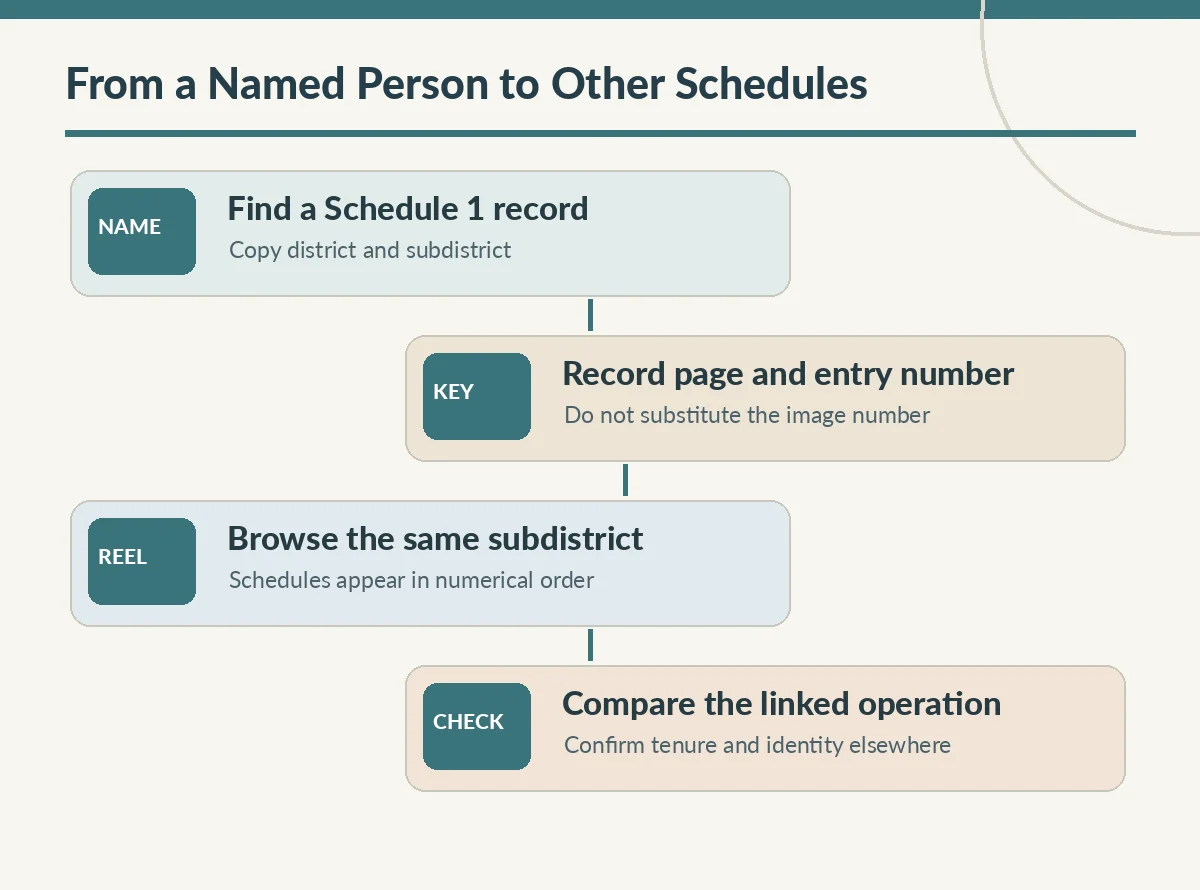
Use the Schedule 1 page and line as a cross-schedule key
Schedules 3–5 and 7–9 commonly reference a Schedule 1 page and entry number rather than repeating the individual’s name. First copy the exact identifying number from the population image, then browse the matching subdistrict’s remaining schedules on digitized microfilm. The official guide explains that each subdistrict’s Schedule 1 is followed in order by other schedules, where extant. Do not assume an absent Schedule 8 was lost: an agricultural interior district might never have completed a shipping return.
Write a ledger with one row per linked schedule: district/subdistrict, reel, printed schedule number, Schedule 1 page, Schedule 1 number, values transcribed, and uncertainty. A matching reference ties the tabulation to a census entry; it does not by itself validate ownership or production income in a later tax year. If the link is illegible, preserve the unresolved reading and compare neighboring reference pairs rather than invent a convenient row.
| Schedule | Primary clue | Lookup warning |
|---|---|---|
| 1: Living | Indexed names and household | Not a kinship certificate |
| 2: Deaths | Names and reported causes | Ontario subset name-indexed |
| 4: Agriculture | Acres and crops | Page/entry key; not name indexed |
| 6: Industry | Establishment details | Only when a return exists |
Look for named deaths on Schedule 2
Schedule 2 is a nominal return of deaths, recording a deceased person’s name, reported age, month and cause of death, among other details. Library and Archives Canada says the 1871 database indexes Schedule 2 for Ontario only, while the rest of Schedules 2–9 require digitized-microfilm browsing. This is not a list of everyone who died in Canada in 1871. It reflects the census collection period, coverage, local reporting and survival; look for the original question and subdistrict before inferring a vital event date. If that is your next decision, our guide “1911 Canada Census” explains how to read Schedule 1 birth, work, and insurance fields.
Compare any found death entry with burial records, local newspapers and civil or church registrations where they survive. A death line may help explain a missing child from Schedule 1, but never assume that a same-surname death belongs to the household without evidence connecting place and relationship. Write down the month as reported, not an invented day. If you find no death, your conclusion should specify the searched schedule and its limits rather than claiming the person lived through the entire year.
Check agricultural and industrial returns without inventing title
Schedule 4 records occupied acreage, tenure categories, lots or concessions and crops, with supporting animal-product figures in Schedule 5. A farm operator recorded as owner, tenant or employee is supplying an administrative classification, not a definitive land-title record. Use the township, lot and concession as leads to historical land registry and tax records. In a town, Schedule 6 can give an industrial establishment, proprietor or company and recorded employment and production facts. Our guide “1901 Canada Census” shows how to verify birth dates, immigration, and land clues.
Not all of these schedules include named persons; the key may point back to a household or an operation. Never assign an establishment’s annual wage bill to an individual worker unless the record actually does so. For non-farming households a blank agricultural reference may be expected. Include a column for ‘not applicable’ separate from ‘not preserved’ and ‘not searched’ in your coverage audit, because those three statements reflect different evidence. For a related choice, see our guide “U.S. Agricultural Census Schedules, 1850–1880”.
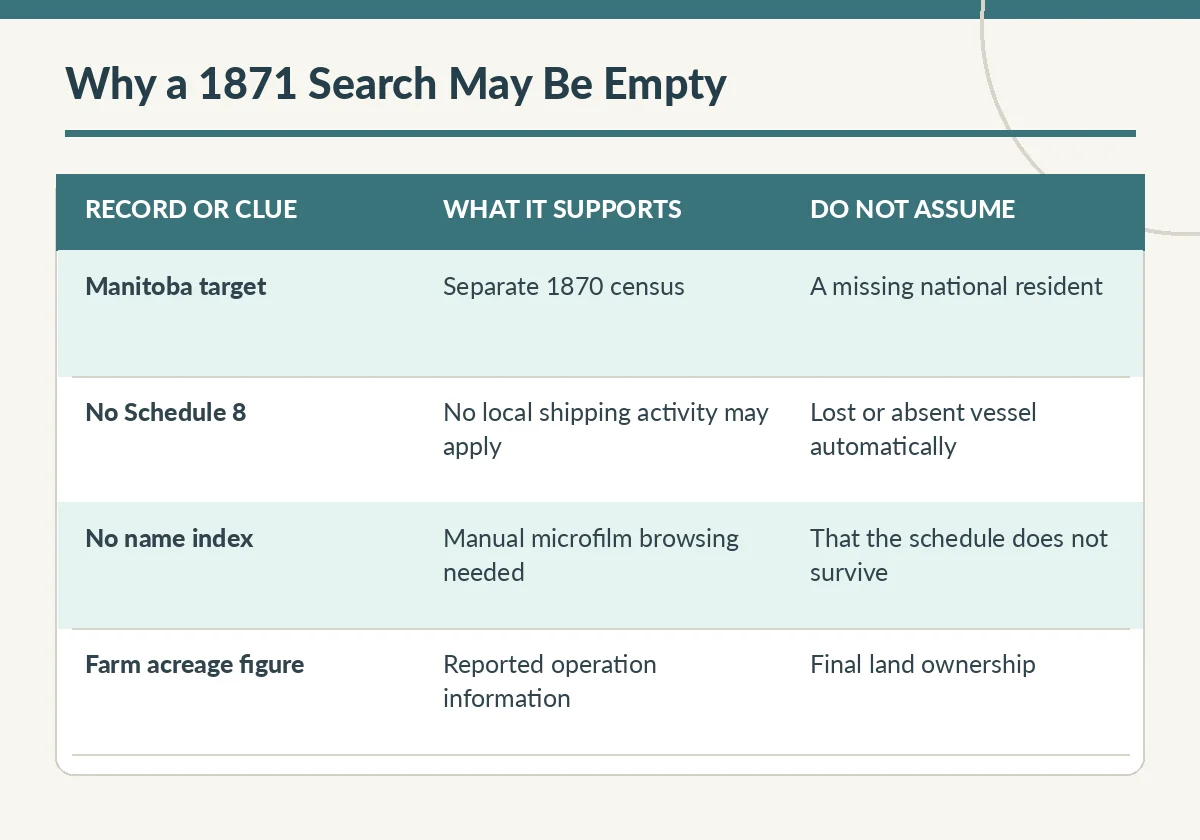
Create a no-result audit for the nine schedules
The surviving set varies by subdistrict. A number of apparently missing returns were never taken because the activity was absent locally. For each desired series, consult the LAC inventory, then record whether the schedule is extant, incomplete, not expected, or simply not indexed. This prevents a misleading claim that a fisher or industrial worker had no business because the relevant page did not appear in a name search.
If the indexed population return is missing, search name variants in a neighboring subdistrict and compare religious registers, directories or property assessments. If the population page exists but no linked agricultural entry appears, recheck the page and line, order of microfilm, and whether the person actually held land or operated a farm. Log one specific next step for each unresolved search; do not fill documentary silence with a narrative. For the fuller picture, see our guide “1851 Canada Census”.
More Records and Archives Guides
How We Research the 1871 Canadian Census
We checked LAC’s current census guide, its displayed field-by-field headings, and its separate schedule inventory. The article deliberately distinguishes Schedule 1’s main personal index from Ontario’s indexed part of Schedule 2 and other subdistrict-level microfilm. The nine-schedule crosswalk is a reproducible research tool, not a claim that every schedule exists for every district. Examples and inferred links are methodological only.
Copy historical administrative terms accurately but avoid projecting period identity categories onto living people. Confirm current access and image locations with Library and Archives Canada before ordering reproductions or making a negative-evidence statement. No paid database is endorsed; see the site’s affiliate disclosure for its general policy.
Ontario, Quebec, New Brunswick and Nova Scotia; Manitoba was counted separately in 1870.
No. Schedule 1 is fully indexed; the official guide identifies Ontario Schedule 2 as partially indexed, while other returns require microfilm browsing.
Take the original Schedule 1 page and entry reference to the later schedule, verify locality and compare property records separately.
No. It may report a month and other observations; verify any exact date through church, civil or burial sources.
Some returns were never completed because a category did not apply; others may not survive or lack an index. Check the inventory.