
To find an England birth record, first ask whether the birth probably occurred before or after 1 July 1837. Civil registration of births began then in England and Wales; older births are usually pursued through baptismal and related parish evidence. A searchable General Register Office (GRO) index can point to a registered birth, but the index is not the full register entry and a common name may produce several candidates. This guide traces an evidence chain from date and locality to index reference, document, and independent family identification, without claiming that a baptism is always the day of birth.
Split the search at the civil registration boundary
The National Archives states that England and Wales birth registration starts on 1 July 1837; certificates are obtained through the GRO or relevant register office, not ordered from The National Archives. Start with an approximate event year, locality, parents’ names if independently known, and an uncertainty interval. An ancestor described as ‘born about 1837’ needs both pathways, because even an accurate approximate date may fall on either side of the boundary. If the place was in Scotland, Ireland, or abroad, the English GRO route can be inappropriate or only a special overseas category.
Work backward from a trusted later document rather than a family tree hint. A census-reported birth year can be inaccurate; a family letter may name a village but not the registration district. List possible birth years and nearby registration districts, then determine whether you seek a civil register entry or a religious baptism. A parish baptism can be much later than birth, and a family may have used a church outside its civil-registration district. Keep those event definitions distinct from the start.
Search the GRO historical birth index carefully
The GRO public index covers registered births and the official ordering guidance says its historical birth and death index includes qualifying digitized years available for free online searches. GRO historical birth index access is not proof that all original register images can be downloaded without payment. Test surname spelling variants, plausible given names, quarter and district combinations, then write down each candidate’s complete index reference. A registration quarter can follow the actual date of birth, so an unexpected quarter is not automatically a mismatch. Do not assume all births were registered promptly or indexed accurately.
If the search gives several candidates, do not buy the first certificate just because the first names match. Build a comparison table with district, year/quarter, index reference, any mother’s maiden surname supplied by that specific index, and alternative candidates. Check whether later census addresses or a known sibling’s registration offer a stronger district clue. The reference makes the subsequent document request more precise and may reduce order costs. Registration entries are official records of what was declared and recorded; their familial details still require correlation with other documents.

Use FreeBMD and parish collections as discovery tools
FreeBMD volunteers transcribe the England and Wales civil-registration index, and the GRO guidance points researchers to it. It is a useful independent search interface but often shares underlying register-index information with GRO rather than creating independent proof of a birth. Compare variant spellings and index references if one platform fails. A transcribed database entry may omit handwriting ambiguity or carry a mistranscription. When a search route produces a plausible registration, return to a source with full reference details before citing it as a particular person’s event. To go further, our guide “Denbighshire Death Records” shows how to find the local index and correct register office.
Before civil registration, look for baptism registers kept by the relevant church and now sometimes held at a county archive, parish, or digitized collection. A baptism entry may identify a child, parents, date, and parish, but the actual fields and register survival differ. Some people were not baptized in the expected denomination; some registers have gaps. Do not convert a baptism date into a birth date unless the specific entry also supplies a birth date. Search nearby parishes and nonconformist collections as appropriate, noting the religious and archival jurisdiction. Our guide “Gloucestershire BMD Index” covers a related question.
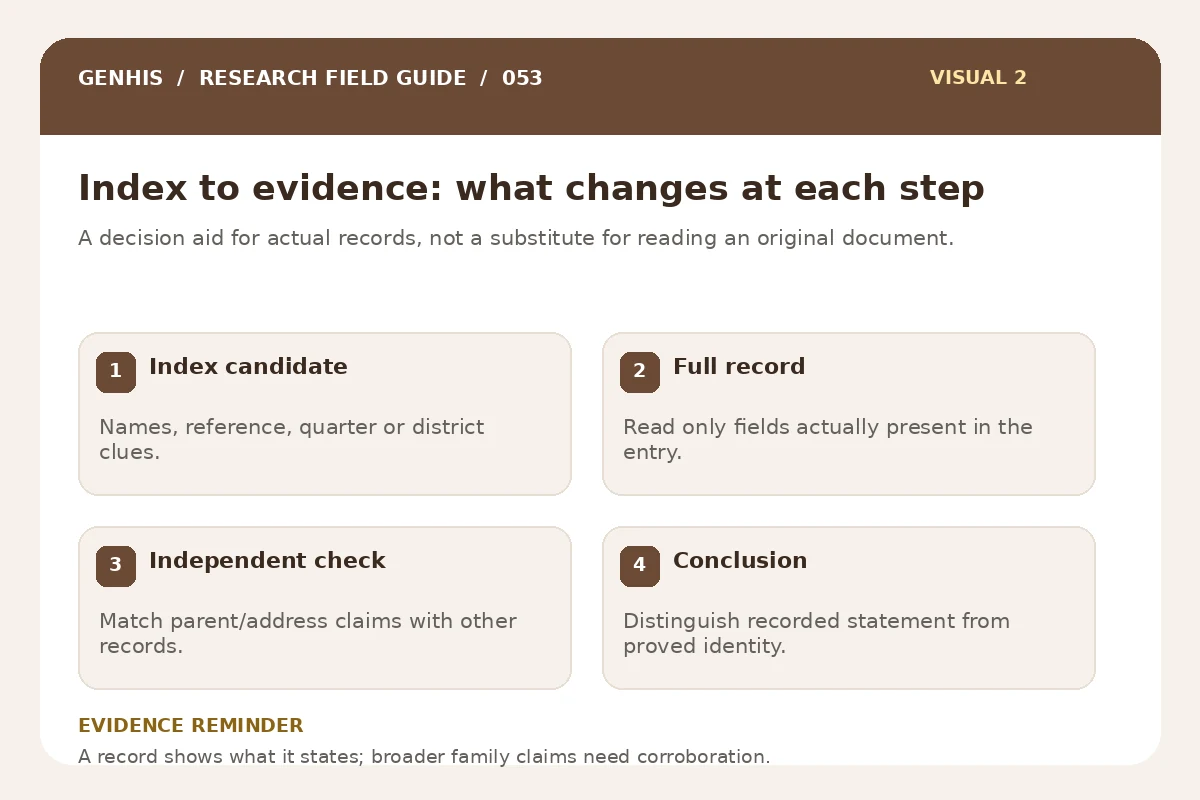
Order the right documentary evidence and read the full entry
GRO guidance distinguishes the public index from a full birth certificate. A full certificate carries more recorded details than a short version, including parentage fields when present; the source warns that a short certificate does not provide parentage details. The historic GRO Online View and PDF products apply to specific eligible historical births and deaths, not to every record type or date. Price and delivery options change, so read the current GOV.UK ordering page immediately before requesting a product instead of relying on a copied fee schedule. Our walkthrough on how to find probate records in England before and after the 1858 court change sets out each step.
On the obtained record, extract the child’s name, birth date and place, named parent or informant information, registration date, district, registration number or reference, and any amendments only if those fields actually appear. A recorded father or mother is an assertion in that record, not automatically verified biological parentage. Compare with marriage evidence, baptism, household records, or later family documentation. When a birth registration is absent, state the exact index years and variants searched; do not presume the individual was never born or that the family never registered an event.
| Decision point | Recommended research action |
|---|---|
| Before July 1837 | Search parish and religious registration sources. |
| After July 1837 | Start with England and Wales GRO civil indexes. |
| Borderline date | Run both pathways with uncertainty noted. |
| Outside England | Check the correct country or overseas series. |
Disambiguate repeated names with a birth-evidence matrix
Take a hypothetical Mary Taylor whose later census suggests an 1862 birth in a Lancashire town. Your first index search might return multiple Mary Taylor registrations in neighboring districts during different quarters. List all likely candidates rather than selecting the first. Check a securely linked sibling or parents’ marriage for a district clue, and compare later locations. If one candidate has a documentary contradiction, write it down as well as supportive facts. Distinguish what an index actually states from a conclusion you reached about a living family group.
The useful outcome is a short ranked plan: candidate A needs its full GRO entry, candidate B is inconsistent with a confirmed address, and candidate C remains possible. If only a parish baptism is available for an earlier event, treat it as baptism evidence and find independent support for the birth connection. A mother’s maiden surname from an index may narrow possibilities, but it cannot alone prove that the indexed child is your ancestor. Avoid joining a public family tree to the first plausible match when competing people share names and ages.

Preserve documentary context and restrict recent personal data
Cite the institution, record class, person’s name as spelled, date or registration quarter, district, and precise index or entry reference. Record whether you inspected an original register image, an official derivative image, a certificate, or a transcribed index. When using a parish book, preserve the parish, denomination if known, archive call number, page, and your transcription uncertainties. The GRO and parish repositories have different coverage, so combining their records under a single citation label hides the provenance required for later checking. To go further, our guide “Somerset Birth Records” shows how to use GRO registration quarters and parish baptisms.
Birth records can concern people who are still alive or include living parents. Although some certificate routes are legal, don’t republish sensitive contemporary details, make surprise contact, or expose individuals in a searchable family tree without consent. The GOV.UK guidance lists restrictions for recent-event orders. For historical genealogy, prefer older sources and remove identifying details of living people from shared examples. Never convert a plausible association into a biological relationship without clear, adequate evidence.
How We Research: map dates, documentary scope, and uncertain conclusions
We compared the National Archives historic registration boundary with the GRO’s current index and product guidance. We deliberately distinguish a civil index locator from a certificate, a parish baptism from a birth, and recorded parental names from independently corroborated identity.
Authoritative sources and collection-specific limitations
www.nationalarchives.gov.uk — institutional source. TNA sets 1 July 1837 start and separates GRO civil certificates from earlier parish registers.
www.gov.uk — institutional source. Official GRO guidance explains public index, historical search, short versus full certificates, and online-view limitations.
www.gov.uk — institutional source. GOV.UK gives the official certificate application route for England and Wales.
More Records and Archives Guides
Privacy, disclosure, and responsible interpretation
This guide focuses on historical England and Wales documentation, not proof of legal parentage or living-person identification. Availability and charges vary; consult the responsible registrar before any order and protect contemporary family data. These archives and public services are cited independently; none is a paid partner or an endorsed affiliate. Read the GenHis affiliate disclosure for site policy.
Civil registration began in England and Wales on 1 July 1837. For earlier dates, look for parish baptism and related evidence.
Not necessarily. It records a baptism unless it explicitly supplies a separate date of birth.
No. An index is a finding aid; full official records and eligible historic digital products have separate access arrangements.
A short birth certificate does not include parentage details. Check the current official options for a full entry.
Compare registration districts, other known records, and the full entries rather than choosing by name alone.