
Illogan parish records provide a route to baptisms, marriages and burials in a Cornish parish, but a database hit is not automatically an image of a register. Begin at the Illogan Cornwall Online Parish Clerks page, identify the kind and date of entry, and then determine whether it came from an original parish book, a bishop’s transcript or a later transcription. Compare families using residences, occupations and neighboring parishes rather than matching a surname alone.
Choose baptism, marriage or burial before running a name search
The Illogan OPC page points to a searchable Cornwall database and supplies context for other local documents. Decide what event you are trying to document. A baptism may record a child and parents but not an exact birth date; a marriage entry can reveal witnesses without proving the spouses’ parents; a burial records an interment and not necessarily the date of death. Searching all these categories together may produce apparent duplicates that are really different events involving several related people.
Begin with the most tightly dated family fact, such as a census age combined with a birthplace or a marriage already documented in a civil index. Search surnames with spelling variants and leave the given name flexible when dialect, handwriting or indexing may affect it. Note the date range searched and which result types were included. Illogan entries are not a complete proxy for the wider Redruth and Camborne area; people may have worshipped or married across parish boundaries.
Read Illogan OPC coverage before treating a year as absent
The Cornwall Family History Society provides separate coverage descriptions for Illogan baptisms, marriages and burials, and warns that shown year ranges may contain omissions. The OPC database may incorporate parish registers, copies, or records derived from several origins. A first and last year in an index is not proof that every intermediate entry survives or was indexed. Before reporting no baptism in 1815, inspect the relevant year and the collection’s stated source type. For a related choice, see our guide “Bedfordshire Parish Registers”.
Make a coverage ledger containing record class, year, the database or book examined, original or copied status, and what was missing. Bishop’s transcripts were contemporary copies prepared for ecclesiastical oversight; they can rescue a damaged or missing parish page but can also introduce copying errors or different spellings. Conversely, a digitized parish register may include marginal notes that a plain transcript omits. Coverage must be assessed at record-series level, not simply by whether a website shows an Illogan search box.
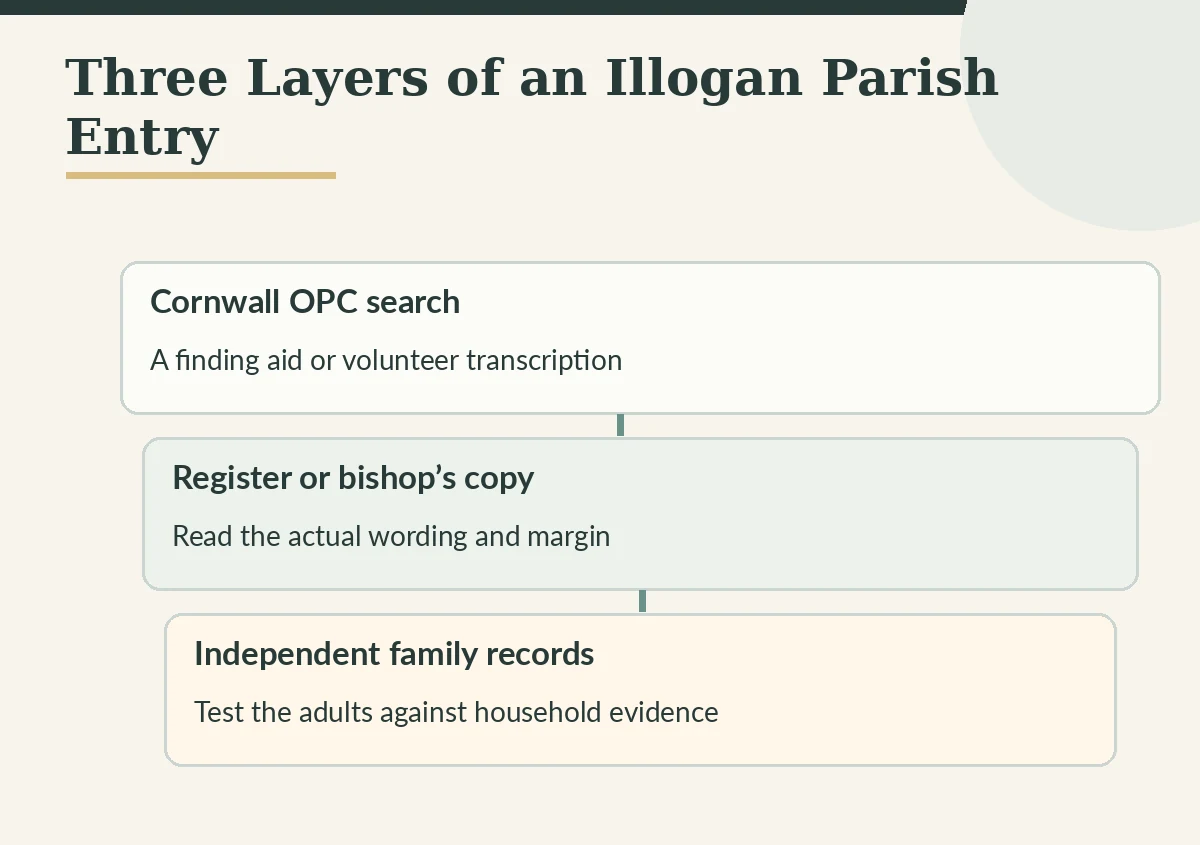
Follow a transcript back to Kresen Kernow or a record image
The Kresen Kernow archival catalogue can be searched by document reference, term, place or subject. The Illogan OPC page also advises that images of many Cornwall parish registers may be viewed through FamilySearch, subject to the individual collection’s access. Record the archive reference provided by the index and check whether the object is an original register, a contemporary transcript or a published extract.
When viewing a handwritten page, include the neighboring entries in your notes. A cluster of entries written in the same hand may help decipher a name, and a repeated residence or occupation can test identity across events. Do not automatically replace the original spelling with a modern standardized surname. If a film is available only at a research center or an archivist must provide a copy, state the access constraint instead of implying that every visitor can download it at home.
Distinguish eighteenth-century parish marriage from a civil certificate
Illogan church marriage registers may provide a marriage date, parish affiliation, marital status, witnesses, signatures or marks and, depending on period, additional particulars. They do not always name both sets of parents. English and Welsh civil registration began in July 1837; for a later event, use the civil index to locate a marriage certificate and compare the statutory entry with the church book when both survive. The records answer overlapping but not identical questions. Our guide “Dorset Parish Registers” covers a related question.
If a couple appears in banns, that is an intention or announcement, not conclusive proof a wedding took place. Look for a ceremony entry and corroborating later household or baptism records. Likewise, a shared witness surname does not alone establish siblinghood. Keep each witness as a separately labeled associate until a baptism, probate document or household link demonstrates the relationship. This method reduces false parent assignments when Illogan families reused a small pool of forenames.

Use Methodist and neighboring-parish sources for missing Illogan baptisms
Cornwall had substantial nonconformist participation, and the modern archivist’s holdings include Methodist and other chapel records. An absence from the Church of England Illogan baptism book may be explained by a chapel baptism, a neighboring parish, emigration or a genuinely lost leaf. Ask first whether the presumed parents lived in Illogan at the proposed event date. Then check adjacent parish resources such as Redruth, Camborne or Gwennap where geography and documentary evidence justify the route. For a related choice, see our guide “Finnish HisKi Church Records”.
A family may appear in an Illogan burial list while its children were baptized elsewhere. Create two columns for denomination and geographical parish and do not silently merge them. Search chapel records under the circuit as well as the village; the administrative location of a Methodist volume can differ from the family’s local chapel. Also review Illogan OPC’s pointers to churchwardens’ accounts, poor-law material and named wills, which may place a person in the locality without proving an exact birth.
Resolve two Illogan namesakes with household and document clusters
Suppose a fictional William Harris appears in two Illogan baptisms several years apart and the index lists both fathers as James Harris. Start with mothers’ names, residence descriptions, occupation and siblings rather than attaching both baptisms to a single couple. Follow each parental unit into census households, marriage witnesses or probate evidence. A repeated family name is a search clue, not a reliable biological link; multiple Harris households may coexist in the same parish. For the next step, our guide “St Matthew Bethnal Green Parish Registers” explains how to find London baptisms and burials.
Document each candidate in a comparison grid: indexed date, exact original text, parent or spouse, residence, denomination, source repository and contradictory facts. Treat unreadable names as unknown instead of inserting the desired family member. Negative evidence becomes useful only after considering the survival and access of the relevant church and chapel sources. Even a correctly read baptism does not by itself prove that the child later used the same name as the adult in your family tree.

Cite Illogan events at the level of the original page
An adequate citation for a scanned register includes parish, event type, entry date, person, register span, page or image number, archive or custodian, and the website or film by which it was viewed. If only a Cornwall OPC transcript was available, cite that transcript and describe it explicitly as a derived source. When a later image gives a different name, preserve both readings in your notes and explain how the original changed your conclusion.
Keep copies or stable links to the result and record the date of your search, but avoid treating changing online row numbers as permanent archive references. The decision to expand your search should follow the open question: if a marriage witness is ambiguous, seek the witness’s own household; if a baptism is absent, inspect chapel and adjoining-parish coverage; if a date conflicts, compare original entries. Each next step should test an identifiable claim.
More Records and Archives Guides
How We Research Illogan Parish Registers
We checked the Illogan-specific Cornwall OPC guide, Cornwall Family History Society coverage page and Kresen Kernow archival catalogue. We separate indexed rows, original church books and bishop’s copies, and do not assert complete coverage for every year. No paid access or affiliate partnership is assumed; see our affiliate disclosure.
No. Coverage and missing years vary by event type and the source represented in each transcription set.
Usually it is an index or transcription. Check the stated source and seek a surviving register image or archive volume.
A contemporary church copy of register entries that may preserve missing details or contain copying differences.
No. Find a solemnization entry or other independent proof of the ceremony.
Inspect Methodist circuit material and relevant adjacent parishes after checking the parent family’s residence and the index’s coverage.