
The 1881 census for England and Wales records households on the night of April 3, 1881. It can identify a person’s reported parish or county of birth, age, occupation, marital status and relationship to the head of the household. The National Archives classifies the returns as RG 11. For a defensible match, open the original enumerator page, capture its piece, folio and page, and compare occupation and birthplace with a second dated source. Neither a matching surname nor a stated relationship makes a biological connection automatically proven.
Search an 1881 household and preserve its RG 11 reference
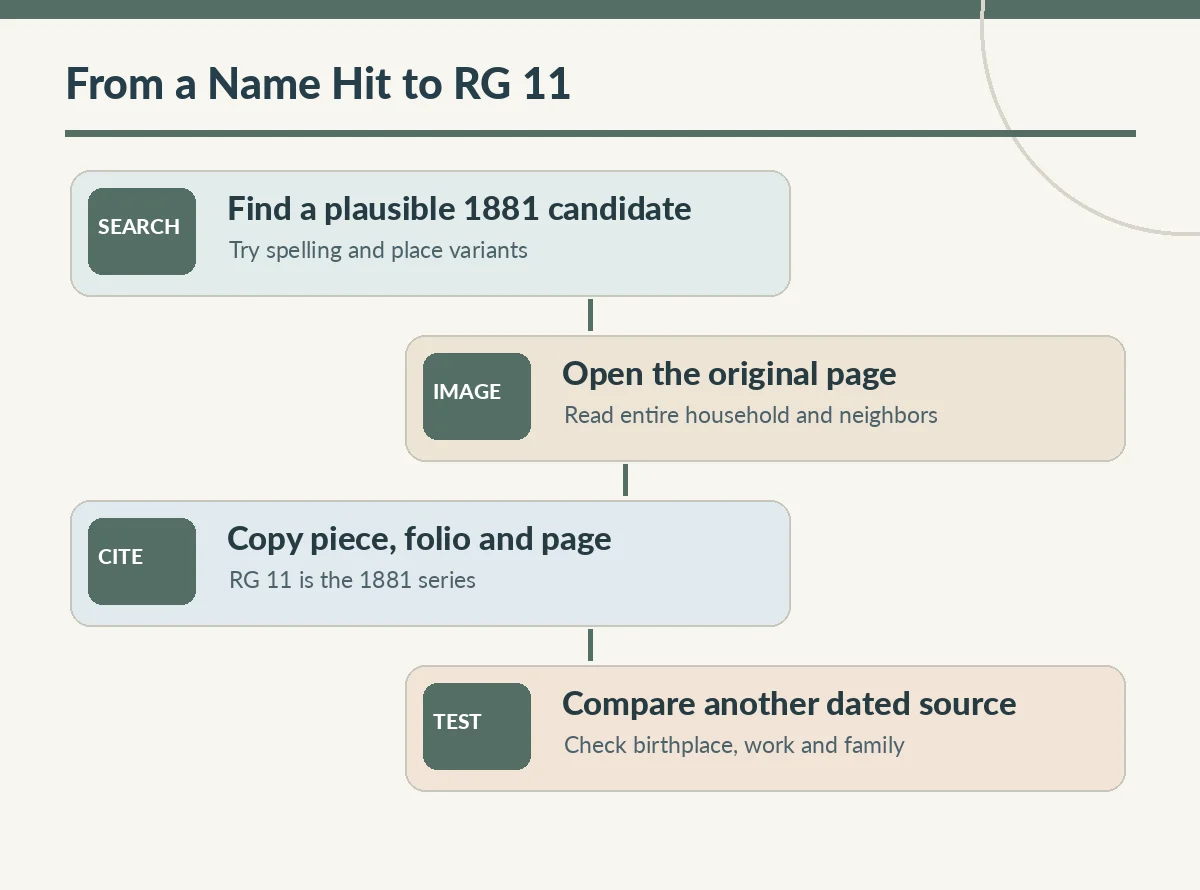
Begin with one anchored fact: a documented marriage location, a birth registration or a 1871 census address. Search an 1881 name index with spelling alternatives and a flexible birth year, then inspect the image for district and household context. The National Archives’ census guide identifies RG 11 as the 1881 series. Record the piece number, folio and page in addition to parish, address, household and image source; the transcript’s record ID alone may not survive a change of website.
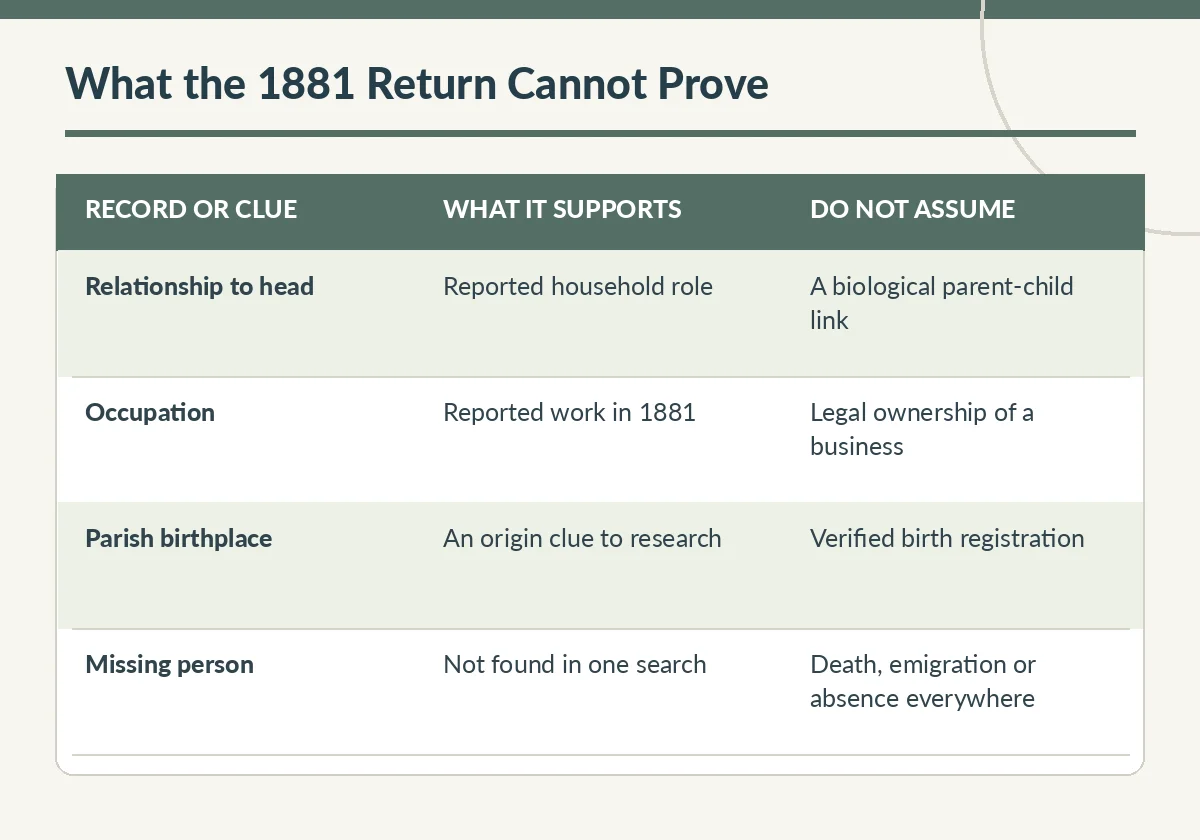
Read across all lines belonging to one dwelling and check the preceding or following page when the list continues. A census household can include boarders, visitors, apprentices, servants and unrelated workers. The relationship column usually describes the person’s relationship to the head as reported for this enumeration, rather than proving a biological parentage. Two neighboring people on a page can belong to different dwellings; don’t create a family unit simply from adjacent names. Our guide “1891 England and Wales Census” shows how to read RG 12 work and Welsh language clues.
Read reported birthplaces at the locality level shown
The 1881 birthplace column can point to a parish or town as well as a county, depending on the enumerator and informant. Transcribe the exact wording, including abbreviations and apparent spelling mistakes, before converting it to a present-day place. An entry ‘Yorkshire’ is much less precise than a named parish, and an ‘Ireland’ birthplace does not identify a county. Check whether the place was a residence or an origin term used by the household member, and compare it with the person’s 1871 and 1891 responses.
If two similarly named Sarah Browns both report Lancashire birth, look for an independently sourced spouse, child, trade or address. One birth location repeated across censuses increases confidence only if the records also agree on other identity anchors. A conflicting birthplace may come from a different informant, a transcription error or a different person; note the conflict rather than erasing one of the two entries. A census birthplace is a lead toward baptism or civil registration, not proof of birth there. Our guide “1861 England and Wales Census” covers how to find households in RG 9 records.

Treat the occupation column as a dated report
Occupations can be unusually useful for distinguishing namesakes, especially when two adults share the same approximate birth year. Read the printed occupation heading, then transcribe the trade or status as written, including qualifiers. A ‘scholar,’ ‘servant’ or ‘widow’ label does not in itself establish income, employer or the history of a trade. Professional titles change across decades, and an apparent sudden shift may reflect ordinary career change rather than an identity error.
Compare the 1881 description with a trade directory, apprenticeship record, marriage certificate or later census when available. Document the edition or event date of each comparison. A directory listing can establish that a named business advertised at an address, but it may not prove the worker lived there in 1881. Do not infer that a person reporting an agricultural occupation owned the land. When a trade name is unfamiliar, consult a historical occupational glossary but mark the modern gloss as interpretation rather than a transcription.
Use folio and page correctly when citing an RG 11 entry
A properly reusable 1881 citation should include ‘England and Wales census, 1881,’ county/parish or registration district, household address, RG 11 piece, folio and page, plus the image repository and date accessed. The folio number is a reference mark on a leaf and can cover two page sides; the printed page number is a separate field. Do not replace the folio number with an online image counter. If a page is unnumbered or damaged, capture the available archival and household markers honestly.
A practical acceptance test is to hand the citation to a second researcher: can they locate the same page without your saved browser search? If not, inspect the image border, transcript citation and catalog description again. For a page where handwriting is ambiguous, keep literal and interpreted readings distinct. Refer to RG 11, not RG 10 (1871) or RG 12 (1891), even if an index provider groups years under one landing page.
Check census-night presence without inventing a family departure
A census names people as recorded on a specific night. Someone missing from the expected home may have been a live-in servant elsewhere, staying with relatives, traveling, working away or omitted. Before interpreting absence as death, emigration or marital breakdown, look for that person’s name separately in other 1881 districts. Also check workhouse or institutional enumerations when independently relevant, taking care not to infer a diagnosis or criminal history merely from an institution heading. Our guide “1901 England and Wales Census” adds more detail on this.
If no indexed hit appears, broaden the search to surname variants, a spouse or child, and a district-first browse. Different indexers may read handwriting differently. Consult the National Archives census guidance for historical coverage and reference conventions; avoid stating that all names are equally searchable on every platform or that every person was enumerated correctly. A documented failure should say which districts and pages were examined, not simply ‘not in 1881.’
Reconcile two plausible 1881 matches against 1871 and 1891
For a fictional William Hughes born about 1849, make two candidate rows rather than selecting the first search hit. Compare their 1881 spouses, children’s names and ages, streets, work descriptions and detailed birthplaces. Put separate dated columns for 1871 and 1891 data; a plausible family migration can explain a new address, but only corroborating records can connect it. If a child’s estimated age conflicts with a birth certificate, the independent certificate may be stronger for the event date.
Keep the rejected or unresolved candidate and the reason for that decision in the research log. A surname, birthplace county and approximate age do not uniquely identify a person in an industrial town. Prefer the candidate with several independent consistent links; if both remain plausible, list the next decisive record, such as a civil marriage or birth certificate that identifies a spouse or parent. This is a proof-oriented search, not a forced fill-in of missing generations.
More Records and Archives Guides
How We Research the 1881 England and Wales Returns
We checked the National Archives census research guide for the exact RG 11 series assignment, record-reference structure and the role of original enumerator books. We compared the existence of name-search access with the official source limitations, rather than suggesting an index result equals an original image. The Hughes comparison is invented purely to demonstrate a namesake test; no particular household or archival result is asserted.
A precise original-page citation and independent event record should precede a permanent family-tree claim. This article does not endorse a subscription database or assert paid access is necessary. See our affiliate disclosure for general policy and verify any provider’s current image-access terms at the point of use.
RG 11 at The National Archives, not RG 10 (1871) or RG 12 (1891).
The census night was April 3, 1881; the entries report that period, not permanent residence.
Sometimes a parish or town is stated, but many entries are less precise and all are reported clues needing corroboration.
No. It describes reported work or status on the census; use deeds, directories and trade documents for separate claims.
Include the place and household, RG 11 piece, folio, page and the source of the image or transcript.