
South Australia’s State Records holds registers and teacher history sheets for government teaching staff, including GRS 9084 and GRG18/167. These are employment records: they are not school admissions lists and they should not be confused with a child’s pupil record. An employee may have worked at several schools and under more than one surname. Begin with a named teacher, an approximate service period and, if available, an appointment location.
Identify the teacher rather than the schoolchild
The archives explains that the government began stipends for teachers in 1847 and regular salaried employment developed with compulsory schooling in 1875. The history sheets considered here chiefly cover the twentieth century. They answer a narrower question: which service entries can be located for this adult educator? They do not promise a continuous biography, a personnel dossier or proof of where every member of the teacher’s family lived.
Choose GRS 9084 or GRG18/167 on evidence
The official teacher guide provides alphabetical surname indexes for GRS 9084, teachers’ history sheets indexed for 1915–1965, and GRG18/167, a separate collection indexed for 1915–1962. Search both as appropriate, because an identical surname may lead to different administrative record streams. Capture the full personal name, relevant index reference and exact series, not merely the web page where the name appeared.
An alphabetical hit should be treated as a pointer to a sheet or unit to be requested, not as a full digitized employment history. If a candidate cannot be distinguished by forename, ask what other initials, schools or dates are recorded before ordering copies. Keep one line per series and archival reference; do not combine information from two equally named teachers before reviewing their original entries.

Inspect an original history sheet for service changes
The State Records guide says employee registers and sheets are the most common records it holds for teachers; comprehensive personnel files are rare. Once access is granted, transcribe the dated service entries in their recorded order. Observe how the archive labels positions or schools, and note any uncertainty caused by abbreviations, cancellations or later annotations. Preserve the original dates even when they do not fit a family timeline.
A staff sheet may document an administrative assignment but not necessarily a permanent household move. A teacher might transfer, commute, take leave, or work in a locality without relocating dependents. To test residence, compare the specific service entry with an independently dated electoral roll, address directory, correspondence or family record. Record the difference between “employed at this school” and “lived at this address.”
Check the 60-year access rule before requesting records
State Records advises that files containing personal, financial or disciplinary information are typically open to general public access after 60 years; less detailed material may open sooner. That is a general access description, not blanket permission for every document in every unit. A name in an index does not establish that the corresponding original is currently available to all researchers.
Before requesting a sheet, check the catalogue item’s public-access determination and any conditions concerning living people. When asking an archivist for help, include the series number, name, date range and index result. If an item is restricted, follow the archive’s legitimate access process rather than asking another service to disclose it. A missing sheet may reflect custody, indexing or restrictions, not proof that the employment never occurred.
Use earlier teacher registers only when the period demands it
For a teacher whose career predates the selected sheets, the same official guide identifies the register of public school teachers for 1859–1920 (GRG18/120), registers of teachers for 1880–1910 (GRG18/90), and student or pupil teacher sources. These are distinct collections and should not be represented as portions of GRS 9084. If your named relative taught in the 1890s, an earlier register may be more informative than forcing a late index.
The guide also describes records of student teacher agreements for 1892–1923 and returns from schoolmasters to the Colonial Secretary for 1847–1851. Each answers a different question. An agreement can identify the trainee and signatories, while a government service register describes professional administration. Check the person’s life stage and the record creator before expanding a search. Do not infer teacher certification from a pupil-teacher reference alone. Our guide “Victoria Teacher Service Records, 1863–1959” covers a related question.
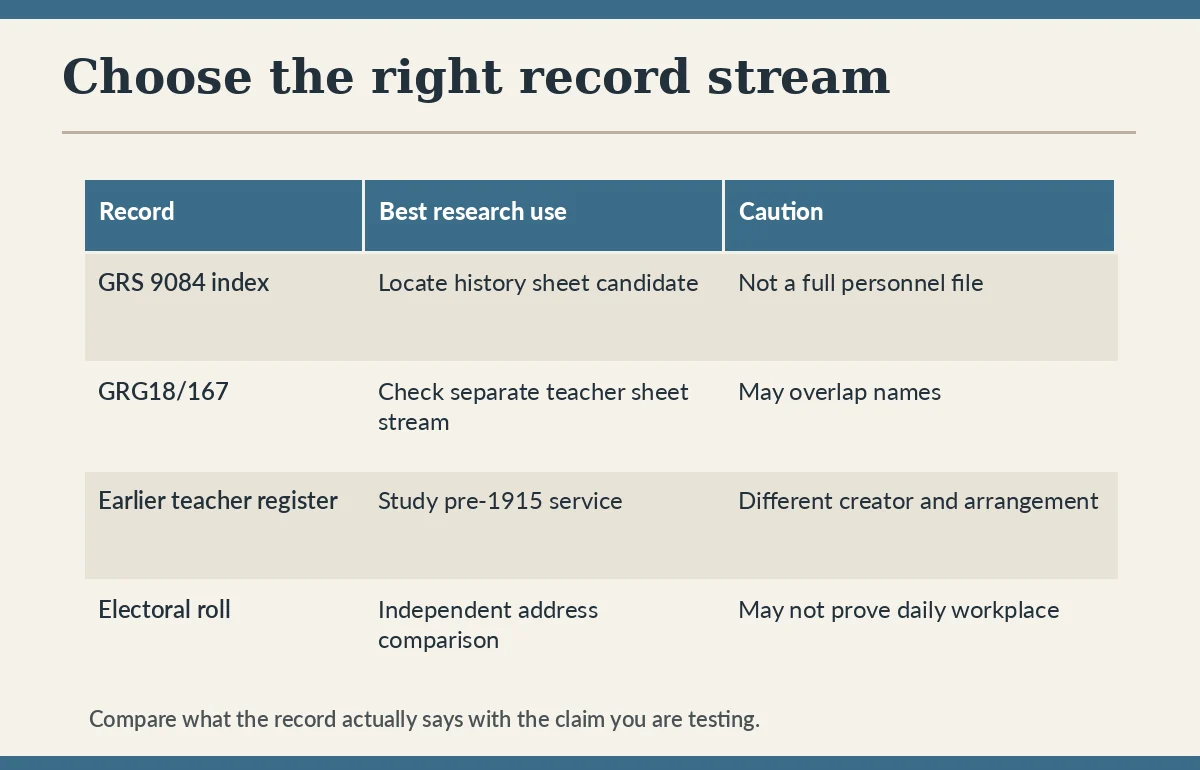
| Record | Best research use | Caution |
|---|---|---|
| GRS 9084 index | Locate history sheet candidate | Not a full personnel file |
| GRG18/167 | Check separate teacher sheet stream | May overlap names |
| Earlier teacher register | Study pre-1915 service | Different creator and arrangement |
| Electoral roll | Independent address comparison | May not prove daily workplace |
Test a fictional transfer without creating a household migration
Imagine a fictional sheet for Elizabeth Turner showing teaching assignments at two named schools in 1926 and 1931. This example is invented solely to demonstrate evidence evaluation. The first conclusion is that the sheet reports a change in appointment; it does not by itself establish that Elizabeth’s spouse or children moved. Save the exact school names as written, recording the series, unit and dated entry for each assignment.
Next, consult a contemporary voter roll or directory under plausible married and birth surnames. If an address record conflicts with the later school appointment, retain both observations rather than rewriting either date. The next search might be a school return or a separate employment entry. This creates a testable timeline and avoids treating a single administrative source as a census of the entire household.

Cite the archive and disclose what you did not inspect
A retraceable reference names State Records of South Australia, the appropriate series (GRS 9084 or GRG18/167), any indexed unit or consignment, the recorded name, dates and whether your evidence comes from an index or an original sheet. If an item could not be viewed, label the result as an index-level lead. Keep any archive access correspondence with your private research notes. Our guide “NSW Teachers’ Rolls, 1869–1908” adds more detail on this.
When publishing, prioritize historical service facts relevant to an ancestor and be cautious with personnel details affecting living people. A school history benefits from documenting a teacher’s actual posted service; it does not benefit from invented motives, assumptions about disciplinary notes, or descriptions of relatives who were not named in the record. Our guide “South Australia Police Personnel Records” adds more detail on this.
How We Research South Australian Teacher History Sheets
We compared the archive’s own descriptions of this collection and its finding aids on 2026-10-22, mapped known time and coverage limits, and distinguished administrative observations from genealogical inferences. The worked names are fictional and explicitly illustrative. The steps describe how to verify a record rather than claiming we inspected an ancestor’s personal file. This guide is educational, not legal or professional archival advice; confirm access conditions and source images with the repository before relying on an individual record.
More Records and Archives Guides
Archive Collections and Finding Aids for South Australian Teachers
Primary government guide for series, indexes, teacher-record scope and access conditions (archives.sa.gov.au).
State Records’ catalogue for confirming item arrangement and current access (catalogue.archives.sa.gov.au).
State Records routes educators to the appropriate employment collections (archives.sa.gov.au).
Editorial disclosure: This independently prepared research guide contains no sponsored recommendations or affiliate purchase links. View the GenHis affiliate disclosure for the site-wide link policy. Avoid publishing sensitive information about living people; copyright and archival restrictions may apply.
The official guide identifies GRS 9084 for 1915–1965 and GRG18/167 for 1915–1962.
State Records says comprehensive personnel files are rare; history sheets and registers are more typical.
No. A school appointment records employment, not necessarily household residence.
Access can be restricted; check the item’s determination and the archive’s 60-year guidance.
Try earlier series such as GRG18/120 or GRG18/90 using the official teacher research guide.