
Unassisted in a passenger-list catalogue means the traveler generally paid for passage; it does not mean the person arrived alone. The State Library of New South Wales describes unassisted passenger collections covering 1826–1922 and lists two useful online indexes for narrower ranges. Early entries can be brief, unevenly indexed or accessible through a library resource rather than a fully free public image. The practical challenge is to locate the right ship and date and decide whether a likely passenger could be the documented ancestor. Use this guide to avoid equating a name match, a shipping notice and a verified arrival record.
Classify the voyage as fee-paying before searching
Start with a documented or reasonably estimated arrival window and any known port or ship. The State Library defines unassisted travelers as people who could pay their own fare, but the definition does not reveal who funded an individual journey or whether the traveler had a sponsor. Compare the family story with later residence, marriage, employment or newspaper evidence. If an assisted migration scheme is named explicitly, select that separate collection instead. For an early nineteenth-century arrival, expect uneven detail and perhaps only a ship movement rather than a full nominal list. Record which research path you chose and why; this will matter if two indexes return different candidates.
Understand what the 1826–1922 collection label covers
A library’s collection date range describes material gathered across years, not a promise that every voyage and name has an equally searchable index. The State Library’s unassisted guide points to a collection for 1826–1922 and narrower indexes for 1842–1855 and mariners and ships for 1854–1900. An index for ships is not equivalent to a complete roster of passengers. Before entering names, look for the series description, access route and whether the result is a transcript or image. If the database sits inside an institutional subscription, state that in your own notes instead of announcing that all records are freely viewable. Preserve the scope note and date viewed. For a related choice, see our guide “Victoria Unassisted Passenger Lists, 1852–1923”.
Search ships and ports when the surname route fails
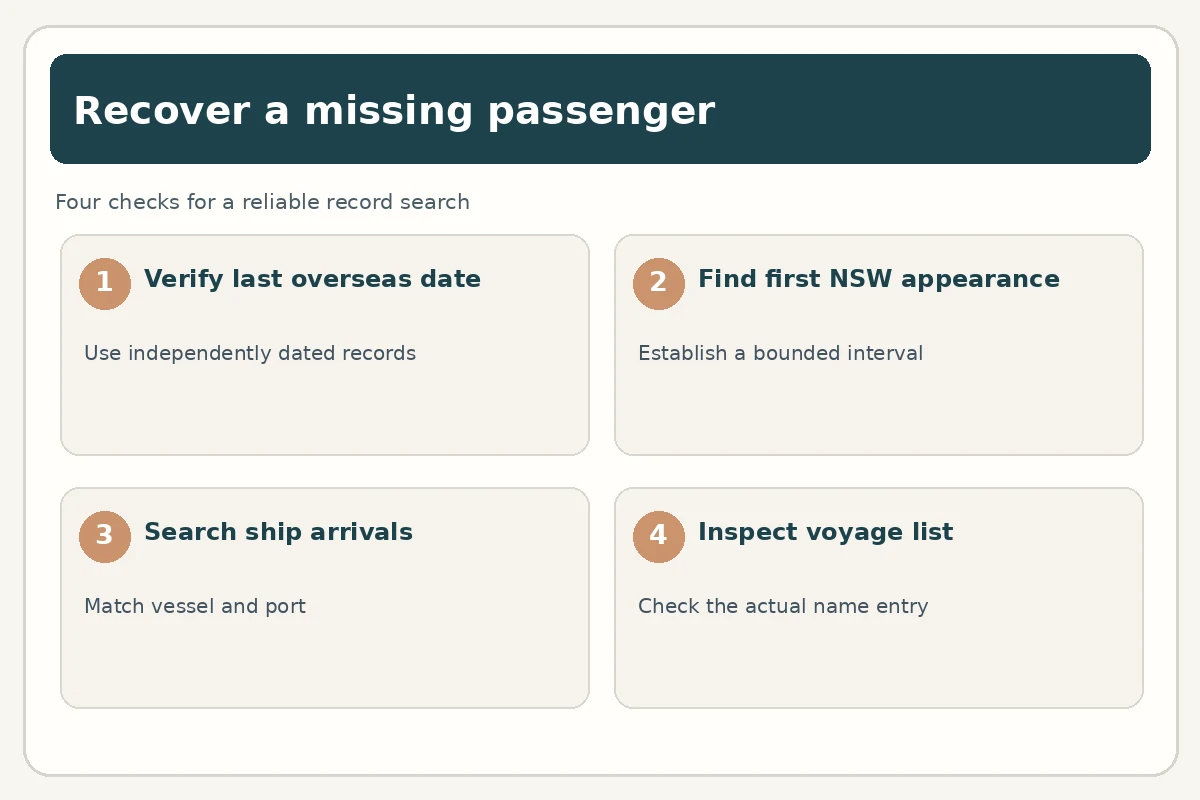
Run a broad name search using surname variants and initials. If no entry appears, rebuild the likely arrival interval from an independently documented first appearance in NSW and the last known residence abroad. Consult contemporary shipping intelligence in newspapers, port arrival registers and the library’s mariners-and-ships tools. A ship notice may tell you that a vessel docked, not that a particular person boarded it. Use the notice to identify ship spelling and arrival date, then seek a passenger-list page for that voyage. Distinguish a date a newspaper published a notice from the day of arrival and from a later transcription date. These distinctions make a negative search much more informative. Our guide “New Zealand Ship Passenger Lists, 1839–1973” goes into more detail.
Read the passenger class and other fields cautiously
A list may show cabin or steerage status and sometimes an occupation, age, native place or fellow travelers; the State Library notes that information varies and may include shipboard circumstances. Class of travel cannot, on its own, prove a person’s later social standing or legal status. An occupation on arrival may be self-reported, abbreviated or misheard. Treat a native-place field as the term recorded by the clerk, not automatically the person’s birthplace, citizenship or cultural identity. Where original handwriting is visible, transcribe it faithfully with uncertain letters marked. A derivative database can normalize spellings; record those differences alongside the original line rather than silently selecting one.
Separate family stories from the documented travel party
Family tradition may describe “two brothers arriving together,” while the image names one man, several anonymous passengers or people with unrelated surnames. Do not treat a matching ship as proof of the family story. Identify the known traveler by triangulating documented age, first NSW address, occupation and subsequent marriage or burial. Keep a comparison table for same-named passengers who arrived in different years; annotate each with the source that does or does not support an identity match. When an apparent spouse appears adjacent in the passenger list, check whether the relationship is expressly recorded. If not, write “traveled on same ship” and continue searching for a marriage or other relationship record. Our guide “Queensland Unassisted Passengers” goes into more detail.

Use newspapers as clues rather than substitute manifests
Historic papers may publish “shipping intelligence,” passenger-name snippets or notices about vessel movements. These are useful for reconstructing an arrival window but were not always complete passenger lists. A shipping column might omit travelers in steerage or provide initials instead of full given names. Compare the paper’s publication date to the ship arrival and identify the newspaper edition so the information is traceable. If the archival list disagrees with the newspaper, record both without assuming one is always correct. The critical question is whether the paper names the person, names only the ship, or merely repeats another report. Each supports a different level of conclusion. Our guide “South Australia Passenger Lists, 1836–1940” goes into more detail.
Cite the record collection and the exact voyage together
Build your reference from the archive or library holding the material, the index or series title, ship, arrival port and date, the passenger’s name as written and the page or image location. Where a subscription site provides access to a historical scan, record its derivative database name separately from the underlying custodian. If you keep downloaded copies, maintain an unedited original image and identify any crop or contrast adjustment as a working image. Log searches that produced no results, including dates and databases checked, so you do not repeat the same failed query later. A citation that preserves the ship name is especially valuable when names are spelled inconsistently. Our guide “NSW Assisted Immigrant Passenger Lists, 1828–1896” shows how to find the original ship record.
Choose the next collection after an inconclusive search
An absent passenger may have arrived through a different Australian port, traveled under a variant surname, disembarked on an intercolonial coastal leg or used an assisted scheme. Compare the State Library’s separate assisted records and the National Library’s shipping overview before widening beyond NSW. Avoid jumping straight to claims of lost records without checking the repository’s own coverage note. If the earliest NSW address predates your proposed voyage, revise the hypothesis. If an entry cannot be found, leave it as an open question and identify the next search: vessel evidence, arrival port, employment or marriage record, or return visit. The objective is a defensible route to evidence, not a forced match. For a related choice, see our guide “Victoria Assisted Passenger Lists, 1839–1871”.

How We Research Historical Passenger Records
We based the access and date-range explanation on the State Library of NSW’s unassisted guide and checked the distinct shipping-records overview from the National Library of Australia. Our workflow distinguishes vessel reports from nominal arrival evidence and avoids inventing an uninterrupted 1826–1922 name index. The diagrams illustrate a search logic rather than reproducing protected passenger documents.
More Records and Archives Guides
Official Record Collections and Research Sources
State Library of NSW defines an unassisted passenger as a fare-paying traveler and explains its 1826–1922 research collection (guides.sl.nsw.gov.au).
National Library of Australia lists repositories, series and approaches for Australian shipping and immigrant records (www.library.gov.au).
State Library of NSW provides separate assisted and unassisted passenger research routes, useful for choosing the correct collection (guides.sl.nsw.gov.au).
NARA outlines general genealogical record comparison practices, a methodological cross-check rather than a NSW collection custodian (www.archives.gov).
This search guide distinguishes fee-paying travelers from those supported by colonial schemes. Collection dates reflect repository coverage, not a guarantee that an individual voyage survives or can be viewed without a library login. Artwork is conceptual; the site makes no claim of partnership with the State Library. Consult the GenHis affiliate disclosure for transparency.
It generally describes passengers who paid for passage themselves; it does not establish that they traveled without family.
Not necessarily. Indexes, digitised records and library-subscription services have different access conditions.
The surviving item may be a vessel notice, incomplete list or index with different coverage from a full manifest.
No. A listed cabin or steerage category is a voyage detail, not a reliable measure of later wealth.
Compare multiple independent details, including dates, locality, occupation and subsequent records, not only a common surname.