
Irish genealogy becomes manageable when you begin with one documented person, one approximate date and one place—not a surname origin story. The 1901 and 1911 censuses cover the whole island, while the released 1926 census covers the twenty-six counties of the Irish Free State. Civil registration, church records and land valuations follow different rules and dates. Begin with the most recent reliably identified ancestor, copy the location exactly as written, and then work backward one generation at a time. The following route helps you choose records without treating a missing census as evidence that somebody disappeared.
Start with a documented Irish place and date
Write down exactly what your strongest existing evidence states: the individual’s name, a marriage or death date, an address, and the source of each detail. A family story saying ‘from Cork’ is not yet a parish or townland. A passenger list may specify only a county, while a marriage entry may record a residence rather than a birthplace. Preserve these distinctions in separate columns. If a year is approximate, create a range and keep the calculation visible, rather than converting an estimated age into an exact birthday. For the fuller picture, see our guide “County Cork Parish Registers”.
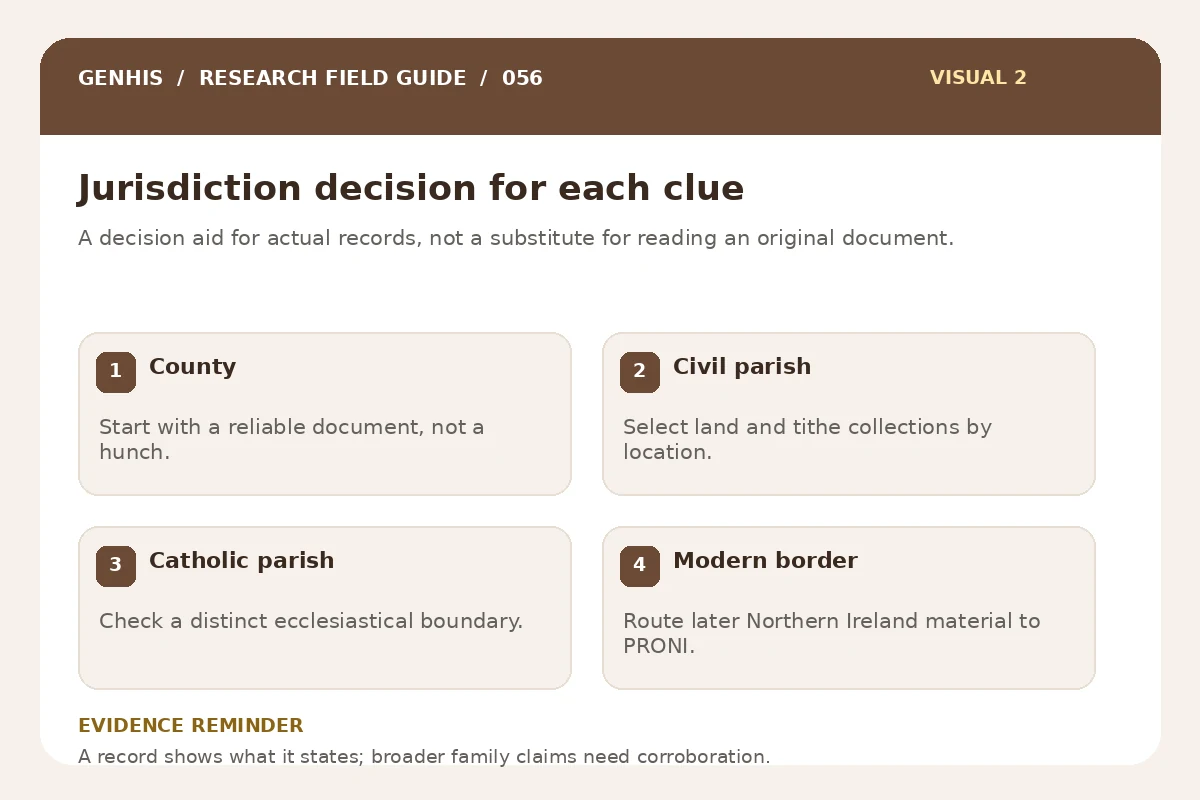
Ireland uses several overlapping geographic systems: counties, civil parishes, Roman Catholic parishes, townlands, poor-law unions and civil registration districts. A place written in one series may not be named the same way in another. Find the location on a period-appropriate map, then determine which church and state registration jurisdiction applied at the event date. For a person connected to the six present-day Northern Ireland counties, include Public Record Office of Northern Ireland (PRONI) resources rather than assuming Dublin holds every relevant item.
Choose the right census years and geographic coverage
The National Archives of Ireland offers surviving full individual returns for 1901 and 1911, covering the entire island. Its separate 1926 collection, released in April 2026, concerns the Irish Free State’s twenty-six counties. It cannot be searched as a 1926 census for Northern Ireland. Use 1901 or 1911 to establish household members, reported birthplace, occupation and neighbors, but interpret relationships as statements recorded on that census day, not conclusive proof of biological parentage or precise birth dates.
Most nineteenth-century Irish household census manuscripts have been lost or destroyed. National Archives guidance identifies surviving fragments from 1821 to 1851; no individual household returns survive for 1861, 1871, 1881 or 1891. This is a structural archive gap, not a failed search technique. Mark each missing year explicitly and substitute other contemporary records. A Griffith’s Valuation entry identifies a property occupier, not the list of family members a missing census would have provided. If you want the full process, read how to search Irish census records.
Use civil registration and parish entries for vital events
Civil registration of all Irish births, deaths and Roman Catholic marriages began in 1864; non-Catholic marriages entered civil registration from 1845. Search the official IrishGenealogy portal first for surviving historic index entries and register images, but check the portal’s current year coverage and privacy cutoffs before declaring a record inaccessible or absent. A birth entry may identify parents or an informant, while an index alone often supplies fewer details. Save the register image and its registration district rather than relying on a search-result snippet.
For earlier events, locate the actual denomination and parish, then inspect available church registers. The National Library of Ireland provides Catholic parish register images covering most parishes up to about 1880; those images are not a universal indexed list of every Irish birth or marriage. Parish boundaries, record-start dates and legibility differ. Church of Ireland and other denominations have different surviving collections. A baptism might support an identity hypothesis, but it does not automatically establish a precise civil birth date. If you want the full process, read how to find Irish ancestry records using civil, church, and local archives.
Recover locality clues from tax and land sources
The Tithe Applotment Books, generally dated 1823–1837, assess qualifying agricultural holdings and can help place an occupier in a civil parish and townland. Their geographic and social coverage is limited: towns, very small plots and people without qualifying holdings may be missing. Griffith’s Primary Valuation, published by county between 1847 and 1864, supplies property and occupier details for another period. Match the valuation’s parish, townland and holding reference rather than chasing only a common surname. Our guide “County Tyrone Tithe Applotment Books” adds more detail on this.
Treat an occupier as a person connected to a taxable property, not automatically the owner, head of a nuclear family or biological father of later residents. For Northern Ireland, PRONI’s valuation revision books can track changes in names and holdings in later decades. For other locations, check the relevant valuation-office and archival series. Land and taxation documents can form a bridge between surviving census years, but they require confirmation with church, civil, probate or address evidence.
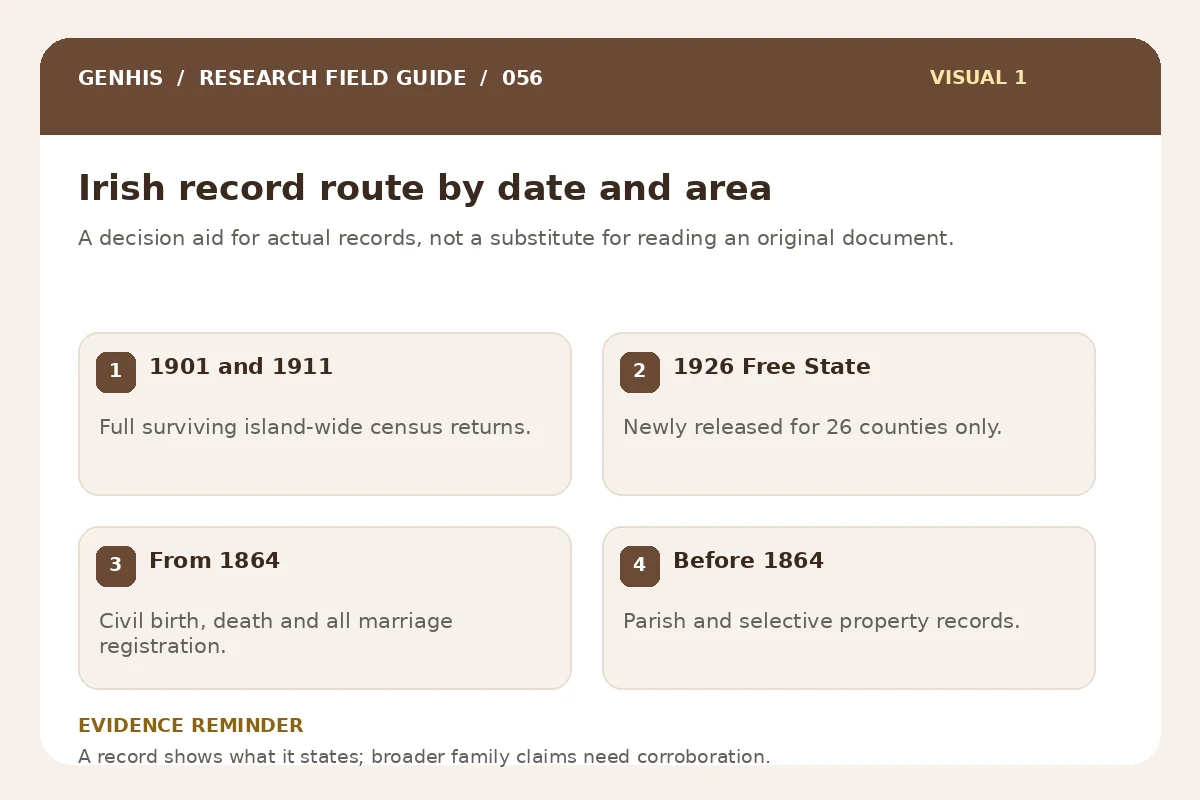
| Decision point | Recommended research action |
|---|---|
| 1901 and 1911 | Full surviving island-wide census returns. |
| 1926 Free State | Newly released for 26 counties only. |
| From 1864 | Civil birth, death and all marriage registration. |
| Before 1864 | Parish and selective property records. |
Apply a three-record identity test before linking generations
Consider a fictional Patrick Byrne appearing in an 1911 household and a similar name in a mid-nineteenth-century valuation. The shared surname is far too weak to assert a direct ancestor. Build a chronological ladder: first identify a parent on a documented marriage or birth record; then locate that parent in an independently identifiable residence; finally test the earlier holding’s location, occupation and chronology. The question is not simply whether two names match, but whether a plausible continuous identity survives conflicting clues. Our guide to Griffith’s valuation for genealogy covers a related question.
Score each candidate against age intervals, spouse, named witnesses, neighbors, townland spellings and surviving documents. Record direct statements in one column, inferences in a second and unresolved questions in a third. If two people remain credible, retain both instead of choosing whichever supports the family story. Note image reference, page and repository for each clue so another researcher can reproduce the comparison. This discipline matters especially in parishes where names repeat over generations.

Follow Northern Ireland and diaspora trails carefully
The island’s record geography does not align neatly with modern state boundaries. The census of 1911 predates partition; the 1926 Free State census does not include the six counties that became Northern Ireland. If a later residence lies in County Down or Antrim, search PRONI’s estate, land, directories and other historic collections as appropriate, and verify which vital-registration service currently holds the record. Records created before partition are not necessarily cataloged under the same modern agency as later documents.
Emigrant records can offer a route back from an overseas death certificate, naturalization file, passenger record or obituary to a named Irish county or townland. Do not infer Irish birthplace from ethnicity estimates, a modern surname distribution chart or another family’s unsourced online tree. Emigration can change names and claimed ages, so preserve variant spellings as search aids rather than facts. A targeted birthplace clue is a better next step than searching the entire island for one common surname. For a related choice, see our guide “1821 Fermanagh Census Fragments”.
Create a reusable Irish genealogy evidence file
Save a folder for each person or research question and include a one-page timeline, exact citations, image files, a candidate table and an unresolved-questions list. In the census citation, record year, county, townland or street, household and the National Archives image or archival identifier. In parish work, record denomination, parish, register, event date and image frame. A download without its collection label can become almost impossible to reidentify later, so keep the retrieval URL and date alongside the image. To go further, our guide “Irish Tithe Applotment Books, 1823–1837” shows how to find landholders by townland.
End each session with a practical next question, such as ‘Which baptism could distinguish the two Byrne households in this parish?’ Search one new record class or neighboring jurisdiction at a time, logging negative results with the fields and dates used. Do not confuse an index’s lack of a result with proof that an original entry never existed. Revise the working pedigree only when you can articulate the link from actual evidence, including conflicts that still need resolution.
How We Research: map dates, documentary scope, and uncertain conclusions
We used the National Archives census collection descriptions to separate the 1901/1911 island-wide collections from the 1926 Free State release, then cross-checked IrishGenealogy registration dates, NLI parish-image limits and PRONI holdings. The surname example is hypothetical and does not describe an actual lineage. Repository coverage is subject to revision.
Authoritative sources and collection-specific limitations
nationalarchives.ie — institutional source. National Archives distinguishes whole-island 1901/1911 census coverage and later census arrangements.
www.gov.ie — institutional source. Irish government confirms free online release of 1926 Irish Free State census on 18 April 2026.
www.irishgenealogy.ie — institutional source. IrishGenealogy gives civil registration start dates and current digitised historical availability.
registers.nli.ie — institutional source. National Library describes its Catholic parish register coverage and limits.
www.proni.gov.uk — institutional source. PRONI describes available Northern Ireland historic record categories.
More Records and Archives Guides
Privacy, disclosure, and responsible interpretation
These methods focus on historical evidence. Do not distribute protected civil records, data about living people or unverified family relationships. Faith, nationality and reported birthplace in historic records are contextual evidence, not proof of identity or ancestry. The Irish and Northern Irish repositories cited here are independent custodians; references do not imply a commercial agreement or archival endorsement. Read the GenHis affiliate disclosure for site policy.
Start with one verified event, date range and place, then choose census, civil, church or land records using the relevant jurisdiction.
No. The released 1926 census is for the 26 counties of the Irish Free State; the 1901 and 1911 census collections cover the island.
Compulsory general birth registration began in 1864. Check the official portal for current historical image access limits.
No. It principally documents taxable property and occupiers, not household relationships.
No individual household returns survive for that census year; use civil, church, land or other substitute sources.