
Ireland’s Tithe Applotment Books, compiled between 1823 and 1837, can identify the named occupier of an agricultural holding decades before many better-known land records. Begin with the National Archives of Ireland’s free name or place search, open the manuscript image and record its civil parish, townland and entry details. These books are a land-based tax source. They usually name occupiers rather than entire households, and they systematically exclude most urban residents and people without taxable agricultural holdings.
Start with a civil parish, not an assumed family tree
The National Archives of Ireland explains that the books were created to assess tithes on agricultural land for the Church of Ireland. They generally cover civil parishes and their townlands and were compiled at different dates between 1823 and 1837. The parish used for a tithe book may not match the Roman Catholic parish where the family attended church. This distinction matters when a modern family address is only a county or town name.
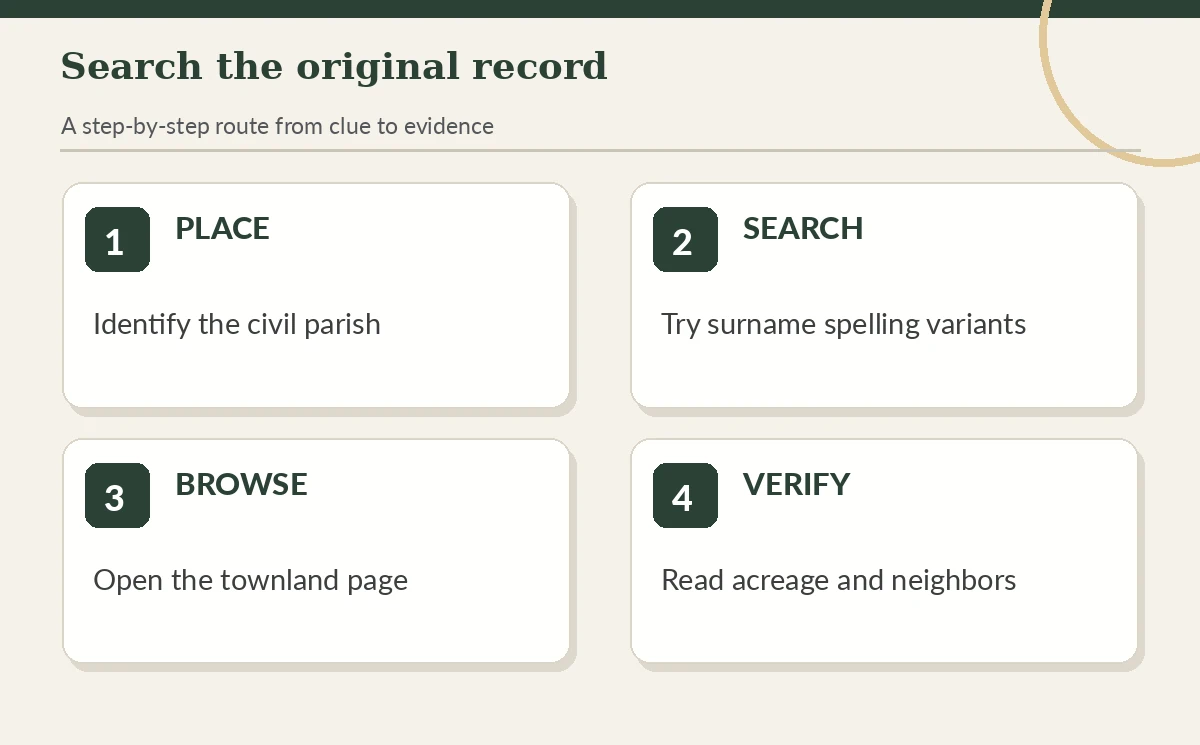
Write down the best-supported locality before searching the surname: county, civil parish, townland and, if known, neighboring townlands. If the evidence offers only a town name, do not automatically select the first parish with that name. Use the National Archives browse feature to inspect a plausible locality and the neighboring entries. A known townland can be a stronger discriminator than a common Irish surname.
Search names broadly and then browse a complete townland
The site supports searching by forename, surname, county, parish and townland, as well as browsing a county-to-parish-to-townland path. Its help page notes that spellings reflect transcriptions, including unclear handwriting and damaged pages; they have not been standardized to a modern family name. Search variants with O or Mc/Mac prefixes and, where appropriate, use the asterisk wildcard suggested by the archive. Our guide “Irish Registry of Deeds” goes into more detail.
Once an index result appears, browse the same townland to see who else was listed. A list of neighboring occupiers is contextual evidence, not proof that the people were relatives. A single townland can contain several people with the same surname. Record alternative candidates before choosing your ancestor. If no result appears, look at the manuscript by locality rather than repeating increasingly narrow name searches.
Read acreage, valuation and tithe as different fields
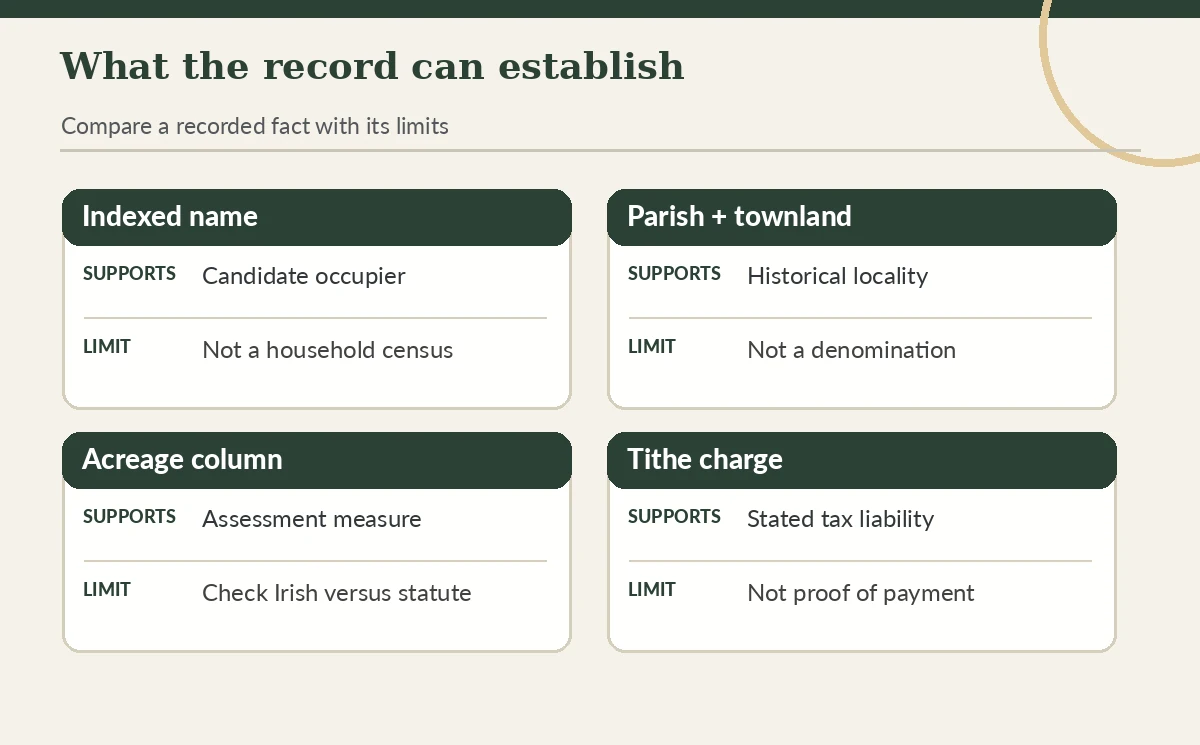
The manuscript applotment typically names the occupier, describes the holding and sets out an amount to be paid. Some books classify parcels by land quality and contain supporting certificates, correspondence or occasional maps. Transcribe headings on the actual page: an acreage column may describe a measure rather than an exact modern survey, and the financial columns may show an assessed liability rather than money actually paid.
The archive warns that some acreages use Irish or Plantation measure, about 1.62 statute acres per Irish acre. Never copy the number directly into a modern acres field without checking the heading and the measuring convention. If you calculate an approximate conversion, label it as derived and preserve the original quantity and units. This simple habit stops apparently conflicting parcel sizes from becoming false evidence that the holdings belonged to different people.
| Record element | Use it for | Do not infer |
|---|---|---|
| Civil parish + townland | Locate the specific holding | A church membership |
| Named occupier | Person assessed for land | Whole household membership |
| Acreage / quality | Compare land descriptions | A modern parcel boundary |
| Tithe assessment | Document a stated liability | That the charge was paid |
Treat omissions as a feature of taxation, not absence from Ireland
The taxable population was selective. The official project page describes agricultural occupiers above the relevant size threshold and explains that urban areas were not systematically included. Women, laborers without a qualifying holding, children, servants and many townspeople can be absent even when they lived nearby. A “missing” person is not necessarily a lost record or someone who emigrated before the book was compiled.
Check whether the parish book survives and whether its boundaries encompass the place you want. Distinguish an absent surname in a searched index, a missing or illegible page, and a class of residents the tax never set out to record. These are three different kinds of negative result. If a household was outside the tithe scope, switch to a different record class rather than assuming you have found evidence of a departure.
Connect a holding cautiously to Griffith’s Valuation
A family may appear in a tithe book and later in Griffith’s Valuation, but the interval can span a generation and local land arrangements may have changed. Compare the precise townland, family name variants, land descriptions and neighboring names while allowing for subdivisions or boundary changes. The earliest listed occupier is not automatically the father or grandfather of the later named person. Our guide to Griffith’s valuation for genealogy goes into more detail.
Use a hypothesis ledger with two columns—what each source states and what you infer about continuity. For example, a name repeated in one townland over time suggests a question about tenure; it does not establish inheritance. Seek baptism, marriage, estate, tenancy or surviving civil documents that bridge the years. If one source uses a ploughland or other older subdivision, record both the historical term and the modern geographic interpretation.
Cite the tithe townland, parish and original manuscript
Your citation should identify the National Archives of Ireland, the Tithe Applotment Books, the relevant county, civil parish and townland, the approximate compilation year, and the image or page viewed. Record the written name and acreage exactly as read, noting where the handwriting is uncertain. Avoid citing an unexamined transcription as if you had seen the original manuscript; the site distinguishes searchable metadata from digitized pages. For the fuller picture, see our guide “County Tyrone Tithe Applotment Books”.
A defensible conclusion might say that a named person was listed as occupier of a described holding in a given parish during the compilation of the tithe book. To claim that the person was a particular ancestor, add independent evidence identifying the same individual and place. Preserve the unanswered question and the next source you plan to check, especially when several occupiers share the surname.

How We Research Irish Tithe Books
GenHis starts with the official archival description and distinguishes an index, the original record and any inferred family claim. For this guide we examined the repository instructions, stated date coverage, available search fields, documentary limits and relevant historical terminology. The sample identity checks are hypothetical and not records of identified ancestors. This is historical research guidance, not a guarantee that every record survives, is indexed or is free to obtain.
More Records and Archives Guides
Official archives and collection guides for Irish Tithe Books
National Archives project summary, scope, years, named occupiers and townland browse (titheapplotmentbooks.nationalarchives.ie).
Original record structure, parish divisions, acreage units and preservation caveats (titheapplotmentbooks.nationalarchives.ie).
Official name-variant search instructions and locality browsing (titheapplotmentbooks.nationalarchives.ie).
Editorial disclosure: This guide includes no paid recommendation or verified affiliate partnership. See the GenHis affiliate disclosure. Record holdings, image availability, access restrictions and prices can change. Verify them with the cited repository before ordering documents; protect information about living people and present uncertain family conclusions as hypotheses.
No. They record agricultural occupiers for taxation, not every resident or full households.
No. Most urban residents and people without relevant taxable holdings are outside the systematic scope.
Yes. Use the official browse path from county to civil parish to townland.
No. Some books use Irish or Plantation acres, so preserve the stated units.
No. Link individuals across dates using independent identity and tenure evidence.