
The 1841 England census is often the first named census encounter with an ancestor, yet it is easy to overread. Adult ages were generally rounded down to the nearest multiple of five, household relationships were not recorded, and a yes/no birthplace column is not an exact birth parish. The return can document that people with specified names and stated occupations were enumerated together on 6 June 1841, but an apparent mother, father, or child relationship requires other evidence. The key to a reliable conclusion is reading the original page and testing one identity at a time.
Read the exact 1841 columns before calculating birth dates
According to The National Archives, the 1841 return names individuals and records an age, sex, occupation, a yes-or-no answer to whether someone was born in the county, and separate indications of birth in Scotland, Ireland, or foreign parts. It does not give the later census columns for marital status or relationship to the head. Transcribe what appears under each heading instead of importing labels from an 1851 or 1881 index. Some online result screens add inferred household groupings that are not literal statements from the 1841 enumerator.
Check the census night, Sunday 6 June 1841, before subtracting ages. A child shown as 12 might have been that age on the census night; adult entries are a different calculation. Do not assume identical surnames make adults spouses or make a younger occupant the biological child of older occupants. A servant, lodger, niece, apprentice, or visitor may share an address. The presence of a dash or overwritten age can reflect transcription uncertainty, not a precise personal date.
Convert rounded adult ages into ranges, not exact birthdays
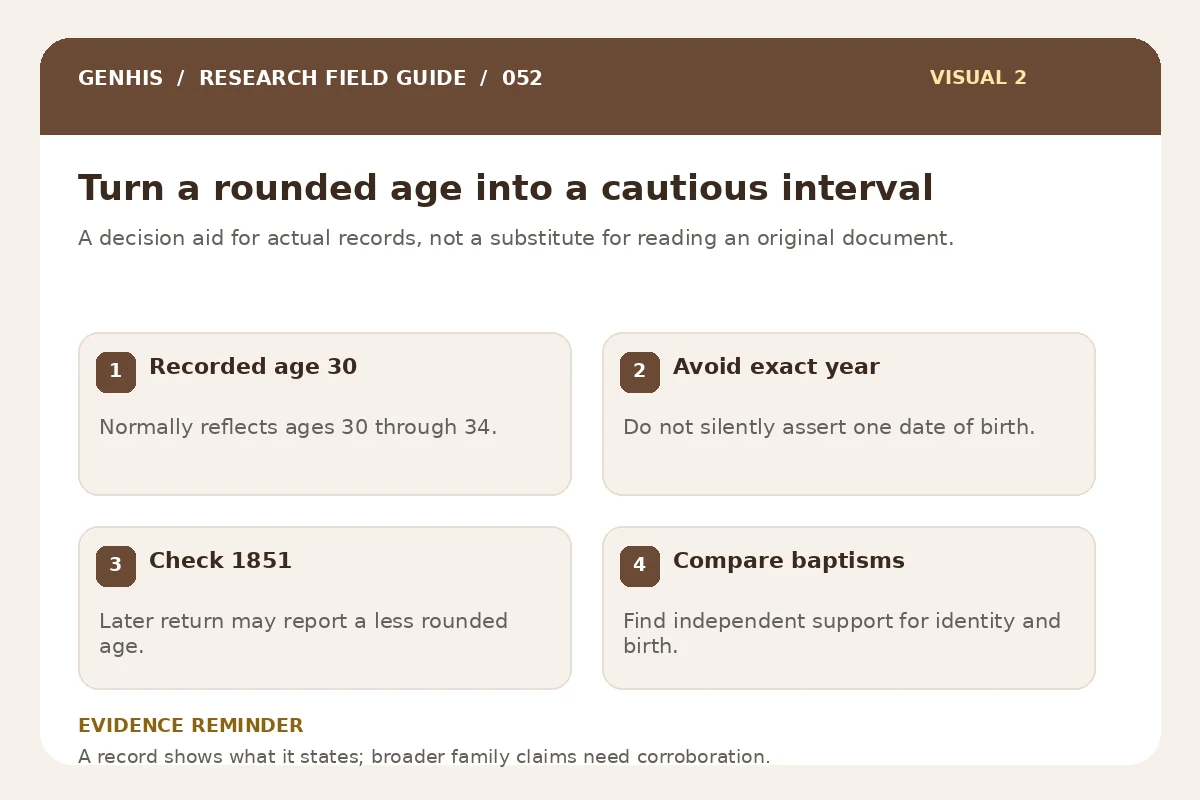
The enumerators’ guidance generally directed adults aged 15 and older to be recorded at the nearest lower multiple of five. Someone entered as 30 could actually have been about 30 through 34 on census night, before allowing for errors, and a birth-year estimate must reflect that range. In the strict arithmetic example, a recorded 30 gives a possible age of 30–34, not proof of birth in a single year. Some enumerators ignored the rounding instruction, so treat this as an interpretive rule rather than a guarantee that every individual was rounded.
For a fictional Elizabeth Hart entered as age 30, keep an approximate birth interval rather than choosing 1811 because a search engine prefilled it. Inspect the 1851 census, baptism register, marriage entry, and possible burial records, each carrying its own uncertainty. If Elizabeth is 42 in 1851, that may still be consistent with the 1841 rounded entry; if a proposed match has an implausibly different occupation, address, and spouse, examine alternative candidates. Age agreement by itself cannot settle identity.
Interpret born-in-county marks within 1841 geography
The 1841 birthplace question asks whether someone was born within the county where the person was enumerated; it does not provide a parish for people marked yes. A no points away from that census county but generally does not identify another English county. Separate codes can indicate Scotland, Ireland, or foreign birth. Read the legend and the actual column writing, particularly for a person in a border parish or where handwriting obscures the Y or N. Do not transform a county-level indicator into a town of birth.
The census county is the administrative geography of the return, not necessarily a present-day county label. When a locality seems inconsistent with family tradition, locate it on a map appropriate to the period and check both neighboring counties if needed. An ‘N’ should lead to a broader search, not a permanent conclusion about migration distance. Compare later census birthplaces with parish registers and note which source supplied each claim. A later exact parish may be useful but is not retroactively an original 1841 census field.
Prove a household relationship rather than assume one
A group of persons under one address may appear to form a nuclear family. In 1841, no relationship field verifies that reading. Use a structured comparison: enumerate every person, age as written, surname, occupation, and position in the book; compare against civil marriage and birth registrations where applicable, parish baptisms, wills, or the 1851 census where relationships are stated. Keep separate columns headed ‘explicitly recorded’ and ‘suggested by context’ so that a co-residence clue does not become a citation for parentage.
Consider two hypothetical Hart children living beside Elizabeth and a man called George. The return shows co-enumeration, not that Elizabeth is their mother or George their father. A baptism naming parents, a civil certificate, or a consistent sequence of later records might support a family grouping, but even a later household description should be tested. Search other nearby Hart households and pay attention to occupations and neighbors; several branches with the same surname can live on the same street.
| Decision point | Recommended research action |
|---|---|
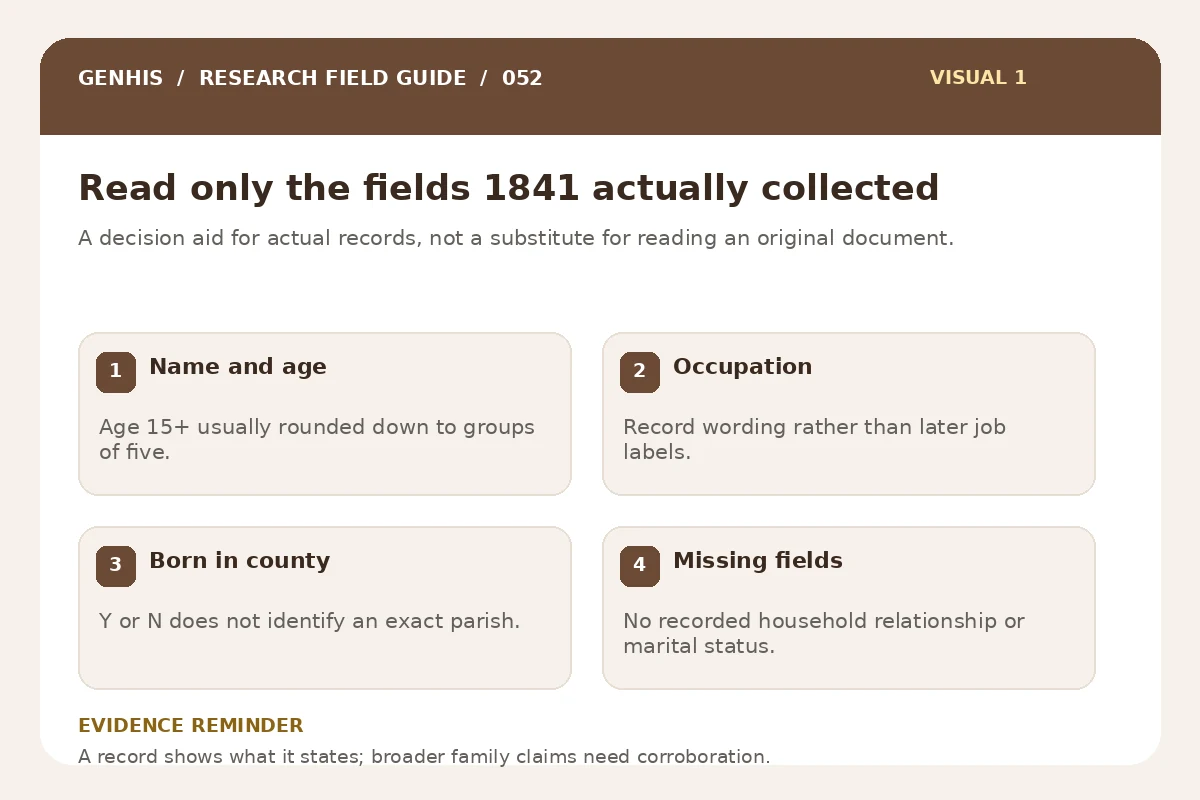
| Name and age | Age 15+ usually rounded down to groups of five. |
| Occupation | Record wording rather than later job labels. |
| Born in county | Y or N does not identify an exact parish. |
| Missing fields | No recorded household relationship or marital status. |
Build a precise HO 107 citation from the original page
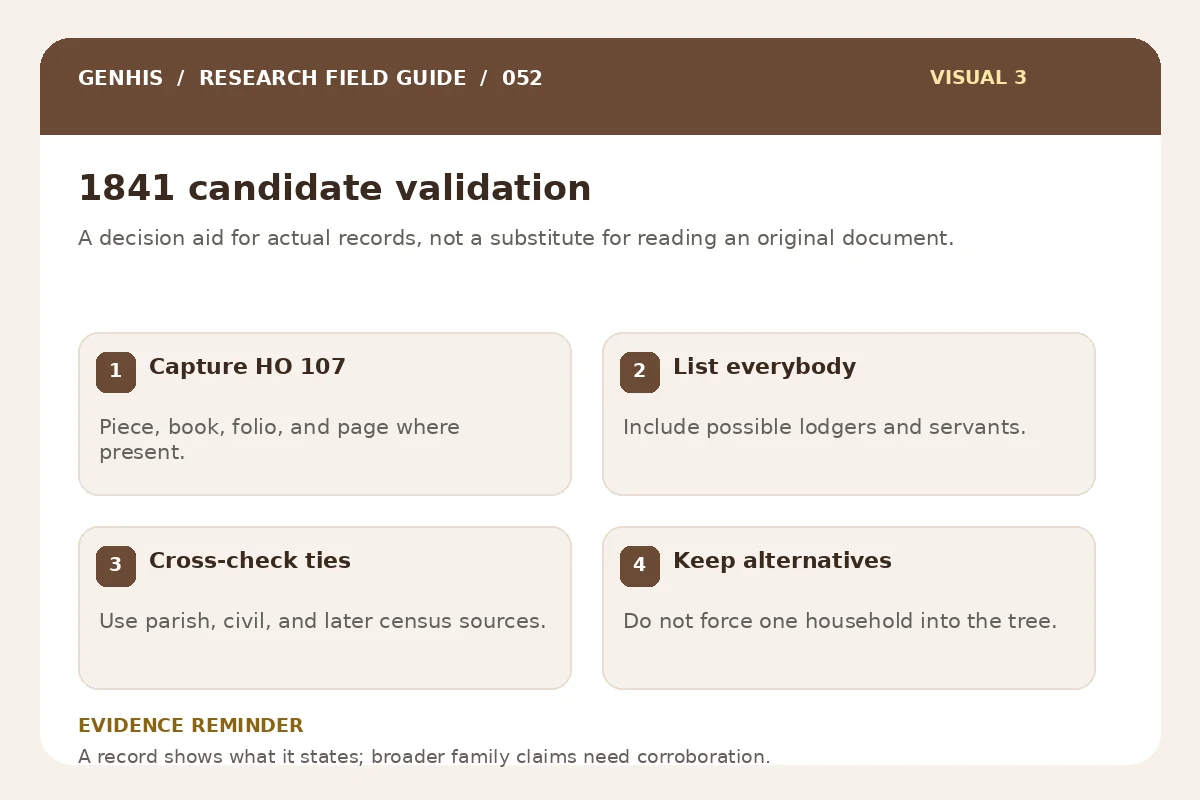
The National Archives identifies HO 107 as the 1841 census series. Unlike some later census references, an 1841 piece is divided into books; record the piece, book, folio, and page as available. An index result may omit one of those components. Open the actual census image to check the page heading, neighboring households, crossing marks, and any enumerator explanation. Write the archival reference and provider’s image identifier as separate fields so the original can be located even if a website’s display changes.
If you encounter a record labeled HO 107 but the page claims relationship-to-head details, inspect whether those details come from a later census or a user-supplied tree rather than from the original 1841 columns. Compare the image with the transcript and leave unclear handwriting explicitly unresolved. A complete citation identifies what was examined and where, while an analytical note records whether any surname, age, or code was read provisionally. That distinction makes later correction possible without losing the original observation. Our walkthrough on how to search England census records for free without mistaking an index for an image sets out each step.
Work an 1841 candidate through a deliberate confirmation test
Suppose a later marriage record suggests a tailor called Henry Clarke lived in Yorkshire around 1841. Search several Clarke spelling variants in the relevant census county, using occupation and associates as supporting filters rather than exact birth year. For each candidate, capture the entire group on the original page and the birth-in-county indicators. Compare the plausible age intervals and location with that later marriage record, but remember that a ‘yes’ flag is not the name of a birthplace and that a shared occupation is not personal identification.
The strongest next move is a record that distinguishes similar candidates, perhaps an occupational directory at the same street, a marriage with named witnesses, a child’s baptism, or the 1851 census with relationship information. State a provisional conclusion such as ‘one plausible 1841 household at this reference’ and list competing candidates. If two households remain possible, preserve both. The real product of 1841 research is a properly bounded hypothesis and a citation, not a family relationship manufactured from people appearing together on the page. To go further, our guide “1851 England and Wales Census” shows how to read HO 107 birthplaces and households.
How We Research: map dates, documentary scope, and uncertain conclusions
We used The National Archives field-by-field census guide for the column definitions and HO 107 referencing, then checked FreeCEN guidance for departures from normal age rounding. Our age examples are hypothetical arithmetic, not assertions about identified historical people.
Authoritative sources and collection-specific limitations
www.nationalarchives.gov.uk — institutional source. TNA lists 1841 fields, age rounding, birth-county marking, and HO 107 book-level citation format.
www.freecen.org.uk — institutional source. FreeCEN warns that some enumerators ignored age rounding and explains transcription and search limits.
www.nationalarchives.gov.uk — institutional source. TNA describes GRO civil registration starting 1 July 1837 and parish research for earlier events.
More Records and Archives Guides
Privacy, disclosure, and responsible interpretation
No individuals or relationships in the illustrative examples are real persons. A shared 1841 household is not evidence of biological kinship, and difficult-to-read entries should remain uncertain. These archives and public services are cited independently; none is a paid partner or an endorsed affiliate. Read the GenHis affiliate disclosure for site policy.
Generally, for ages 15 and above, to the nearest lower five years. Some enumerators did not follow the instruction; always inspect the original entry.
No relationship-to-head column appears. Co-residence and surnames are clues that require corroboration elsewhere.
No. It indicates birth in the county of enumeration, not a specific parish or town.
HO 107 is the National Archives reference series for the 1841 and 1851 returns. The 1841 citation additionally uses a book within the piece.
The normal rounding rule is consistent with a true age from 30 through 34 on census night; the precise birth year remains unproved.