
For an ancestor born in County Donegal, search a civil birth registration if the birth occurred in 1864 or later; for earlier births, identify the historical parish and surviving baptismal book. Ireland’s state registration system began recording all births in 1864, but an online name index cannot establish every detail of the event. The IrishGenealogy portal publishes a historical date-limited set of civil images, while church records follow denomination and local preservation. This article uses a Donegal-specific two-era route so an empty database result does not become an invented absence.
Choose the Donegal birth-record system using the event year
Start by separating a reported birth date from the year in which the event may have been registered. The official IrishGenealogy civil-records guide confirms that Irish civil birth registration started in 1864. For later births, attempt the civil search first. For earlier births, use a baptismal register or other contemporary substitute. Be careful with a family story such as “born about 1863”: several plausible years may straddle the legal change and require searching both paths.
Do not treat 1864 as the beginning of all surviving Irish birth evidence. Religious communities recorded baptisms long before civil registration in many areas, but their books begin and survive at different dates. The historical civil search offers accessible images only within the periods currently released by the government. A twentieth-century birth may have a registration that is lawfully restricted even if the family knows its precise date. Note your search era before drawing a negative conclusion. Our guide “Somerset Birth Records” covers a related question.
Search IrishGenealogy Donegal registrations and original pages
Use the government portal’s historic birth category, entering surname, given name, reasonable year range and registration context. The current FAQ identifies available birth images for 1864–1925 at the time of review; this is a release window, not an assertion that every event or image appears. Search a neighboring year because an event late in the calendar year may have been entered or indexed later. Make a note of every spelling and variation tried.
Open the underlying register image when available. Copy the date and place of birth, recorded parent names, residence, occupation or other visible details only if they are actually present in that entry. Compare them with independent sources. A civil record can have an incorrect age or misspelled surname; an indexed transcript may also contain a reading error. If the image is missing, preserve the registration-index data and follow the official route for copies rather than fabricating what the document would have said.

Resolve Donegal townlands, parishes, and registration districts
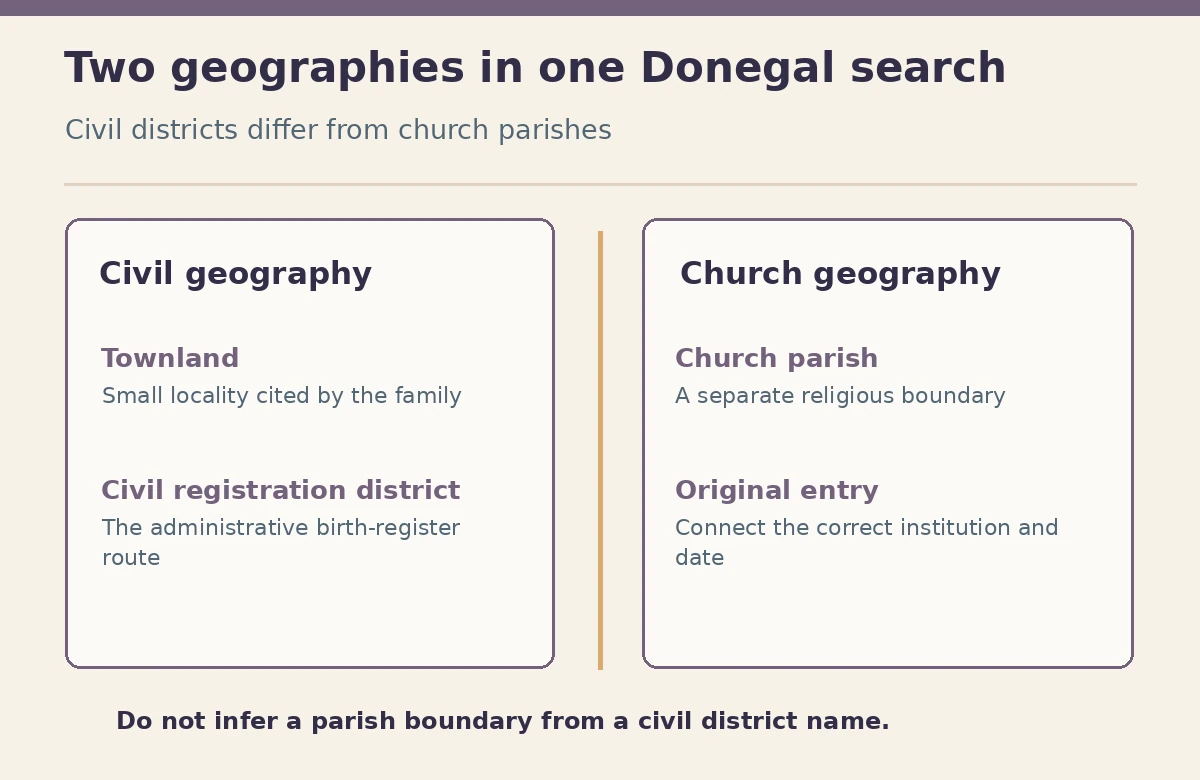
“Donegal” alone is too broad to identify a specific historical baptism. Record the townland, neighboring village, district, parish, and denomination if independently known. Civil registration geography and church parish boundaries are different systems; neither can be inferred from a modern postal place name. A family may also use a different spelling of the same townland in censuses or emigration documents. Build a place worksheet showing each historical name and its source date.
As a hypothetical example, a birth index names a child “Patrick Gallagher” without sufficient information to distinguish him from a second child of that name. One candidate’s parents and townland fit a later marriage register; the other matches only the surname. Keep both civil records until parent names, residence and subsequent events establish the identity. Never choose the closest parish simply because its baptismal images are easiest to browse. For a related choice, see our guide “German Baptism Records”.
Find a Donegal baptism before civil registration
The National Library of Ireland Catholic registers service provides images of microfilmed parish books from much of Ireland, generally into the nineteenth century. It is a parish-and-image search, not a promise of an indexed hit for every infant. First establish the denomination and historical Catholic parish; select a volume spanning the candidate year; then browse entries around the reported date and transcribe the original handwriting.
Different denominations kept and preserved records differently. Church of Ireland and other Protestant baptism entries may be held in a diocesan library, parish or local archive. The county’s cultural resources identify local microfilmed church material, while official IrishGenealogy warns that online transcriptions of Donegal Catholic records are limited relative to many other counties. Thus, absence from one national transcription service is especially weak negative evidence here. Record the actual parish registers searched, not just the website. Our guide “Northern Ireland Births Before 1864” covers how to find parish baptisms and check gaps.
Separate baptism, birth, and later family claims
A baptism is an administered religious rite; its date may be days or weeks after a birth. Some registers give the birth date, some only the baptism, and early books may identify sponsors or the residence of parents without giving an infant’s full later identity. Do not silently change the baptism date into a birth date. Transcribe what the priest or minister recorded, including spelling and abbreviations, and keep your modern translation or interpretation apart from the quotation.
Named sponsors can suggest social connections, but are not proof of a biological relationship. A mother’s surname or a father’s occupation may help distinguish two households; check whether it is stated in the actual entry. Where a child died young and the same forename was given to a later sibling, baptism registers and death records can prevent accidental merging of two different people. This is particularly important in families with repeated traditional given names. Our guide “Irish Civil Death Records” goes into more detail.
Resolve empty Donegal searches using a coverage ledger
When neither the government civil search nor a church transcription returns a match, identify the missing coverage before trying another person. First confirm the civil time window, then whether the registration district or parish was correctly chosen, followed by alternative spellings and years. Check whether the volume survives and whether its pages are viewable. A blank index and a missing physical register require different next actions; put them in different cells of the search log.
Conclude with an evidence statement: “No birth index match found for these terms and years on this date” is defensible. “The child was never registered” is not, unless a much more comprehensive examination supports it. Cite the IrishGenealogy record or nil result, parish volume and page, and any independent marriage or census record used to identify a candidate. The point of a Donegal-specific plan is to make these limits visible while still producing a practical next archive request.

More Records and Archives Guides
How We Research Donegal Birth and Baptism Evidence
We compared the named repository’s current description of its holdings or online search with the other institutional guides cited here, then checked what each source can directly establish. Our examples are hypothetical and never represent an identified real person. A database hit, original record and later inference are treated as different evidence levels. Coverage, copying arrangements and privacy policies can change: verify them at the relevant institution. We have not asserted paid endorsements or affiliate relationships. See our affiliate disclosure.
All Irish civil births were subject to registration from 1864; earlier baptisms require church or other sources.
No. Coverage of transcriptions is incomplete; identify the parish and inspect surviving microfilmed images.
Not necessarily. Record both fields only when explicitly present in the source.
Check spelling, adjacent registration years, district and whether the image or entry was released.
No. Sponsorship is a recorded social or religious role, and kinship needs separate evidence.