
Identify the correct Quebec parish and burial act, use church and civil-copy collections, and verify a death claim without assuming dates match. Begin with a single research question and a dated location, then identify the surviving original record before assigning a name to your family. A database entry is a useful lead, not proof of kinship or of a field absent from the document.
Start With the Parish and the Reported Death Window
In historic Quebec, the practical route to a death often begins with a burial entry in a named parish, not with a modern statewide certificate search. Collect an approximate date from a family letter, marriage record or cemetery inscription and locate the family’s denomination and community at that time. The same person may have lived in one parish and been buried in another. A town name can denote a civil municipality, religious parish or wider administrative area, so preserve the exact wording. Establishing those distinctions before entering a name cuts down false matches among families who reused traditional given names.
Understand Why Church and Civil Copies Coexist
For much of Quebec’s history, parish books served as vital documentation, and churches sent copies of baptisms, marriages and burials to civil authorities. FamilySearch’s Quebec civil-copy index identifies material from 1642–1902; its description states that Catholic and Protestant churches are included. The index is not a modern death-certificate database and does not ensure that two surviving copies are letter-for-letter identical. If a parish version and civil copy both exist, compare them rather than assuming the index represents a third independent eyewitness. They may derive from the same underlying act and share the same reporting error. For a related choice, see our guide “Dublin Church of Ireland Registers”.
Choose Catholic or Non-Catholic Register Collections
FamilySearch publishes separate collections for Catholic parish registers and for non-Catholic parishes, the latter with documented coverage from 1763–1967. The dates describe collection boundaries, not a promise that a given congregation has every year. Verify denomination from evidence, not a French or English surname. Explore image-browsing paths when name indexing is partial; church and civil-copy collections can be indexed differently. Write down the parish, collection title, image or volume and the year span actually checked. If the proposed parish was not established at the event date, research where its members previously worshipped rather than inventing an earlier book.

Read the French Burial Formula Precisely
A burial entry commonly uses words such as sépulture, inhumé or décédé, but wording and what is stated vary with clerk, century and record type. Identify the burial date explicitly and separately record any death date. Some entries give only burial and age; others identify a spouse, a parent for a child, or witnesses. Do not convert a priest’s approximate age into an exact birth date without independent support. The word épouse or époux may help identify a reported spouse, while veuf or veuve refers to widowhood. Translate conservatively and retain the original phrasing in your notes.
Move From the Index to the Bound Register Page
An index result provides a candidate event and often a pointer to the parish, date or volume. Open the linked image or browse the relevant volume if only images exist. Read entries immediately before and after to verify that you are interpreting the correct heading and page date. A civil-copy index might omit details found in the page itself; conversely, an image can be difficult to read and lead to an erroneous transcription. Note exactly which version you inspected. Keep separate citations for a modern index and an original register or historical civil copy, rather than presenting them as one interchangeable source.
| Record form | Can document | Must not assume |
|---|---|---|
| Parish burial act | Reported interment and names | Exact death date |
| Civil copy of act | Copied official parish text | Independent informant |
| Online index | Locator to candidate act | Identity proved |
| Cemetery listing | Interment or memorial clue | All persons are relatives |
Distinguish a Burial from a Death and a Grave
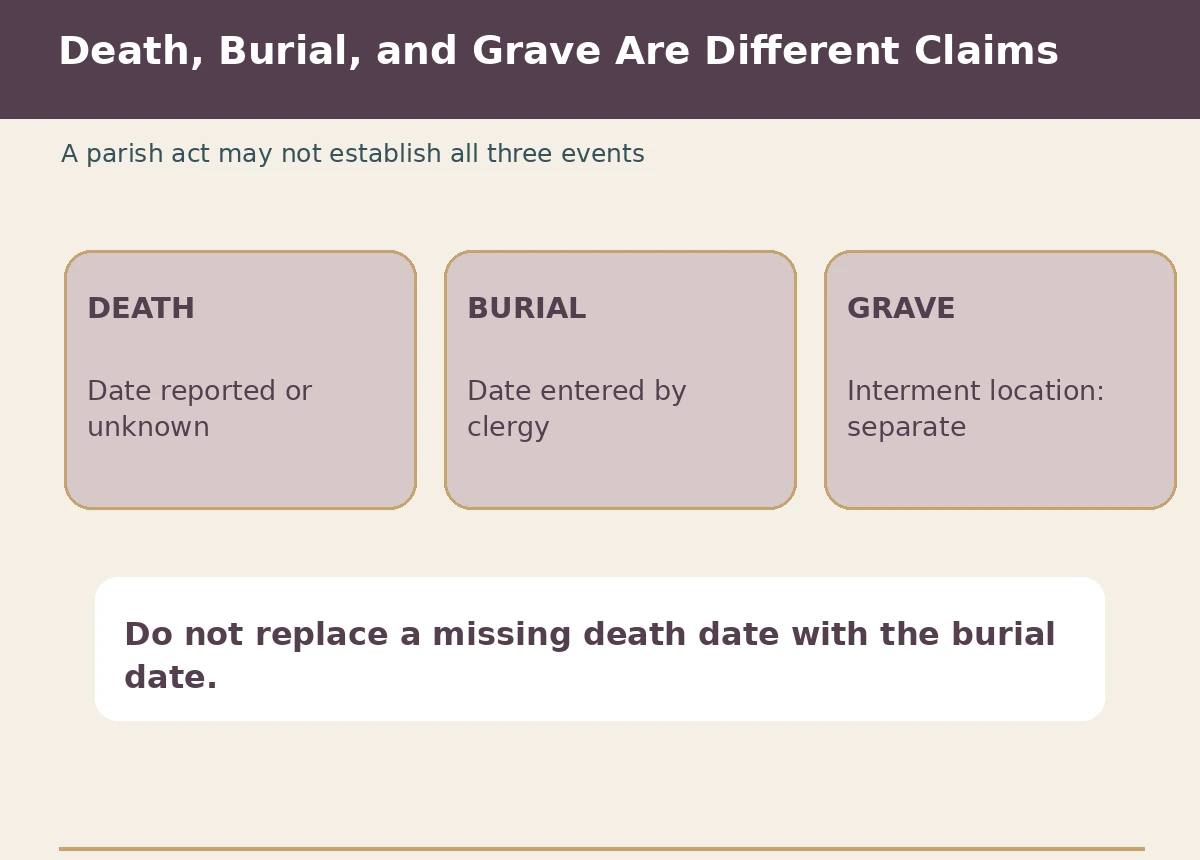
A burial act documents a recorded religious burial; it does not always give the actual date of death, a precise gravesite or a surviving headstone. A cemetery record may locate interment or grave ownership, while a memorial inscription could describe someone not physically buried there. Create three columns headed death reported, burial recorded and grave located, marking unknown where the text is silent. This prevents an apparently exact cemetery date from overriding an original parish act. If the sources disagree, consider delayed burial, transcription error or reuse of a memorial before deciding which is correct.

Test Identity When the Parish Reuses Given Names
Imagine two residents called Jean with the same surname, one buried in a rural parish and the other in a nearby town a year later. A matching age estimate or spouse for one candidate may favor that record, but both require testing. Compare the spouse’s name and residence with marriages, baptisms of children and earlier census information when available. Do not combine the two burial acts into a single family chronology. This example is illustrative and identifies nobody. It demonstrates why a French-language burial act must be assigned to a person through a network of independently dated records, not by surname frequency.
Use the 1994 Administrative Change Carefully
Quebec’s separate civil-status administration under the Directeur de l’état civil begins in 1994. That is not permission to use a historical parish database to seek protected records of living people. Pre-1994 records held or reproduced in genealogical collections are different in purpose and access from contemporary official copies. For a late twentieth-century event, confirm current provincial eligibility and privacy rules rather than assuming that any digitized index confers a right to retrieve all information. Keep this article’s workflow focused on historical deceased relatives, original manuscripts and appropriate legal access.
Check Copies and Alternate Repositories for a Missing Year
An empty name search might be caused by an unindexed handwritten book, a spelling variation, a lost parish series or a family belonging to a different church. Try a different collection and browse the correct community’s images. FamilySearch’s Catholic register description notes that copies sometimes survive even where one volume was destroyed. Do not assume this happened for every parish. Track precisely what remains online and what would require inquiry of a repository. Negative evidence becomes meaningful only when coverage, identity variants and possible records have been explicitly investigated. Our guide “Drouin Collection Quebec Parish Records” shows how to compare civil and church copies.
Document the Burial Act as a Specific Claim
Cite the denomination, historic parish, event type, date as written, page or image reference, collection title and record custodian or publisher. Transcribe the French phrase supporting the burial and translate it separately. If your conclusion infers a family relationship from the spouse or parents, identify the exact words that prompted it and test them against independent sources. Mark a derived estimate as such; never supply a date that a register did not contain. This source-to-claim discipline allows a future reader to reconstruct the finding even if an online database changes its indexing interface.
More Records and Archives Guides
How We Research Quebec Historical Burial Records
We reviewed the distinct FamilySearch catalog descriptions for Quebec parish registers, Catholic volumes, non-Catholic books and indexes to historical civil copies. The article restricts its date ranges to collection descriptions rather than claiming perfect parish coverage. It treats death, burial and grave as separate claims and does not extend historical public access assumptions to recent individuals.
Reference guides reviewed on October 24, 2026: primary research guide; companion institutional resource; source collection; primary research guide. These links explain collection scope; they do not imply that we viewed every original entry or identified a particular ancestor. This article includes no paid recommendation. Our affiliate disclosure explains the site policy; no affiliate relationship is asserted here.
No. A historical parish burial act may give a burial date and family clues without recording a precise death date.
Some civil-copy indexes include both, but separate parish collections have different contents and coverage. Select the correct congregation and browse if necessary.
Not automatically. A church original and a civil copy may reproduce the same underlying informant statement.
Sépulture marks a burial; compare any separate décédé wording before assigning a date of death.
Check relevant civil copies, alternative denominations or custodians and the collection’s actual years; do not infer the person was absent.