
Civil War Union draft enrollment lists from 1863–1865 can place an eligible man in a specific community even when he never served in uniform. Begin by finding his congressional enrollment district, locate the consolidated list in National Archives Record Group 110, and transcribe the actual entry before looking for military records. A name on the list establishes enrollment under the wartime system—not that a man was drafted into service, fought, was exempted, or hired a substitute.
Understand the 1863 enrollment and what survives
The federal Enrollment Act of March 3, 1863 created the Provost Marshal General’s Bureau, whose records are described in Record Group 110. Consolidated enrollment lists generally group men by state, congressional or enrollment district, and class. They are not a national service roster. Records from local enrollment districts can include descriptive books and separate paperwork about drafted men, exemptions, substitutes and deserters. Follow those files on their own archival trail. Our guide “French Military Registres Matricules” covers a related question.
The National Archives warns that many consolidated lists are incomplete. A locality with no matching page may mean a missing list, a wrong district, a different spelling, or an ineligible person—not proof that the man escaped registration. Note what volumes and years the catalog says were actually reviewed; do not treat one empty commercial search screen as evidence of historical absence.
Find the congressional district before searching a surname
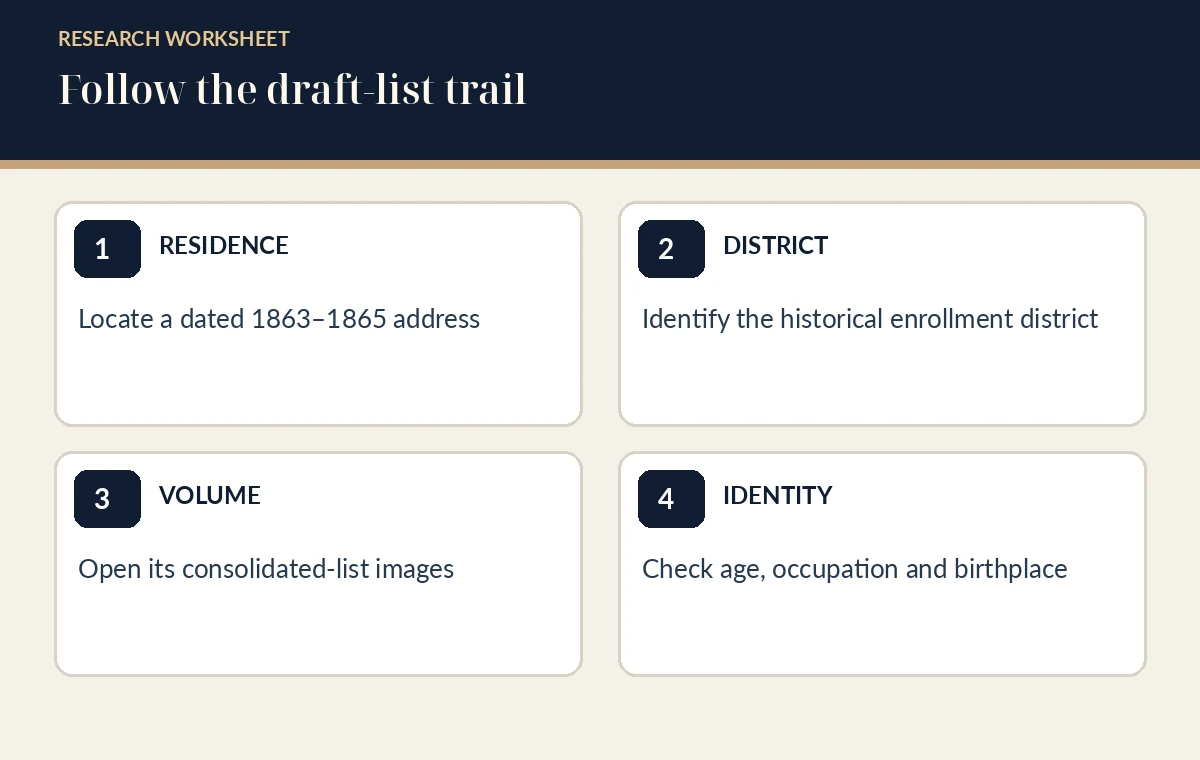
Start with a reasonably dated residence in 1863 or 1864, ideally from a city directory, tax roll, correspondence or contemporary map. A later federal census address can guide the search, but it cannot establish the enrollment district on its own. Congressional boundaries and enrollment subdistricts are historical. Locate the relevant district within the state and record how the locality was mapped at the date of the enrollment.
Now search a provider index or the National Archives catalog for the consolidated list. If a database shows a candidate, move to the source image and inspect the heading: state, district, class, date and surrounding entries. Browse adjacent pages if necessary. A familiar surname in a different district is a competing candidate, not an alternate citation for your ancestor.
Read class, occupation, birthplace and the remarks column
A consolidated entry may report a man’s age as of July 1, 1863, place of residence, birthplace, occupation, marital status and the period’s recorded race classification. Class I and Class II were administrative categories, not grades of soldiering. The source’s language and racial classifications belong to their historical context; reproduce them carefully when necessary rather than treating them as modern descriptions.
Write each fact in a claim ledger with the source heading beside it. Birthplace is reported information, age can be rounded or mistaken, and spelling may vary. Remarks are especially easy to overinterpret. If the writing is unclear, preserve a literal transcription, a tentative reading and the surrounding image reference instead of silently turning a guess into a clean data field.
| Evidence source | What it can support | What it does not establish |
|---|---|---|
| Consolidated enrollment list | Enrollment in a named district and class | Enlistment, combat or completed draft order |
| District exemption or substitute file | A specific local administrative decision | The complete military career |
| Compiled service record or muster roll | Reported duty with an identified unit | Identity without corroborating details |
Make a separate service-or-exemption decision
Use two independent columns: “Enrolled in the draft system” and “Evidence of actual service.” A consolidated-list entry fills the first column only. To support service, seek a compiled military service record, unit muster roll, pension application or comparable document that actually places the candidate in a military organization. For an exemption or substitute, look for district-level paperwork specifically reporting that decision.
A soldier with the same name and approximate age is not automatically the enrolled man. Compare residence, occupation, regiment recruiting locality, birth details and later pension information. If the enrollment list says nothing about what occurred after registration, record the outcome as unknown. Do not substitute a memorial, unsourced tree or an index label for an original adjudication or service file.

Work a fictional two-candidate identity test
Suppose the target is a fictional Thomas Mercer recorded as a cooper in a Pennsylvania town in 1864. One draft-index hit names a laborer in a neighboring congressional district; another records a cooper in the expected district but lists a different birthplace. Neither match is established by the name alone. Transcribe both entries, their administrative headings and the exact conflicting details. For a related choice, see our guide “1942 Fourth Draft Registration Cards”.
Look for a town directory or tax entry near the enrollment year and a later marriage, pension or household record that reliably links one candidate to the same occupation and address. If the birthplace difference remains unresolved, retain both possibilities. This hypothetical example illustrates a verification procedure, not an assertion about a historical Thomas Mercer.
Cite the entire enrollment volume and report gaps
For a reproducible citation, retain the state and enrollment district, class, volume or list identification, page or sheet, entry, repository record group and the exact online image link when supplied. A commercial database title alone is too broad to let another reader recover the same line. Include whether the image is a derivative of a microfilm or archival volume when that can be identified.
End the search log with a distinct result for every district and time window checked. If a regional archive holds additional local bureau records, note the repository and finding aid rather than assuming all field-office material is online. Your conclusion should say “listed in an enrollment register” unless a separate source genuinely supports something stronger. To go further, our guide “World War I Draft Registration Cards” shows how to read all three forms without assuming service.

How We Research Civil War Draft Registration Records 1863 1865
We compared the National Archives description of RG 110 with its focused explanation of Civil War enrollment lists, including missing volumes and separate district-level paperwork. Our example uses invented people. Every proposed military-service claim remains conditional on a distinct service document, and users should verify their target district against contemporary addresses before drawing a conclusion.
More Records and Archives Guides
Archive catalogs and original-source guides for civil war draft lists
National Archives RG 110 guide: provenance, Enrollment Act and record organization (archives.gov).
National Archives article: enrollment classes, fields, gaps and service distinction (archives.gov).
Also, National Archives research brochure: federal draft and district-office material (archives.gov).
These links lead to official or archival research resources, not approved paid endorsements. Read the GenHis affiliate disclosure. Access conditions and digitization coverage may change. Research historical people with appropriate context; do not disclose private details about living people or treat allegations and administrative labels as proven facts.
No. It establishes an enrollment entry; separate service, draft outcome or exemption records are needed.
The consolidated lists are part of the Provost Marshal General’s Bureau records, National Archives RG 110.
A list may be missing or partially indexed, the name may vary, or the district or eligibility may differ.
Typically by state, enrollment or congressional district, and class; inspect each volume heading.
Not alone. Compare residence, occupation, birth details and independently dated military documents.