
If an ancestor arrived in Victoria by ship from another Australian port between 1852 and 1923, search the inward coastal passenger lists in Public Record Office Victoria’s VPRS 944. Do not confuse an interstate arrival with VPRS 948 outward departures or VPRS 947 unassisted overseas arrivals; verify ship, direction, and date from the original list.
Select the right passenger series for the direction of travel
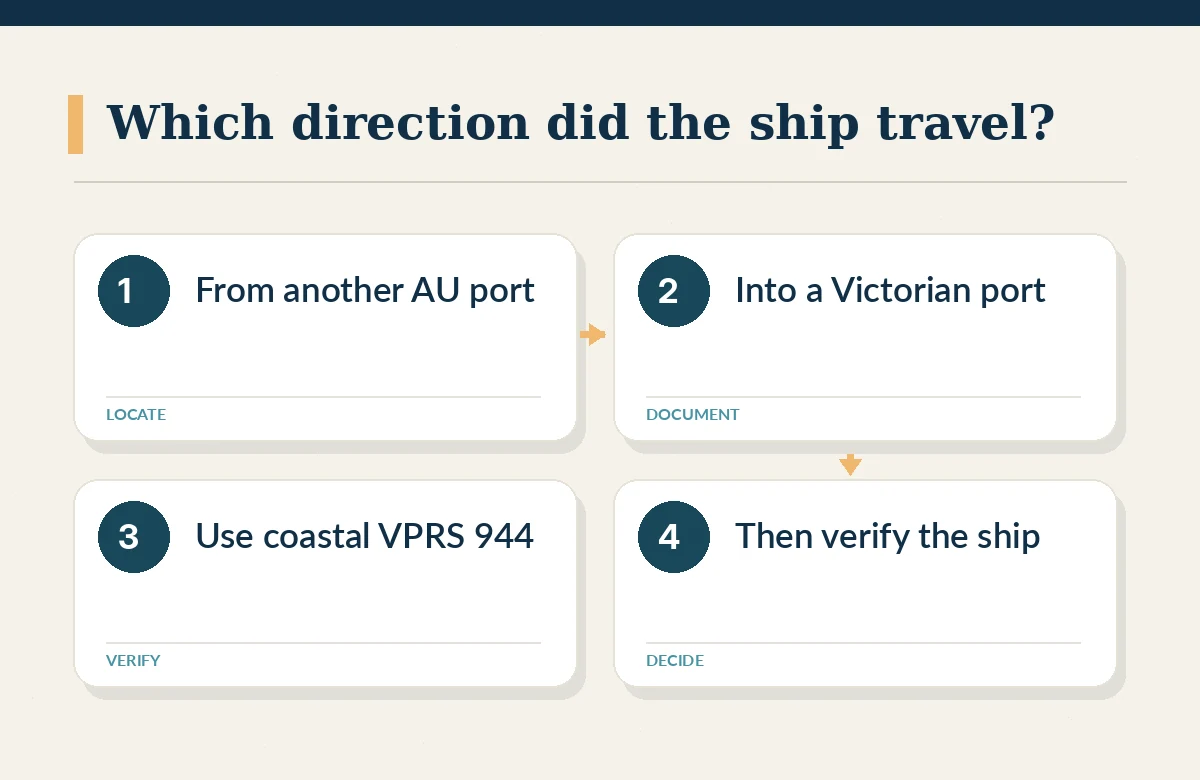
Public Record Office Victoria identifies coastal passenger lists from 1852 to 1923 as VPRS 944. State Library Victoria describes them as records of people traveling by ship into Victoria from another Australian port. The same passenger may also appear in records created by the departing jurisdiction. Before searching a name, draw a simple arrow: from which port, toward which port, and on what approximate date? For the fuller picture, see our guide “Victoria Outward Passenger Lists, 1852–1923”.
That direction matters because PROV separately lists outward passenger records in VPRS 948 and unassisted passengers from overseas in VPRS 947. Assisted arrivals are another collection again. If a family story merely says someone “came to Melbourne,” first establish whether the vessel’s previous port was interstate or overseas, instead of searching every immigration index indiscriminately. Our guide “Victoria Unassisted Passenger Lists, 1852–1923” shows how to find ships and verify arrivals.
Use a year range and ship clue to narrow the search
Collect the ancestor’s full name and spelling variants, approximate arrival year, any known ship name, a departing state, and documentary evidence of residence on either side of the move. Check PROV’s coastal passenger collection and see what its current interface allows. Where a database supplies a transcription or a year browse, open the underlying image and note its order and ship heading.
A departure notice in a newspaper and a later electoral or directory listing can help bound a possible voyage, but each measures a different event. If the family lived in Adelaide in one month and Melbourne later, the dates form a search window, not proof they used one particular steamer.
Read the heading and passenger rows together
Once a likely ship list appears, copy the vessel, voyage date, originating and destination ports, and any passenger details actually present. Remember that fields vary with the period and the list. Even when a name is legible, check surrounding entries; a traveling party may be grouped, separated by class, or affected by a transcription error.
Do not infer a family relationship merely from adjacent passengers with the same surname, and do not assume the arrival port was the first Australian landing for a person born overseas. A short coastal passage may have occurred years after international immigration. Identify and date the specific transport event you can document.
Recover names omitted by indexes or poor transcription
Try initials, alternate spellings, married and maiden names where securely documented, and likely ship or route filters. If the named search fails, shift from person-first to voyage-first searching: inspect candidate vessels in the relevant months and compare departure and arrival notices. The resulting absence remains specific to those searched lists, not to the person’s location in all of Australia.
State Library Victoria identifies FamilySearch as one transcript access route and Findmypast as another access point available in the library, with different viewing conditions. These discovery sites are not substitute custodians of the original VPRS 944 documents. Always record which transcription you used and how you checked it against the archival image.

Match a passenger to your documented family
Make one row for each candidate: exactly transcribed name, ship, date, route, age or other stated attribute, source, and an independent matching fact. Compare with a birth registration, a later local address, a marriage, or an employment document. A plausible surname and ship alone are insufficient when names are common.
If a record lists a group of passengers, test every proposed relationship separately. A parent-child assertion needs other evidence even if two names appear next to one another. An arrival list may be useful for chronology, but it seldom supplies proof of a relationship that the record never explicitly describes.
Distinguish travel from permanent migration
Coastal lists can document visits, return journeys, work-related passage or permanent relocation; the ship entry itself often does not state the traveler’s intentions. If the goal is to prove that a household moved to Victoria, compare repeated directory entries, electoral rolls, property or employment evidence before and after the crossing.
A person who arrives in Melbourne may later travel onward by rail, road or another ship. Do not turn an arrival at a port into a claim that the person immediately resided in the city. Similarly, a departure from Tasmania or New South Wales does not establish birthplace, citizenship, or legal immigration status. Our guide “Tasmania Passenger Arrivals, 1803–1900” adds more detail on this.
| Record or checkpoint | What it supports | What it cannot prove alone |
|---|---|---|
| VPRS 944 | Inward coastal passenger arrival | International arrival or residence |
| VPRS 948 | Departure from Victorian ports | Arrival at the destination |
| VPRS 947 | Unassisted arrival from overseas | A separate interstate leg |
| Newspaper shipping notice | Dated ship movement clue | Every passenger on board |
Work through a fictional Sydney-to-Melbourne lead
Suppose an ancestor named Clara Bennett appears in a Sydney directory in 1887 and in a Melbourne marriage document in 1889. A candidate coastal passenger appears in 1888 on a ship inbound to Victoria. Copy its original heading and compare all stated details; treat Clara as one of several candidates until age, dates and another independent identifying feature align.
If the passenger list names only “C. Bennett,” do not fill in Clara’s given name from the marriage record as though the ship page printed it. Keep the observed initials and your proposed identification in separate columns. This is a fictional method example rather than an archival passenger transcription. Our guide “Hamburg Passenger Lists, 1850–1934” covers a related question.

Cite the voyage, not merely the online hit
A useful source note names VPRS 944, the port and direction of travel, vessel, voyage date, passenger entry, page or digital image identifier, and Public Record Office Victoria. If a third-party index led you there, also record its title, search terms and date. Preserve any unclear handwriting as uncertain. Our guide “Victoria Seamen Deserter Registers, 1852–1925” goes deeper into ships and identity clues.
If you cannot locate the voyage, write a limited search conclusion and try contemporaneous port news, different name variants and related coastal routes. An unproductive name search does not prove a person never moved interstate; it proves only that the queried record and access layer did not yield a match.
How We Research Victorian Coastal Passenger Lists
This guide was researched using the repository’s published collection descriptions and official finding aids. We compared the specific date spans, item and index identifiers, access directions, and what each type of entry can establish. A catalogue description is not a transcription of every surviving page; verify the individual record against its headings and the archive’s current access conditions before relying on a family conclusion.
The scenarios are illustrative research exercises, not claims about identified historical individuals. We do not insert fictitious names or “sample” historical facts into genuine source transcriptions. Review the citations and any conflicting original evidence before adding a relationship to a public tree.
More Records and Archives Guides
PROV and State Library coastal passenger sources
PROV official passenger series guide distinguishing coastal VPRS 944, outwards VPRS 948 and unassisted VPRS 947 (prov.vic.gov.au).
State Library Victoria guide to inward interstate passenger lists and access routes (guides.slv.vic.gov.au).
State Library Victoria separate outward passenger routes, helpful to prevent direction confusion (guides.slv.vic.gov.au).
Editorial disclosure: This guide contains no paid placement or approved affiliate recommendation. Read the GenHis affiliate disclosure. Archived records can contain offensive historical language, allegations, and information about people or families. Quote accurately, protect living people, and never turn an unverified administrative label into a current medical, legal, or personal judgment.
It is PROV’s inward coastal passenger list series, described for 1852–1923.
No. Inward coastal, outward, and overseas unassisted arrivals have distinct PROV series.
No. It documents a voyage; use later records to test residence and intention.
State Library Victoria identifies additional finding aids and transcripts through FamilySearch and library-access Findmypast.
Search spellings and initials, then browse by ship, port and a narrowed time window.