
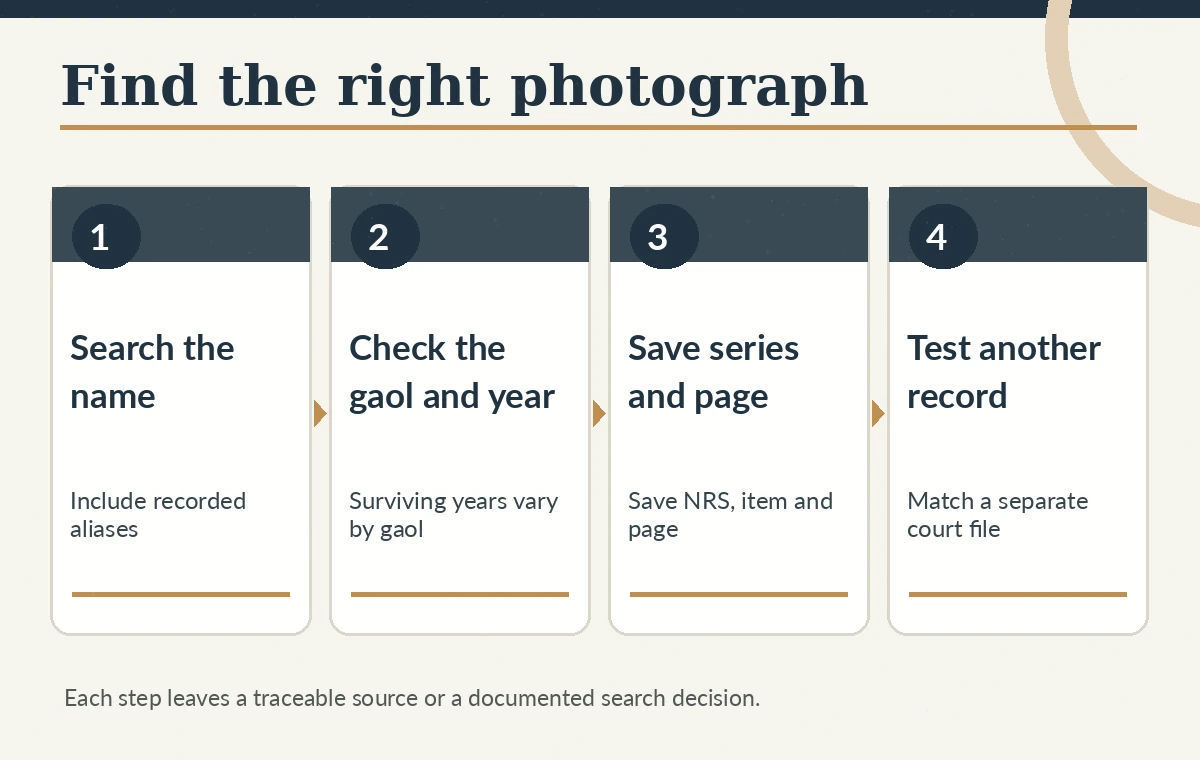
The NSW Gaol Inmates and Prisoners Photos Index is a route into surviving photographic description books, not a complete list of everyone imprisoned in the colony or state. Search a name and likely alias, then record the gaol, photograph date, archival series, item and page before comparing an entry with independent evidence. The books broadly span 1870–1930, but individual gaols have different surviving periods; not every inmate was photographed. The procedure below distinguishes a face, a prison admission and a verified ancestor, which are three separate claims.
Understand what the index actually covers
Museums of History NSW describes photographs and accompanying descriptions from multiple gaols, not one centralized, continuous admissions register. Each establishment has its own date range, and specialized books for particular groups also appear in the online index. A blank name search could therefore mean that the person was held elsewhere, entered outside the surviving dates, was photographed under another name, or was never photographed. First write down the specific gaol or district you are testing and the plausible decade. Treat the archive’s gaol coverage table as a survival screen before deciding whether an absent result matters.
Search name variants before relying on a portrait
Begin with surname and first name together, then repeat surname-only searches and consider recorded aliases. The official index provides fields such as date of birth, place of birth, gaol, photograph date, photo number, remarks and archival location. Entries may preserve multiple aliases or uncertain spellings taken from earlier index cards. Search results are not proof that these aliases belong to your relative; they are assertions from an administrative record. Copy the exact spelling from every candidate instead of silently normalizing it to the version in a family tree. Compare each candidate side by side before choosing.
Capture series, item and page, not just a name
The value of a photo index is its path back to an identifiable surviving page. Record the gaol’s name, the photo date, any photo number and the precise NRS, item and page displayed. Those identifiers distinguish two prisoners with the same name at different institutions, and they help locate or request a better copy when an image is unclear. If you share the discovery with another researcher, a surname and web search alone are not reproducible. Keep both the displayed index information and your note about what original page you have actually inspected.
Read the entire description beside the photograph
The NSW guide lists possible descriptors including aliases, native place, approximate birth year, trade, ship of arrival, physical features, trial location, charge and sentence. Fields are not guaranteed to be complete or equally reliable. A birth year calculated from an age may be approximate; an arrival-ship name may be a report rather than an independently verified voyage. Where available, distinguish observations made at intake from later annotations. Transcribe identifying marks and occupational details exactly, but remember that historical descriptions can reflect institutional bias and obsolete or offensive terminology.
Distinguish photograph date, admission and trial date
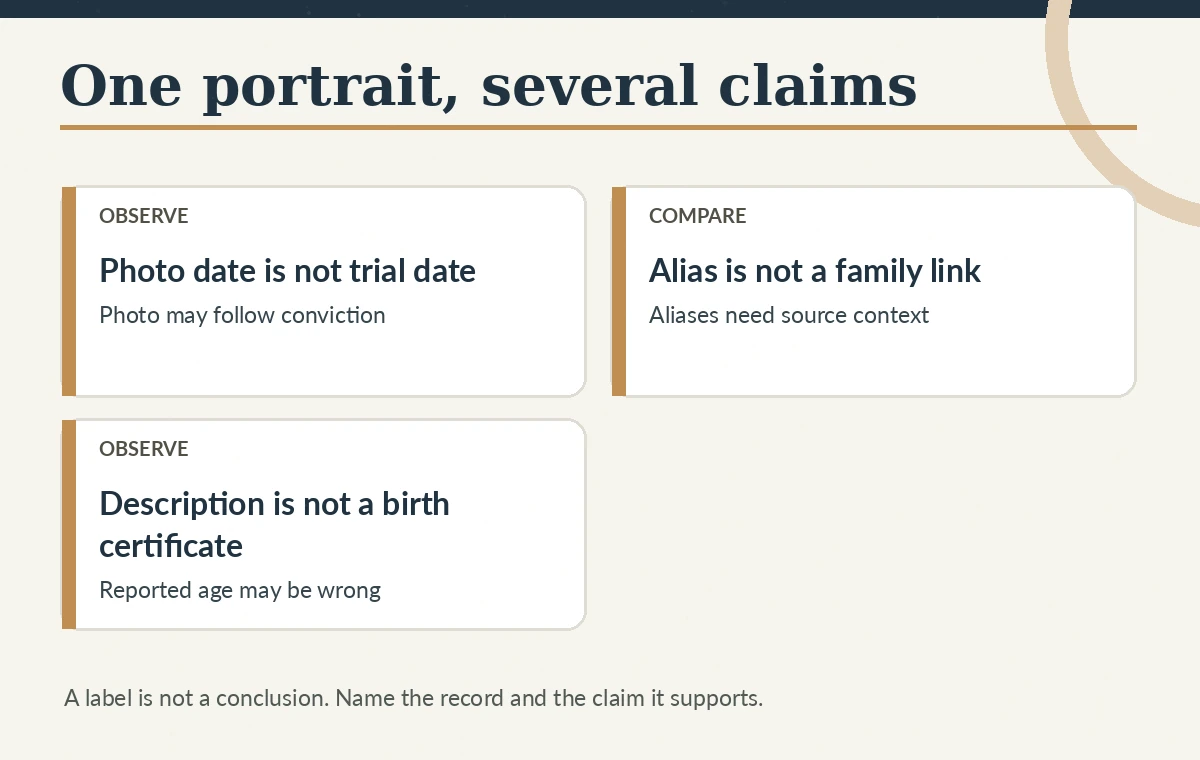
A portrait taken after conviction is not necessarily the day of arrest, entry into custody, trial, discharge or release. Record each date under its own column and label the associated source. When the prison description gives a court name or offense, search the appropriate court or police records for the legal event. When the same prisoner appears several times, each photo date may represent a distinct custody episode, rather than a simple continuation of one imprisonment. A chronology with separate dates is more reliable than a biography assembled by blending labels into a single event. A similar decision comes up in our guide “Scottish Prison Registers”, which explains how to read admissions without assuming conviction.
Build an alias and gaol identity matrix
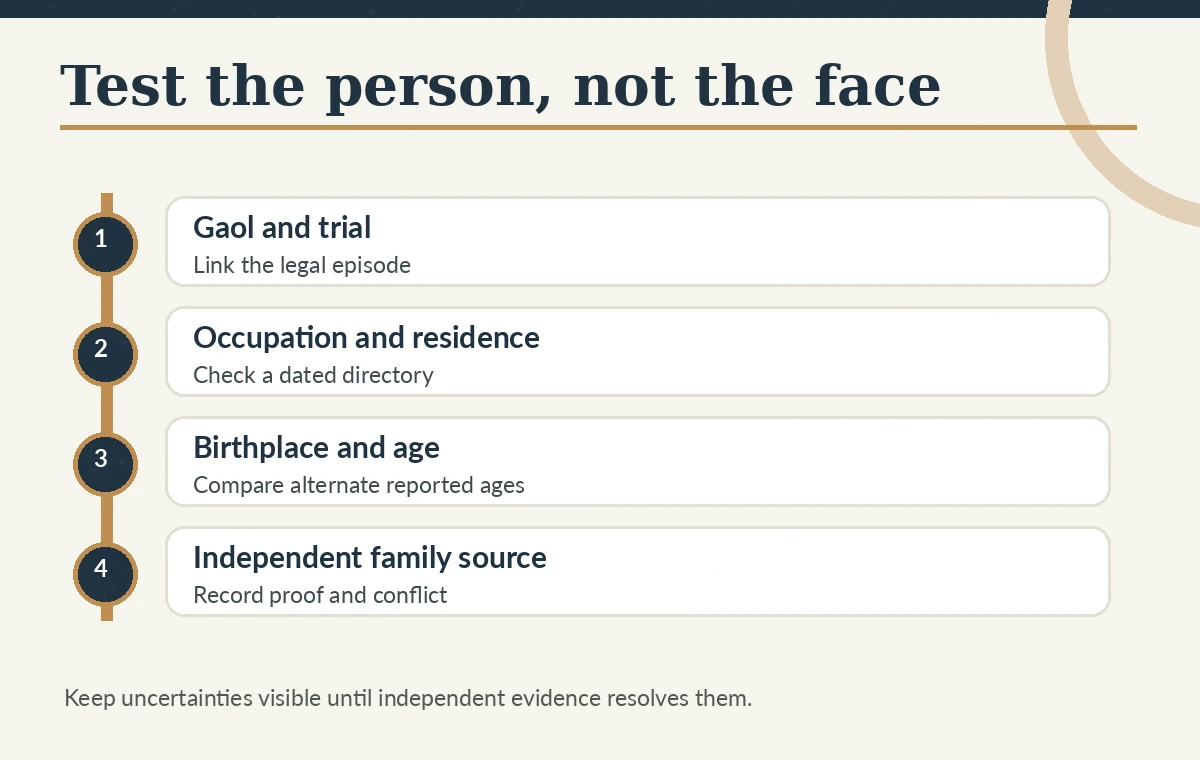
For two fictional candidates called Thomas Reid, suppose one entry gives Maitland, a 1903 photo and an alias; another gives Darlinghurst in 1896 and a different occupation. Do not choose by which face looks familiar to a descendant. Compare place of birth, reported age, occupation, known residence, spouse or household dates, gaol, trial court and actual archival references. Mark each match as consistent, contradictory or unknown. The example is illustrative, not a claim that either prisoner existed; the decisive test is a separate record tying the family member to that precise legal episode.
Find a separate record of the alleged event
A gaol photo description book was created for correctional administration; another record can independently test its content. Look for court proceedings, surviving police gazettes, local newspapers or discharge records at the relevant place and date. Confirm that the reported court and offense are compatible before treating the photo entry as an ancestor’s experience. Newspaper reporting can be inaccurate, and a charge differs from a conviction. The goal is not to find an embarrassing story, but to establish whether two independently created records describe the same historical individual and what actually happened. To go further, our guide “Sydney Gaol Entrance Books, 1819–1841” shows how to find a prisoner and verify the entry.
Handle difficult images and gaps carefully
The archive notes that photographs were copied from fragile bound volumes; glare, page curvature and damage may affect digital images. Do not infer an illegible characteristic from a damaged photo, and do not modify a displayed historical face to make an identity claim. If a scan is inadequate, check the archive’s reproduction guidance and retain a copy of the original description. Even a very clear face cannot alone establish a relationship to a person in a family photograph. A missing page, missing institution or absent portrait is a limitation of survival and access, not evidence of innocence or absence.
Record responsible conclusions about incarceration
Distinguish allegations, recorded convictions and sentences, and actual time in custody. People named in the books were documented by institutions exercising power; the language can be stigmatizing, particularly for marginalized communities and children. Quote only the historical language required to explain the entry, with attribution. Avoid publishing identifying detail about living relatives without consent, and never imply that a descendant inherited a legal or moral characteristic. The record documents an institutional encounter and may not tell the full story of the person’s life or the circumstances behind imprisonment.
Write a citation and next-record question
A useful working citation identifies the NSW State Archives Collection, gaol, photographic description book, NRS number, item, page, photograph date, and the repository’s index or image URL with access date. Then write a short conclusion specifying which details match an independently established ancestor, which details conflict and what remains uncertain. If the identity is not established, state that openly. One focused next search—such as a named court docket in the month before the recorded sentence—is better than downloading another dozen undifferentiated portraits.
| Evidence | What it supports | What it cannot prove |
|---|---|---|
| Index hit | A photographed candidate is indexed | Identity with your ancestor |
| Photo and description | Reported appearance and custody clues | Accuracy of every personal detail |
| Court record | A separate case or ruling | Automatic match to the portrait |
| Family record | Independent residence or kinship clues | That two matching names are identical |
How We Research
We checked the issuing archives’ public research guides and series descriptions, identified what each search route does and does not establish, and separated index data from original documents. All named example people in this guide are explicitly fictional. The coverage, access and jurisdiction cautions come from the custodians’ descriptions, not assumed completeness. Consult current item access conditions before ordering or sharing sensitive material.
More Records and Archives Guides
NSW gaol photograph indexes and original record guides
Official NSW Gaol Inmates and Prisoners Photos Index, with gaol coverage, series and item references (mhnsw.au).
State Archives guide distinguishing entrance, description, photographic and discharge books (mhnsw.au).
Museum article on multiple photographic entries for one person and descriptive fields (mhnsw.au).
Editorial note: This independent historical research guide provides no legal advice or paid referral recommendation. No commercial partnership is claimed. Follow applicable privacy and archive access rules. See our affiliate disclosure.
No. The NSW State Archives expressly cautions that photos were not taken for every prisoner and coverage varies by gaol.
Yes. Check recorded alternative names and index remarks, then verify whether the alias belongs to the specific candidate.
Cite the particular gaol, photographic description book, archival series, item, page and photo date, not only a search-results screen.
Not by itself. Check the trial and court outcome; distinguish being photographed or held from a specific proven charge.
Preserve the original and consult the archival copy service or descriptive page rather than inventing missing details.