
Queensland State Archives is not simply another search portal for birth certificates. Its family-history collections include immigration, land orders, naturalisation and other government files, while certificates belong to the separate Registry of Births, Deaths and Marriages. For an immigrant ancestor, the most useful starting point is often the archive’s assisted-immigration index, which links many names to original ship-arrival registers. This guide explains how to follow those links and why a failed name search does not mean your ancestor never arrived. The fictional examples are methods, not claims about any named real family.
Choose the correct Queensland archive before searching
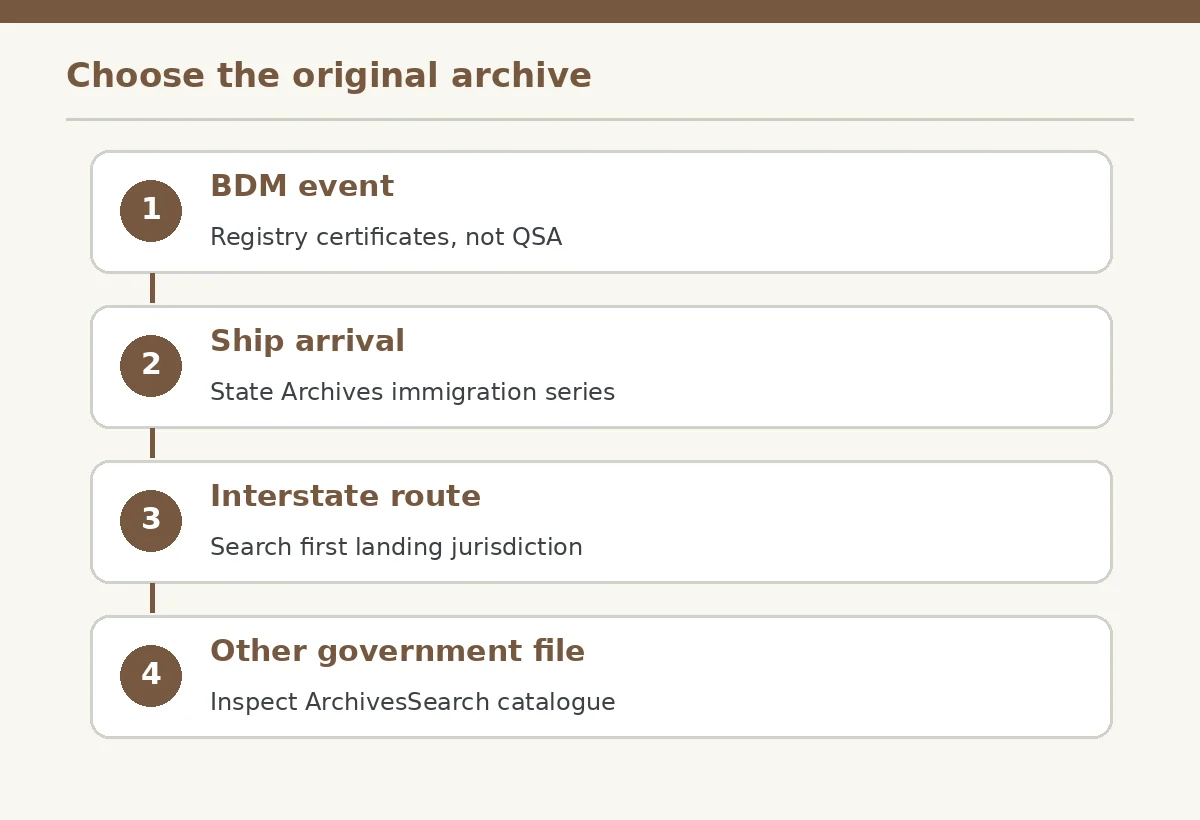
The Queensland Government’s State Archives family-history page explicitly says birth, death and marriage certificates are not held there for direct viewing: those must be sought through the BDM Registry. The archives instead preserves government-created series that may name immigrants, land-order applicants or people involved in court and school administration. Start with the record-creating agency relevant to your question. If you are trying to establish a ship arrival, collect a probable year, arrival port, original surname spelling and any later locality. If you need to confirm a wedding, switch to BDM rather than treating a passenger-list result as a marriage record. This distinction prevents redundant requests and mislabelled citations.
Use the assisted immigration index for 1848–1912
Queensland State Archives describes an Assisted Immigration index covering 1848–1912, derived from Registers of Immigrant Ships’ Arrivals. Its guidance provides direct links to digitised passenger lists for many entries. Search with given name and surname, then broaden to a surname alone if an initial, middle name or spelling has changed. Inspect the result details and use the image link where available. The original list may give the ship, voyage timing, port, group and type of passage, although fields differ over time. Record the series identifier, ship and image details. An index name with the right birth year is only a candidate until compared with a subsequent independent event. Our guide “Queensland Unassisted Passengers” goes into more detail.
Read the passenger list in its administrative context
The archives notes that the earliest surviving lists may provide only the immigrant’s name, vessel and arrival date; later records may supply occupation, marital status, nationality or sponsors. Do not project a later form’s columns backward onto a sparse earlier manuscript. If relatives appear near each other, inspect whether the list labels them as a family group rather than inferring kinship from line order. Preserve a literal transcription of occupation and origin, even if the place has since changed its name. A ship’s arrival at Brisbane does not prove a traveler settled there permanently. Search for a dated residence or marriage afterward to link the traveler to the ancestor in your tree.
Account for the 1893 Queensland flood losses
The official immigration guide warns that many earlier manifests did not survive and that pre-1893 immigration documents suffered flood damage in 1893. Some damaged records were later rewritten by departmental staff and may contain transcription or voyage-date errors. Consequently, a neat surviving transcription may not be contemporary with the journey. Mark whether you viewed an original manuscript or a later reconstruction. If the reported arrival year conflicts with a newspaper ship report, record the conflict and compare vessels, itineraries and dates rather than choosing the prettiest copy. A negative archive search cannot establish non-arrival when the underlying series has a known survival problem.
Test whether the traveler was eligible to be recorded
Queensland State Archives states that its immigration holdings particularly document assisted, nominated or free passages administered under government programs. A person who funded their own voyage may not appear in those immigration series. Likewise, a traveler who disembarked in another colony before moving overland or by coastal steamer to Queensland may not have a Queensland overseas-arrival record. The archive’s lists are largely focused on immigrant arrivals from Europe; coverage of journeys from elsewhere is not a complete mirror of all migration into the state. Before searching again, classify the likely journey: sponsored, assisted, self-funded or interstate movement. That classification points to different repositories.
Expand beyond the main ship register when useful
Queensland’s current archive index includes land orders for 1861–1878, nominated immigrants in various districts, Brisbane immigrant registers, and later immigration correspondence or passenger series. These collections document different steps of migration, and some reflect an intention or application rather than completed travel. An immigrant remittance entry may show money sent for passage, not a guarantee that the intended traveler embarked. Try port- or depot-specific holdings when the main index returns nothing. Record each collection’s coverage and what kind of administrative event it actually captured. The useful output is a documented sequence of application, voyage, arrival and residence—not one undifferentiated ‘immigration fact’.

Use adjacent colonies and federal archives as alternatives
If a family tradition says a person landed at Sydney then traveled to Queensland, search the arrival jurisdiction first; Queensland’s own guide specifically warns about migrants entering through another colony. For later twentieth-century travel or self-funded arrivals, the National Archives of Australia may have more appropriate series than a state-assisted-immigration index. A contemporary newspaper ship notice can establish that a vessel reached a port on a date, but not that your named ancestor was on board unless the notice or another source says so. Work through the trip in chronological order. Avoid copying unverified ship names from collaborative trees when official records and local documents disagree. For a comparable plan elsewhere, our guide “Grosse Île Immigration Records” shows how to find deaths, ships, and sources.
Correlate an arrival with the correct family member
Suppose a hypothetical Elizabeth Nolan appears on a passenger list in 1882 and the same name appears on a Queensland marriage record in 1886. You still need to test whether both entries describe the same person. Compare age, spelling, reported origin, occupation and the earliest known address after arrival. Seek an independent record with a spouse, child, relative or employer where possible. If there are two passenger entries for the name, keep both candidates open and state the exclusion test for each. Arrival data is often self-reported or clerically copied, so small discrepancies are not automatic disproof. Equally, matching names do not justify a confident family-tree merger.
Record the proper archival citation and limits
Cite Queensland State Archives, the specific immigration series and item or index name, the ship, arrival date and page/image locator. Save the original document when allowed and annotate any later transcription separately. Log searches that produced no result, including whether you checked assisted, nominated and port-specific indexes. Document the condition of a record if the scan shows a later rewrite. Archive web interfaces change; retain enough descriptive metadata to rediscover an item after its URL moves. State precisely what you concluded, such as ‘this person appears on a named assisted immigrant list,’ rather than claiming a birthplace, relationship or lifelong residence not proved by the page. For the fuller picture, see our guide “Queensland Historical BDM Records”.

Quick Evidence Log to Keep with This Search
| Source | What to save | What remains open |
|---|---|---|
| Index or search result | Name, search settings, record reference | Is this the correct person? |
| Original record image | Series, page, exact wording | Who provided the information? |
| Independent corroboration | Place, date, author, separate citation | Do details and timeline agree? |
How We Research Queensland State Archives Family History
This guide follows the specific institution guidance linked below and distinguishes original records from searchable indexes. We checked descriptions of the relevant collections on 2026-10-20. The sample people and scenarios are fictional. We did not interpret absent index results as evidence that an event never happened, and none of the diagrams reproduces a government record. If an access or digitisation rule changes, the current repository instructions take precedence over our summary.
More Records and Archives Guides
Verified Institutional Sources and Further Reading
Queensland State Archives explains assisted immigration 1848–1912, flood damage and original scan access (www.qld.gov.au).
Queensland State Archives separates agency-produced archive holdings from BDM registration records (www.qld.gov.au).
Queensland provides detailed searchable series for immigration, land orders and related records (www.qld.gov.au).
FamilySearch describes selected Queensland immigration index collection and archival provenance (www.familysearch.org).
Research and disclosure: these are editorial information guides, not archive endorsements or paid placement. No affiliate offers are used in this article; see GenHis affiliate disclosure. Verify current access conditions and respect privacy restrictions, particularly in records potentially involving living individuals.
No. Its official family-history guide points BDM certificate researchers to the separate Queensland Registry.
Start with the Queensland State Archives Assisted Immigration 1848–1912 index and open the linked ship register image when available.
Early series were incomplete, and the archive reports substantial damage to older immigration records during the 1893 floods.
Not necessarily. These records mainly represent government migration schemes; independent passengers may require another archive.
No. Match the record to a separately established timeline using ages, places, names and subsequent evidence.