
Start with the correct Victorian passenger series before treating a name match as your migrant. Public Record Office Victoria identifies unassisted inward passengers for 1852–1923, a period when privately funded passages were often recorded with brief or inconsistent personal details. Separate sequences reflect arrivals from British, foreign and New Zealand ports; early passengers can be missing or reduced to initials, a surname or a family group. This guide shows how to select the relevant series, follow the index to a real image, handle missing names and compare an arrival claim with independent evidence from life in Victoria.
Choose unassisted inward travel instead of coastal or outward lists
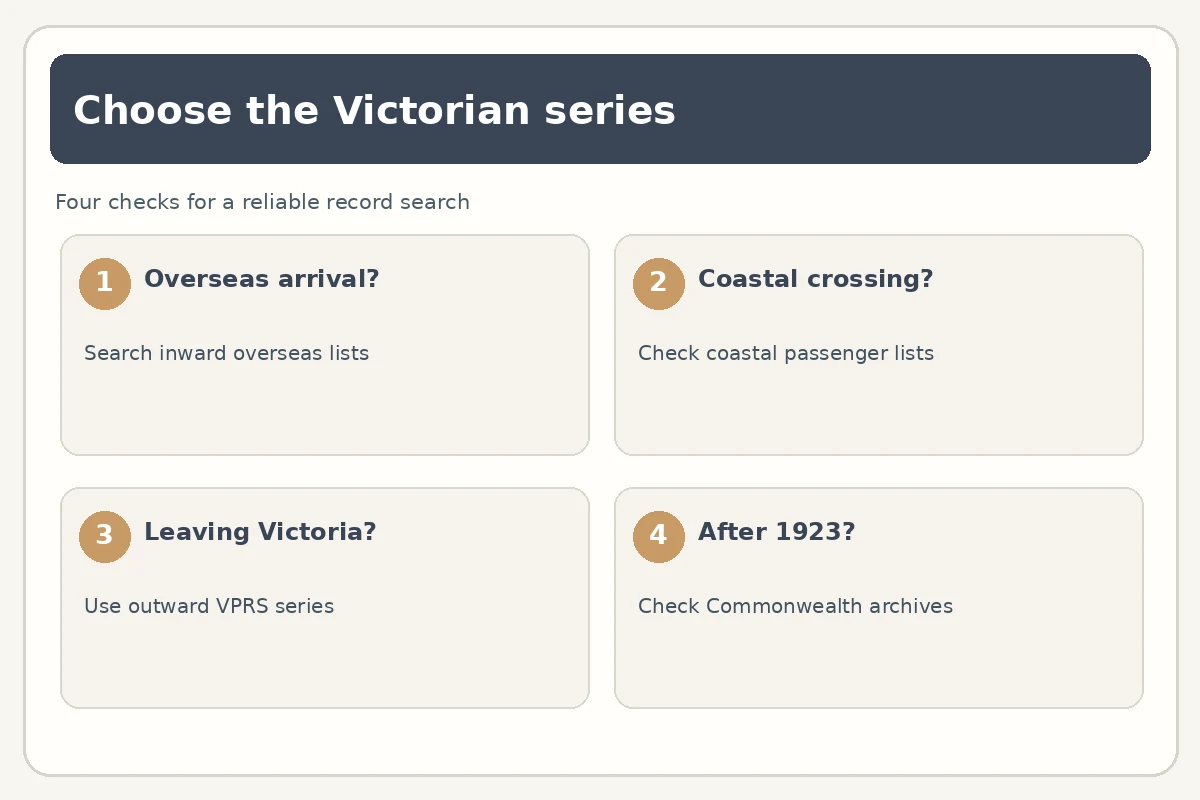
The first decision is the direction and kind of journey. PROV separates inbound overseas passages from coastal arrivals from another Australian port and outward journeys leaving Victoria. A family might have landed at Sydney, then traveled by ship to Melbourne; searching only the overseas inward series for Victoria can miss that later leg. Unassisted means people paid their way or were privately sponsored, as the State Library explains. It does not mean their names were recorded reliably, or that a traveler came alone. Use an approximate year and first known Victorian location to ask whether your relative arrived from overseas directly, moved between colonies or left and later returned. Write that itinerary hypothesis before searching a database. For the fuller picture, see our guide “Victoria Coastal Passenger Lists, 1852–1923”.
Use the 1852–1923 date range with its real limits
The published index spans 1852–1923, but the State Library cautions that pre-1852 information is covered by separate sources and that individual unassisted travelers were not always recorded fully even after 1852. Search results in the official online index may lead to a digitised list, yet a list can remain extremely brief. After 1871, assisted migrants were no longer maintained in a separate Victorian assisted-arrival series; the later unassisted lists therefore need to be checked for arrivals that were actually subsidised. That administrative change is an important exception to a simplistic “paid versus free passage” keyword search. For immigration after 1923, consult the National Archives of Australia’s Commonwealth-era records rather than expecting coverage to continue indefinitely at PROV. For a related choice, see our guide “NSW Unassisted Passenger Lists, 1826–1922”.
Select British, foreign or New Zealand origin sequences
PROV’s finding guidance explains that the historic inward lists were managed in different sequences based on where voyages originated: British ports, foreign ports or New Zealand ports. These are filing arrangements and need not describe a passenger’s nationality or birthplace. A British-born individual could board a ship elsewhere, and a voyage from a New Zealand port could carry travelers from several origins. Start with the port from which the vessel sailed as recorded on the list, not a family’s ethnic label. Where a surname index does not find the person, a known ship and month may allow direct review of the appropriate sequence. Always note which index or microfiche series you consulted, because the same surname can recur on many vessels. For the fuller picture, see our guide “New Zealand Ship Passenger Lists, 1839–1973”.
Read the list image alongside the indexed summary
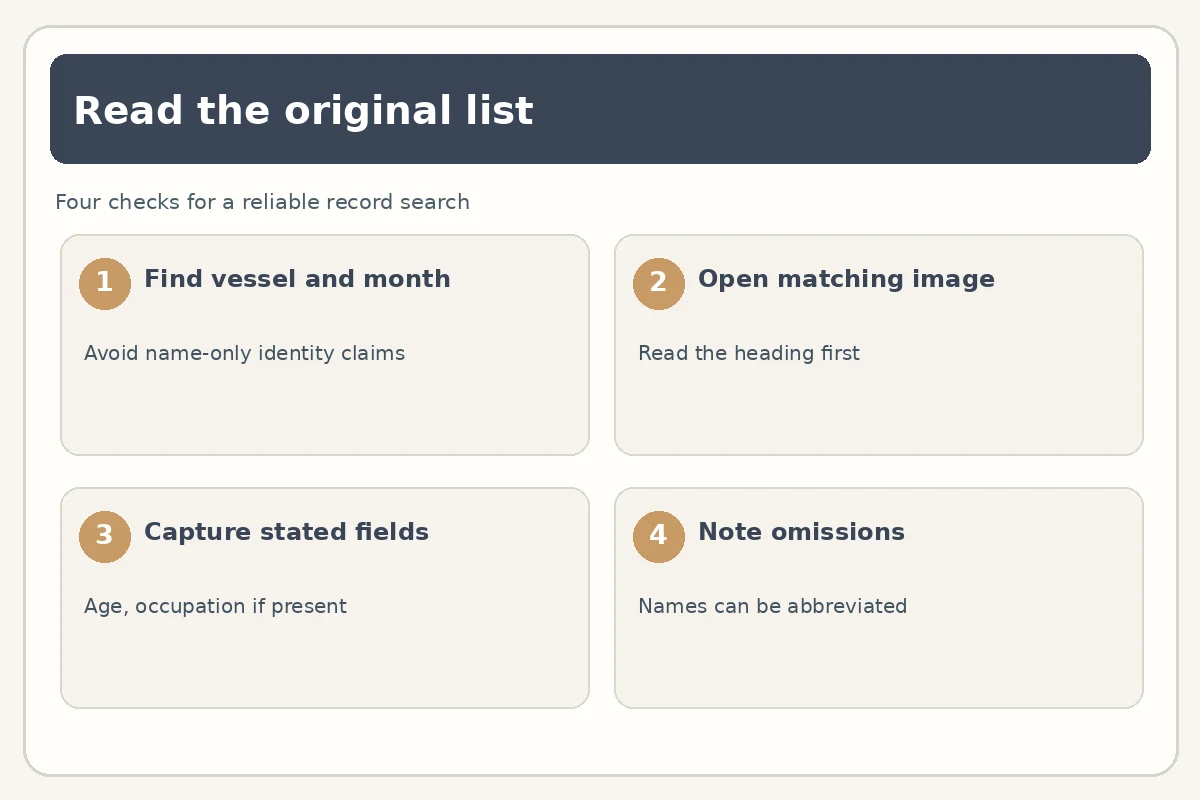
After a plausible hit, view the digitised unassisted passenger list. Read the ship’s heading, voyage and passenger category before extracting the name. Lists usually contain age, sex and marital status, with nationality or occupation appearing frequently but not uniformly, according to the historical series description. Some passengers appear only by initials or as “and family”; the State Library also warns that women, children and servants were sometimes left out. Do not fill an absent child’s name from an online tree or an adult’s exact birthday from an age entry. Transcribe both the information that is present and what the source does not record. When the image contradicts the search index, keep both readings and explain the discrepancy. For a related choice, see our guide “NSW Assisted Immigrant Passenger Lists, 1828–1896”.
Work around omitted names using a documented ship
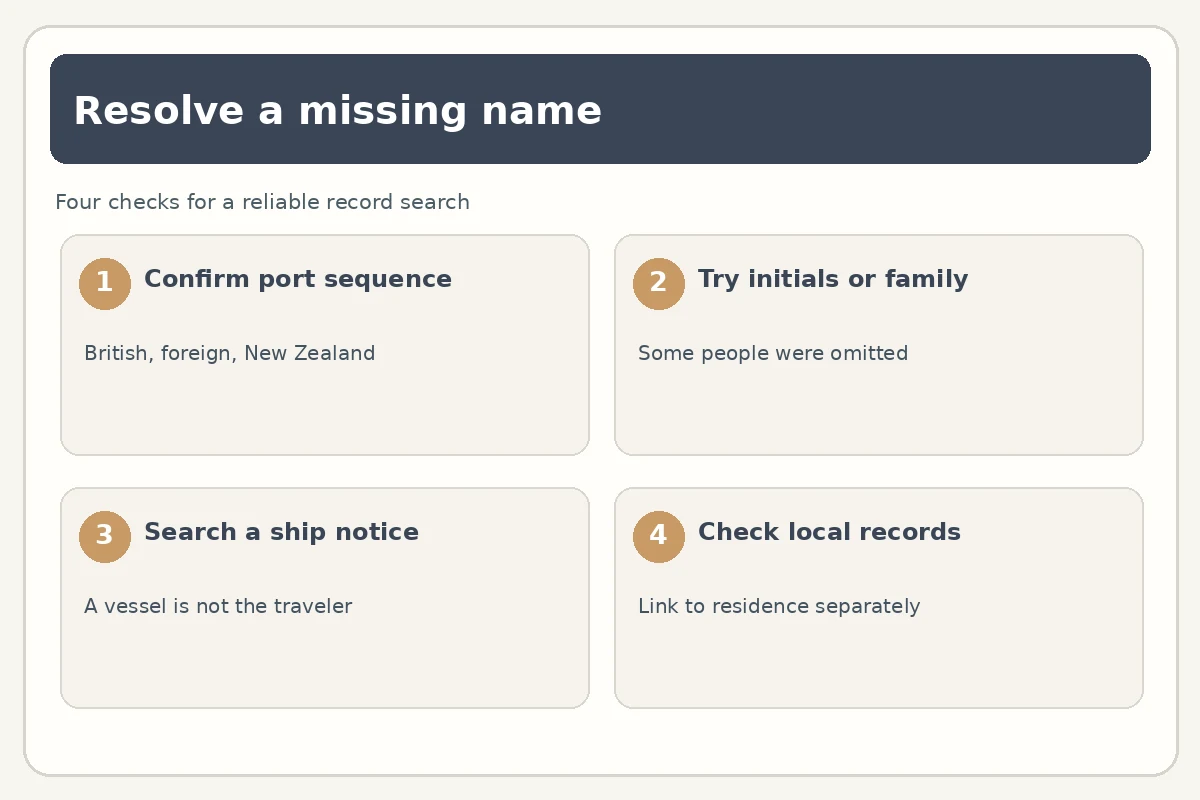
Suppose a family letter names a vessel and approximate arrival month but the index returns no surname match. Locate that ship in a PROV index or digitised list for the month, then look for alternate spellings, a head-of-household entry or an unnamed family group. Search period newspapers for shipping intelligence while recognizing that such reports can omit passenger names. Do not conclude that the voyage was impossible simply because an individual line is absent. Note whether the ship arrived at Melbourne or another Victorian port, whether the list reflects overseas or coastal travel, and whether more than one voyage used the same vessel name. The combination of a vessel and date constrains the search but still requires corroboration of personal identity.
Separate the voyage event from residence and relationship claims
An arrival record proves, at most, what its recorded details support about a traveler at a particular time. It does not by itself show a couple married after landing, permanently settled in Melbourne, or are the parents of someone born later in Australia. Test any identification against land, marriage, birth, directory, employment or burial records in a plausible locality. If the same name appears on a second ship a decade later, consider whether it was a return trip or another individual; compare ages, occupation and independent context. A fictional match such as “J. Brown, 26” is especially weak without a known ship, residence or linked family member. Record confidence and the missing evidence, not just the attractive candidate. Our guide “South Australia Passenger Lists, 1836–1940” adds more detail on this.
Build a PROV citation with the inward series identifier
A reusable citation needs the archive, collection title, VPRS series if identifiable, ship, arrival month and year, the particular page or image, and the passenger’s recorded name. The VPRS 947 archival description identifies a key inward overseas series; related copies and indexes can bear their own reference numbers. A search hit and digitised page are different artifacts, so cite both when an index reading was essential to the discovery. Save the URL or archive item reference and note the date it was accessed. If using the State Library’s microfiche route, record the film or fiche identification as well. Precise references are essential when several similarly named ships arrive in consecutive seasons. Our guide “Victoria Assisted Passenger Lists, 1839–1871” adds more detail on this.
Handle the absence of a passenger without inventing a record
Check whether the voyage fell before 1852, after 1923, into coastal rather than overseas lists, or into a different port-origin sequence. Then consider abbreviated entries, possible omission from the register, variant spelling, and whether a ship name was remembered correctly. The State Library openly describes such limitations, so do not turn a name-index failure into evidence that the ancestor never reached Victoria. Try an independent clue such as first employment, later marriage or a named ship in a family letter. If the paper trail remains incomplete, label the immigration date as an approximate inference and cite the records that establish the bounding dates. That is stronger research than a fabricated manifest. Our guide “Victoria Outward Passenger Lists, 1852–1923” adds more detail on this.
How We Research Historical Passenger Records
We distinguished PROV’s official collection categories from State Library Victoria’s detailed warning about abbreviated and missing travelers, then checked the PROV explanation of British, foreign and New Zealand sequences and the VPRS 947 description. We did not treat the 1852–1923 range as continuous name completeness. The examples use invented scenarios rather than private passenger biographies.
More Records and Archives Guides
Official Record Collections and Research Sources
Public Record Office Victoria distinguishes assisted, unassisted, coastal and outward passenger collections, and notes Commonwealth responsibility after 1923 (prov.vic.gov.au).
State Library Victoria describes how unassisted lists for 1852–1923 can omit some passengers and how indexed images can be searched (guides.slv.vic.gov.au).
PROV explains the administrative distinction between British, foreign and New Zealand port lists in its unassisted shipping recordkeeping (prov.vic.gov.au).
The official PROV-linked archival description identifies series VPRS 947 as inward overseas passenger lists and notes fields vary across the 1852–1923 period (researchdata.edu.au).
The vessel imagery is original illustrative artwork rather than an identified Victorian ship or a photograph from PROV. Lists with abbreviated names must not be used to reconstruct living people or invent family connections. We do not suggest endorsement by Victoria government archives. See GenHis affiliate disclosure for site relationships.
The main PROV unassisted inward series and index cover 1852–1923, with other sources needed earlier or later.
Potentially yes. Victoria ceased maintaining a separate assisted immigrant series after 1871.
Some people appear with initials or a family label, were omitted, or traveled through a different type of passenger list.
No. Its classification reflects the voyage or filing route, not proof of a traveler’s nationality.
Use it as a lead, but check the ship, page and other details in the source image before drawing conclusions.