
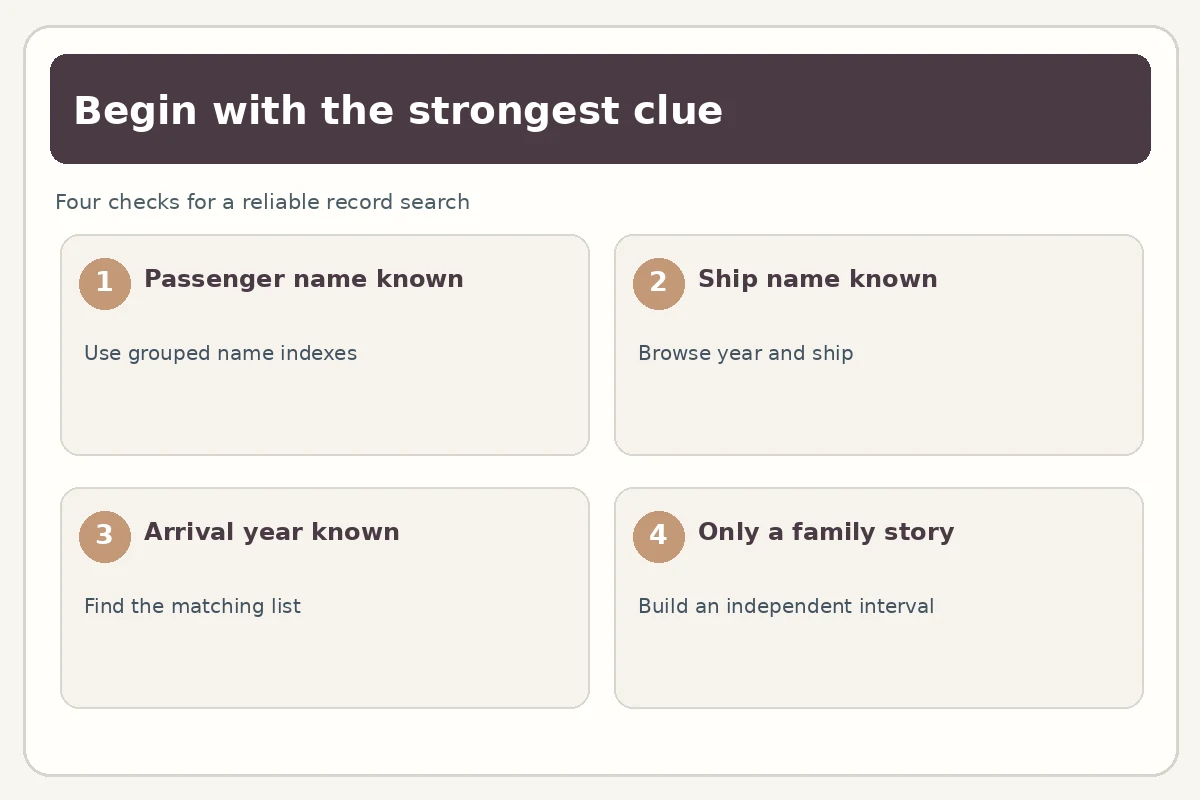
In South Australia, start with what you know: passenger name, ship name or arrival year. State Records of South Australia publishes several name indexes across 1836–1940 and digitised passenger lists organized by ship and year for 1845–1940. Those are not identical resources: early name references may have been extracted from newspapers rather than a surviving official passenger manifest. The archival route changes again for post-1940 arrivals. This guide provides separate searches for known names and known ships, explains how to resolve conflicting dates and shows how to record what an index actually proves.
Match a research question to the correct South Australian index
Decide first whether the key clue is a person’s name, a vessel or an approximate date. State Records provides name indexes grouped by document source and lists ships chronologically, so one large keyword search does not replace navigating these categories. Look up a surname in the name-based indexes for the relevant years, then use the ship and arrival date to find the corresponding digitised list. If you already know a ship, start with the year-and-vessel sequence and work backward to the passenger entry. Always read the explanatory key supplied with each index. A name from a newspaper-based transcript has a different evidentiary path from a clerk’s official register, even when the two match. For the same kind of choice in another place, see our guide “New Zealand Ship Passenger Lists, 1839–1973”.
Separate the earliest 1836–1845 material from later lists
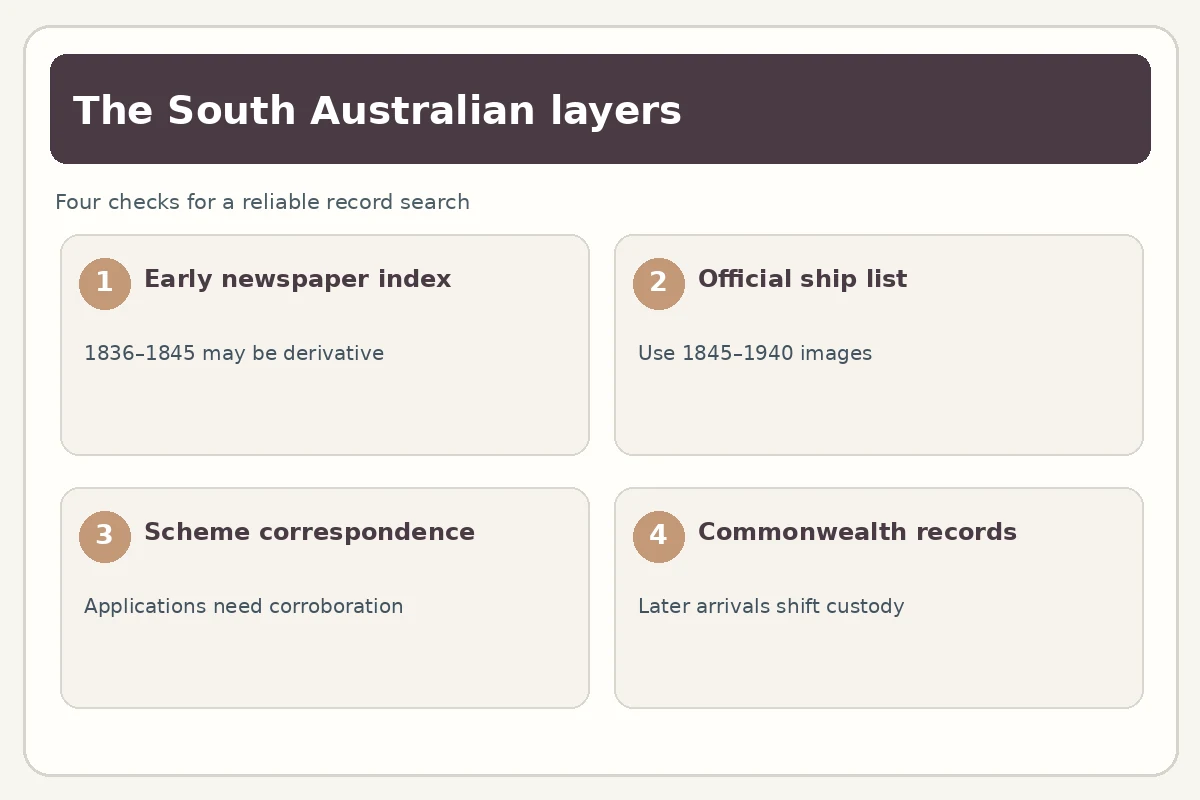
State Records describes an early 1836 reference connected to the ship Buffalo and newspapers-based passenger indexes for 1836–1845. These historical compilations should not be described as one uninterrupted set of original ship manifests. An index may cite a newspaper issue or an older printed extract that must be located independently. Before 1845, ask what item the index actually summarizes and whether an original list survives. When a name is absent, that may reflect the survival or transcription of a particular source, not a gap in the person’s migration. Record the index title and the code to its original source. If you cannot follow the citation further, say “named in derivative index” rather than “found on the original passenger manifest.”
Use the 1845–1940 digitised lists by ship and year
The South Australian archival guide identifies a set of digitised official passenger lists for 1845–1940, organized by year and ship name. Begin with the probable year; ships could make repeated trips, so verify the month and landing destination before opening a matching image. Browse the document heading to identify whether the list is incoming, outgoing, assisted, or otherwise classified. Passenger details can vary with date and record purpose. Transcribe the full line and document the page’s title, year, ship and any identifying archival reference. If the scan contains handwritten corrections, preserve them rather than using the index’s tidied version without comment. An index is a navigation tool; its corresponding image is the principal evidence. Our guide “Ship Passenger Lists” goes deeper into the South, 1538–1825: trace each name back to its source.
Search maritime notices when the ship name is uncertain
For nineteenth-century arrivals, the archive links to indexes drawn from newspapers, including shipping notices. Begin with a bounded time range inferred from independently dated events in South Australia, then search likely papers by surname and port. A shipping notice can show that a ship landed, but it may not list every traveler or clearly distinguish passengers from crew. If a family’s story preserves a ship name with uncertain spelling, compare the fleet names and dates in the archive’s ship-arrival list and look for similarly named vessels. Never assign a person to a vessel merely because that ship arrived in the right year. Your notes should label each item as name evidence, ship evidence or contextual evidence so unsupported leaps are visible.
Distinguish immigration schemes from ordinary arrivals
Government-supported passage arrangements generated paperwork beyond the passenger list, such as applications and correspondence. State Records describes records of migration schemes and government immigration offices in addition to arriving vessels. These may help when a passenger’s original entry is brief, but a sponsorship file may concern a proposed trip rather than proof that a person actually traveled. Read its creation purpose: application, nomination, approval, voyage list or subsequent employment. A familiar surname in an application should be compared with an actual arrival and the person’s documented later residence. If the scheme did not proceed, no arrival should be invented. Record the relationship between document types as a sequence of possibilities, not a guaranteed complete file for every individual.
Test arrival stories against the port and family chronology
An arrival at Port Adelaide does not alone prove a migrant stayed in South Australia or was related to other passengers with the same name. Confirm an approximate birth year, a later town, and at least one independent clue from a marriage, land record, directory, birth or obituary. Consider internal movement between Australian colonies after the initial landing. For a fictional family said to arrive together in the 1860s, a passenger list naming one “M. Ryan” does not establish which relatives were aboard; search for other names and later household ties. If ship and family chronology conflict, keep the contradiction and examine competing explanations. Reliability improves when your reasoning shows exactly how the arrival is linked to a documented individual. Our guide “Western Australia Passenger Lists” goes into more detail.
Route post-1940 research to the National Archives
State Records explains that South Australian passenger arrivals after 1940 are held by the National Archives of Australia, with Commonwealth passenger collections also covering broader Australian ports from the twentieth century. Do not apply a state archive’s 1845–1940 image guide to someone who arrived in 1954. Consult the National Archives’ arrival records guidance for the later series, search methods and any applicable access restrictions. Avoid exposing personal information about living travelers merely because a search interface presents it. Document which government had custody of the record at the date of arrival; modern repository labels can mask changes in recordkeeping authority. The aim is to choose a lawful, plausible archival collection, not to bypass its rules. Our guide “South Australia Assisted Passage Certificates, 1862–1885” shows how to check nominees.
Write a citation preserving name, ship and source layer
For a digitised South Australian list, capture the State Records collection title, vessel, arrival year and date, the person’s exact recorded name, page or image identifier, and the official item or series reference. For a newspaper index, add the underlying paper, publication date and page if the key provides them; do not present a derivative printed extract as an original logbook. Retain an image or stable archive citation, and note whether a transcription contained spellings different from the manuscript. A good working note also lists other possible arrivals with the same surname so future readers know what was tested. Separate the basic event statement from an inferred relationship or birthplace.

How We Research Historical Passenger Records
We checked the two navigation systems on the State Records of South Australia site, including the distinction between early newspaper-based extracts and digitised year-and-ship lists from 1845. We also consulted its separate descriptions of ships and migration-scheme papers plus the South Australian Maritime Museum guide. The graphics are original workflow aids, not representations of actual passenger pages.
More Records and Archives Guides
Official Record Collections and Research Sources
State Records of South Australia provides passenger name indexes for 1836–1940 and year-and-ship digitised lists for 1845–1940 (www.archives.sa.gov.au).
South Australia's government archive describes ship-arrival indexes and early source categories including newspapers and immigrant ship papers (www.archives.sa.gov.au).
State Records of South Australia explains the range of immigration holdings and that later arrivals are chiefly in National Archives custody (archives.sa.gov.au).
South Australian Maritime Museum offers a complementary guide to tracing a ship voyage and original official lists (maritime.history.sa.gov.au).
South Australian newspaper extracts and official registers have different evidentiary status; readers should follow each item to its cited document before reusing an arrival story. The illustrated ship is fictional and no historic manifest is reproduced. This guide carries no official archival affiliation; consult GenHis affiliate disclosure for relationship transparency.
There are early indexes and source extracts, but the complete digitised official-list route described by State Records begins in 1845.
Yes. State Records offers a year-and-ship arrangement for its digitised passenger lists.
No. Follow the source code and consult the original newspaper or manifest before making that statement.
Start with the National Archives of Australia, which holds relevant later passenger-arrival records.
They can provide clues when relationships are explicit, but a shared ship or surname needs corroboration.