
RG 35 preserves miscellaneous foreign death returns for 1791–1921. It is not a single global death register or a list of every British person who died abroad. Its usefulness depends on where and when a death was reported, the administrative channel involved, and which pieces survive. The National Archives’ guide places RG 35 beside, but not inside, related overseas series RG 32–RG 36. Start with a known overseas location and an approximate date, not with the assumption that a missing name disproves a death.
Select the Foreign-Return Series by Place and Date
First write the country, city, event year and name variants as separate inputs. The National Archives’ country-by-country table is the most useful starting point because it maps particular places to different kinds of returns. For France it lists death returns for 1831–1871 in RG 35/8–13 and later returns for 1871–1920 in RG 35/20–44. Other locations use different overlapping sections of RG 35 or entirely different Foreign Office references.
Do not use the date span 1791–1921 as a claim of complete annual coverage. It is the span assigned to the collection of miscellaneous returns. The exact piece, place and class of entry control whether your proposed person is even within scope. An absence in one set of volumes may be a location mismatch or reporting gap, not proof a person survived.
If the event occurred at sea, follow the sea-record branch instead of treating any coastal death as an RG 35 entry. The National Archives distinguishes merchant-ship reports in BT 158, BT 159 and BT 160 from overseas registers and consular returns. It is also possible that a local civil registrar recorded the death without any corresponding British return. Record the institution that created the evidence.
Use a location comparison table if a family member moved between ports. A death in a French city, a death aboard a British ship near France and an event recorded by a British consulate might all appear in different archival systems. Place the actual event, reporting authority and archive series in separate columns before ordering anything. This small triage step can prevent repeated paid searches against a volume that was never designed to include the event.

Understand What a Foreign Death Return Can Establish
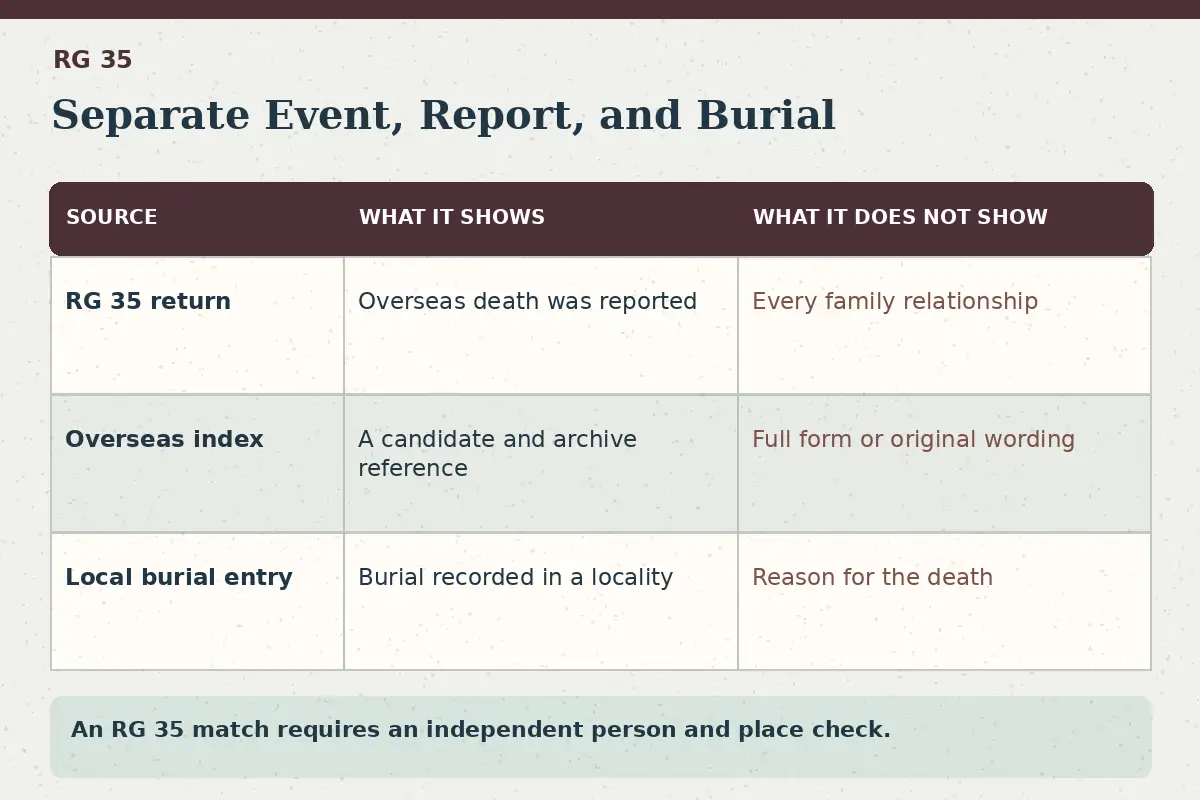
A return can provide evidence that a death was reported to a British administrative authority. Its detail depends on the form and period: do not promise an age, parent’s name, birthplace, occupation or a cause of death without reading the actual entry. Even a literal transcription of a name and event date is not automatic proof that the individual is the ancestor sought.
Preserve distinct dates: when the death reportedly occurred, when it was registered or notified, and when a copy reached a later archive. A later administrative return may be based on information supplied by a third party. If the return uses a place name that has since changed, transcribe the historical locality first and add the modern equivalent in a clearly labeled note.
Use a namesake test. Put in columns the candidate’s full name, age or estimated birth period, residence, known occupation, relatives independently established, and any distinguishing clues visible in the return. A match on a common surname, a city and a broad decade is weak. Prioritize a contemporaneous local death record, burial entry, employer notice or probate document to test the identification.
Do Not Treat Wartime Hospital Lists as Complete
The National Archives separately lists RG 35/45–69 for certain military deaths in hospitals and related situations during 1914–1920. The published guide warns that this group is alphabetically arranged yet lacks certificates for surnames beginning C, F, P, Q and X. An apparent absence under one of those initials is therefore not a family-history conclusion and not a routine failed index search.
Even where an entry exists, a wartime death return is not a complete service record or proof of the specific unit, battle or circumstances in which a person was wounded. If you need those claims, locate official military personnel, casualty, hospital or burial evidence that independently establishes the service number and the event. Do not add a regiment from a family story to a foreign return merely because the dates resemble one another.
For other countries, inspect the exact country line in the archival guide rather than transferring the special letter-gap warning to every record. Some sets are organized by location, others by time or administrative source. Negative evidence requires documentation that the relevant piece survives and was actually searched, including any omitted names or folios.

Cite the Return and Plan a Second Verification
Create a log entry for every searched reference: target name and spelling, historical place, event date range, RG 35 piece, image or folio identifier, website or repository, date accessed and result. Keep the difference between finding an index hit and inspecting the record explicit. Paid digitized access may be through TheGenealogist or Ancestry, but the historical archival reference belongs in the citation.
For a hypothetical report of a person dying in Paris in the 1850s, consult the applicable France and Paris categories and then compare the death date, age and address against another independent contemporary document. A return headed “France” may have been compiled for an administrative group much wider than one parish. It is wrong to assign an invented burial place from the collection heading.
When possible, identify a local death certificate or burial register in the country of death. If you find a will or estate file, distinguish the probate date from the death date and beneficiaries from proven children. Preserve disagreements as separate transcriptions with source citations. The final conclusion should state exactly which event is demonstrated and which relationships remain uncertain.
An example of a controlled negative search would read: France, 1856–1858, specified RG 35 pieces checked from originals, three name variants inspected, no matching entry found. That statement is narrower, and more useful, than a claim that a death never occurred. Keep a blank field for who reported the death; if the record names an informant, their reliability on birthplace or family identity is a new question, not an automatic guarantee.
More Records and Archives Guides
How We Research RG 35 Records
We use the non-parish and overseas records guide for the 1791–1921 RG 35 series boundary and the births, marriages, and deaths at sea or abroad guide for place-specific piece ranges, exclusions and available access routes. Both are official National Archives guides.
No imaginary death certificate is presented as historical fact. Dates, kinship and burial are assessed separately. Our affiliate disclosure explains editorial relationships; naming a commercial database does not imply a partnership.
The National Archives describes miscellaneous foreign death returns spanning 1791–1921; coverage differs by place and type.
No. They are distinct classes of overseas registers and miscellaneous returns; choose by event, country and date.
No. Available fields vary. Read the actual record before relying on a family relationship.
RG 35/45–69 has documented alphabetical exclusions, including surnames beginning C, F, P, Q and X.
No. A return or index may show a reported death; burial location needs its own evidence.