
HO 323 contains prison instructions and circulars issued to establishments by the Prison Commission and, after its transfer to the Home Office in April 1963, the Home Office Prison Department. Such records can establish official guidance, but not how every prison applied it or what happened to a particular inmate. This guide gives a precise source route, identifies what the archive can and cannot show, and names the independent documents needed before a personal or geographic conclusion becomes defensible.
Start with the Issuing Body and Circular Date
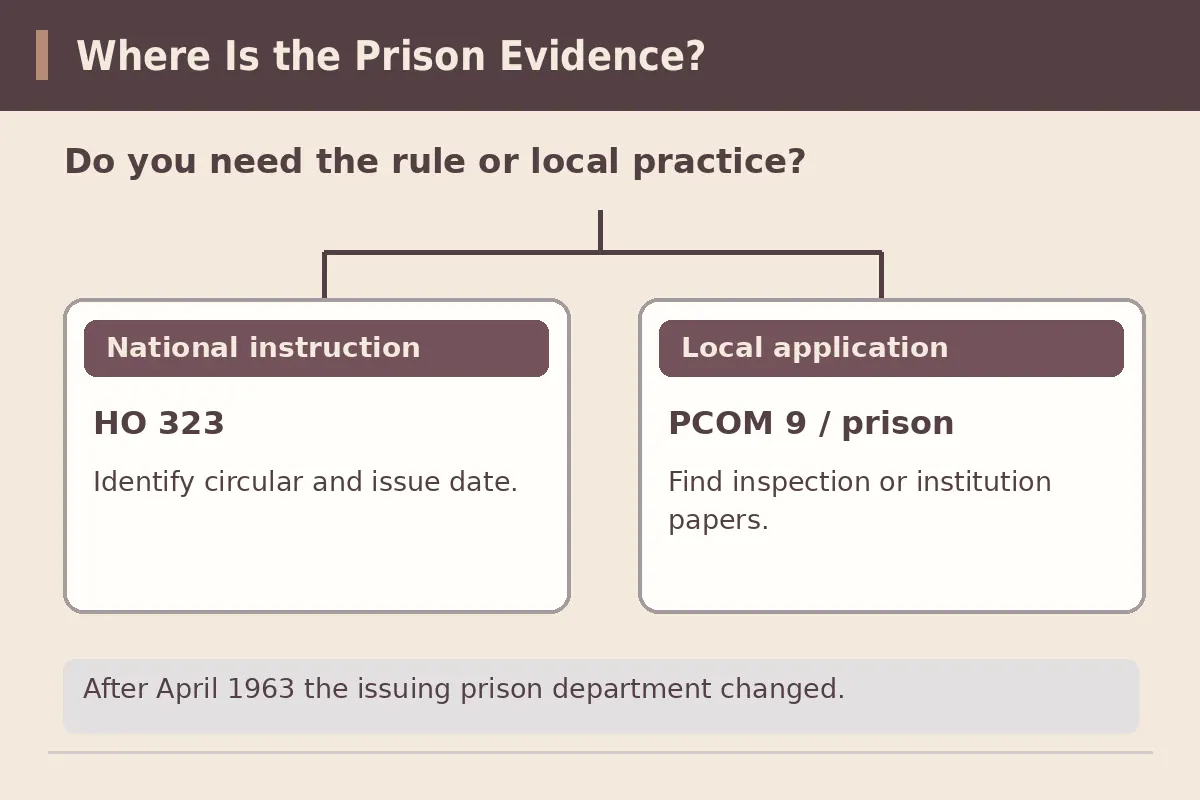
The National Archives identifies HO 323 as instructions and circulars issued to prison establishments for 1933–1981. Responsibility for prisons changed during that span: the Prison Commission was absorbed into the Home Office as a new prison department in April 1963. The two names are not evidence of two wholly unrelated kinds of prison, but the administrative change matters for understanding who issued or revised an instruction. Record the actual letterhead or issuer when inspecting an original item, rather than retroactively labeling an early circular as a later Home Office order.
Search the series by subject as well as the year. Possible subjects include management procedures, prison rules or everyday institutional administration; confirm that the specific catalogue piece covers your question before describing its contents. A printed circular date is not always the date local staff received or adopted it. A later amendment or replacement may exist. Keep columns for issue date, distribution date if shown, amendments, the effective date if stated and the years for which you can demonstrate continuing force. Otherwise use cautious language such as “an instruction was issued.”
Distinguish Mandatory Words from Demonstrated Compliance
Administrative instructions may use strong language such as “shall” or “must,” yet a government rule is still a different kind of evidence from an observation of practice. To study enforcement, ask whether records show communication to the target establishment, a local acknowledgement, inspections or disciplinary follow-up. The National Archives also lists PCOM 9 for prison management and HO 391 for later prison policy. These records can help test national intent against institutional administration, but they do not guarantee a consistent experience across all prisons.
Use a rule-to-practice worksheet with columns for the exact requirement, people or facilities covered, issue date, local institution, supporting action and unresolved conflicts. Do not turn an instruction about diet into proof that a named inmate ate a specified meal. A circular about visits does not show that any particular visitor entered. Even a surviving receipt stamp only proves delivery of the circular unless further evidence exists. When exceptions or complaints survive, quote them carefully without treating one prison as representative of the entire system.
Hypothetical example: a family account describes a change in prison visitation during the 1950s. An HO 323 circular could show an instruction issued in a particular year, while a prison visitors’ book or local correspondence could document changes at one establishment. Neither source, by itself, proves that a named relative was visited. The research question must move from national rule to local application and then to a person-level record.

Route Person-Level Questions to the Right Custodian
If your goal concerns an ancestor who was imprisoned, HO 323 is usually background evidence rather than a prisoner’s personal file. The National Archives explains that prisoner details are scattered across registers, court calendars, licences and local archives, and that there is no single complete national prison register. Start with the name of the prison, the court and an approximate date. A policy circular with matching years cannot prove that the ancestor was detained there. Local prison records may have different survival histories and may remain closed for privacy reasons.
For staff research, ask a separate question: did the person hold an appointment at that establishment during the period when an instruction was current? Staff registers, pay records or local minutes may establish that link. Still, employment does not automatically show responsibility for writing, issuing or enforcing a particular rule. One clerk’s initials on a circular may establish a receipt or transmission rather than authorship. Keep named individuals and national policy as separate strands until a record directly connects them.
Compare Earlier and Later Administrative Series
The official prison guide distinguishes the Home Office’s major registered papers in HO 45, Prison Commission management files in PCOM 7 and PCOM 9, and later Home Office prison policy papers in HO 391. These are complementary record sets, not stages every circular must move through. Search the theme within HO 323 first, then consult the others when you need the reasoning for a change or evidence of institutional response. A reference to a circular in a management file is not automatically its full text; obtain the relevant original where possible.
For a reform said to begin in a certain year, build a narrow before-and-after chronology. Identify the old guidance, any superseding circular and the local records that show whether practice changed. Avoid writing “this reform started nationwide” when the evidence merely dates an internal instruction or committee recommendation. The line between proposals, issued directions and implementation is particularly important in a long-lived series spanning changes in government structure. If records conflict, display each date and source rather than smoothing away the contradiction.

Evaluate Missing Pieces and Access Limits
A keyword search in Discovery does not read every paragraph inside an HO 323 file. Some descriptions are at piece or subject level and may omit the name of a local prison or individual. The National Archives warns that most prison-management collections are not directly viewable online, so researchers may need to visit Kew or order copies. Check the location and access conditions for each result. Do not assume that a later twentieth-century file is automatically open or that a lack of digital images means the record was never created.
An appropriate final finding might say a specific dated national circular prescribed a rule and that a surviving local minute recorded receipt. It should not say that every governor complied, or that a named prisoner experienced the measure, without other evidence. Provide a full archive reference and preserve exact wording where the rule is contested. That restrained claim is more useful than a dramatic account of treatment assembled from administrative paperwork alone.
Citation template: The National Archives, HO 323/[piece], circular number and title if visible, issue and revision dates, issuing body, and document consulted. Cite any PCOM 9, HO 391 or local prison source separately; do not attach a prisoner’s identity to the national circular without a direct documentary link.
More Research Method Guides
How We Research This Archive Series
This guide starts with the documented evidence in an authoritative source, not a claim that we have inspected a particular person’s private file or a specific original piece. The archival statements here concern the series or research method. A hypothetical example is labelled as such; it is not a newly discovered historical event. We use the Discovery search guidance to distinguish keyword matches from archive holdings and document contents, because catalogue descriptions do not transcribe every word of an original.
For every real candidate, record its historical place or person’s name, the creator, document type, date, full HO 323 piece or item reference, access restrictions, and the exact claim being tested. The official citation guide explains how to document those references so another researcher can retrace them. An unread document remains a catalogue lead, never proof of imagined details. If a record is missing, preserve the searched terms and dates and examine survival and alternate custodians before interpreting the gap.
Before sharing a conclusion, audit the difference between original source wording and your interpretation. Require independent evidence for any further claim about an individual, property owner, legal effect, or completed action. Respect archival access limits and living people’s privacy. This website also provides an affiliate disclosure; no paid partnership or commercial access is implied by these archival references.
Instructions and circulars issued to prisons from 1933 to 1981 by the Prison Commission and later the Home Office Prison Department.
Yes. The Prison Commission transferred to the Home Office in April 1963.
No. Look for local administrative, inspection or operational evidence.
Not reliably. Use prisoner registers, court material and the appropriate custodians for person-level claims.
No. Most of the management records covered by the official guide require a visit or copy request.