
Start an India Office church-record search with the event place, date, denomination and regional IOR/N series. The British Library holds copies of returns, not a complete civil register of everyone who lived in South Asia. Review the site’s affiliate disclosure before following any research-service links.
Know What the India Office Actually Received
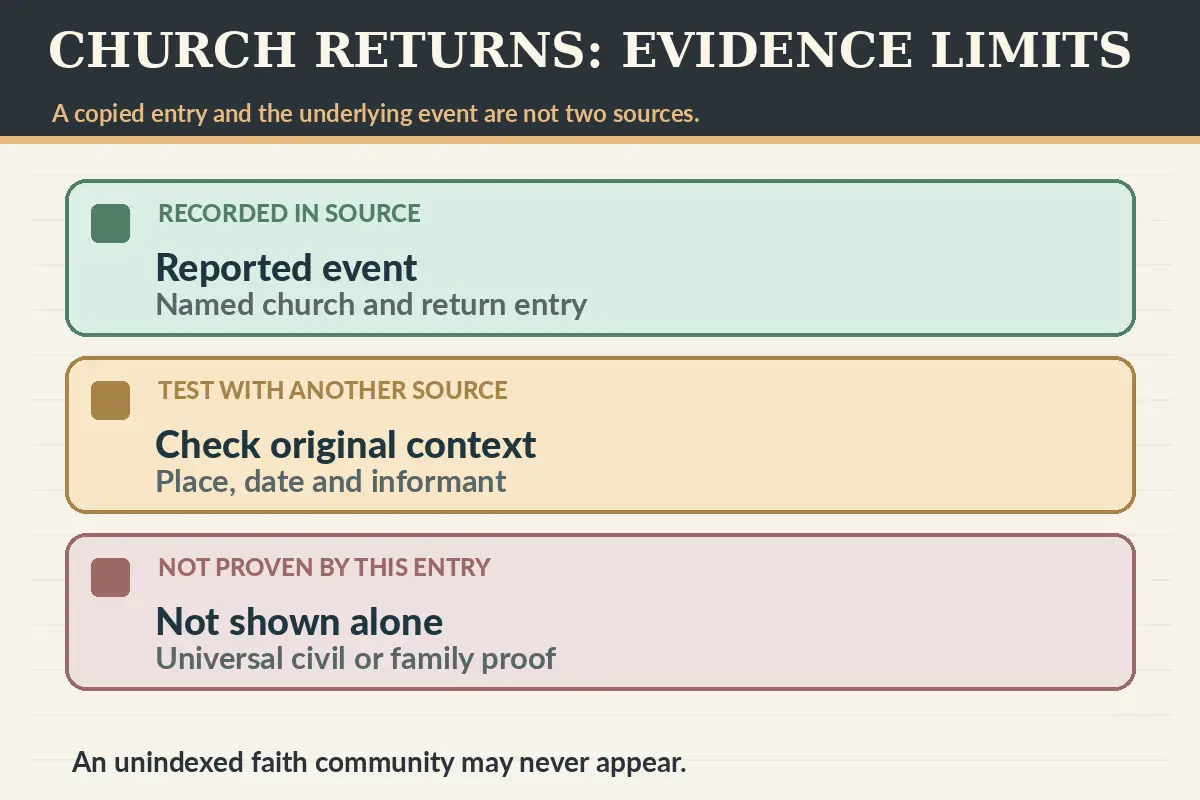
The British Library describes IOR/N Ecclesiastical Returns as copies of baptism, marriage and burial registers sent to London by chaplains and ministers operating in territories administered by the East India Company or the Government of India. The overall archival span is 1698–1968, with regional and religious differences. The collection predominantly concerns European and Eurasian Christians; it is not a comprehensive vital-registration system for all religions or communities living in India, Burma or neighboring territories.
Begin by writing the exact historical locality, approximate event year and known family religious affiliation. An Indian ancestor’s absence from the Christian returns does not demonstrate that no birth or marriage record was ever made.
Choose Bengal N/1 by Place and Historical Date
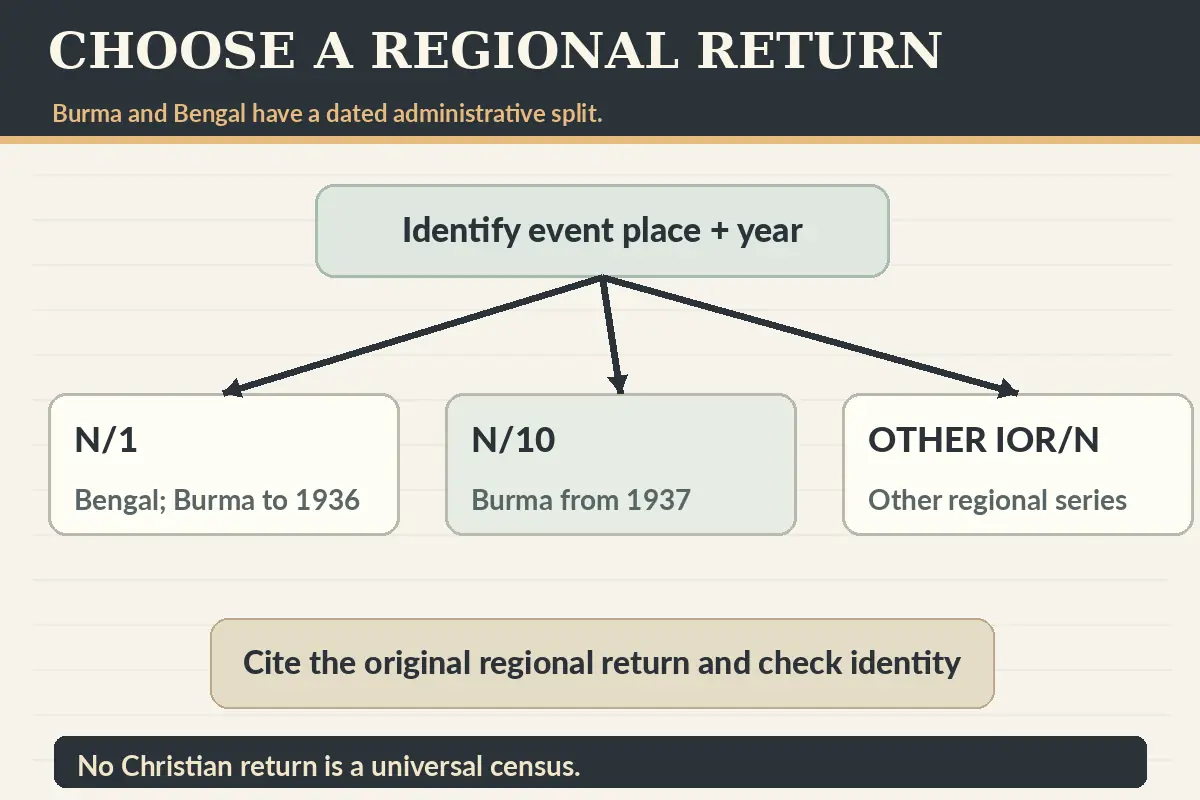
The official British Library catalogue labels IOR/N/1 as Bengal baptisms, marriages and burials, principally 1713–1948. Burma was included within the Bengal returns until 1936 and then handled in separate N/10 registers beginning in 1937. That boundary is important for a family moving between Rangoon and a Bengal station.
Do not choose N/1 simply because a present-day map places a locality in eastern South Asia; determine the applicable presidency or administrative record route for the year in question. Record the title of the exact volume and whether it is an original-looking duplicate or a later indexed derivative.
Separate Event Year From Filing and Return Dates
A church entry can record a sacramental event, an earlier birth or death, and the later date when a copy was forwarded to an office. These are not interchangeable dates. A baptism need not occur on the child’s birth date, while a burial register entry does not always specify the moment of death. Transcribe the original labels and the stated station or parish.
Review an entire page for omitted headings carried from the previous leaf. If an online search supplies only an event type, name and approximate year, obtain the image or archive reference before drafting a precise chronology. A forwarded return may duplicate information from a local register without being a separate eyewitness.
Read the Particular Fields Without Inventing Parents
Depending on location and period, baptism entries can give parents, family residence, occupations and the officiant. Marriage entries may list parties, witnesses, marital status or parents; burial returns may provide age, station or date. These possibilities are not guarantees for every copied book.
If a baptism names one parent but omits the other, state exactly that rather than asserting a complete family group. Likewise, witnesses to a marriage are not automatically kin, and the same surname in a military cantonment may involve unrelated people. Repeated family names in colonial church documents are particularly vulnerable to accidental merging across distant stations.

Select an Image Source and Recognize Access Limits
British Library holdings are the archival container, but names may surface first through a FamilySearch search, a commercial image service or a transcription project. FIBIS describes indexed ecclesiastical returns and directs users to partner images for certain collections. Since the British Library catalogue is operating in an interim form during its post-cyberattack recovery, verify the current ordering and access information for the exact volume rather than assuming everything can be downloaded from one site.
Note whether you saw a transcript, an image of a forwarded return, or a modern catalogue record. All three can be cited, but each supports a different claim.
Build a Regional Timeline for a Mobile Family
For a hypothetical family with a Bengal baptism and a much later Burma marriage, list all events with historical place spellings and contemporary administrative geography. Determine whether the relevant Burma event occurred before or after the 1937 shift into N/10. Check whether the names, ages, parent references and occupations fit one documented family rather than connecting people solely by last name.
A posting or journey cannot be inferred from two church records without accounting for the years between them. Look for independent evidence such as an employment register, military posting, passenger list or probate document. If none survives, keep the move as a plausible but unproved route.
Cite IOR/N and Explain the Scope of the Result
A reproducible reference contains the exact IOR/N series and volume, event type, named church or place, entry date, page or folio and the interface or archive used. Do not cite the general British Library search page as though it were the original entry. Where two websites index the same underlying church return, they are not independent witnesses simply because the websites are different.
For a negative search, specify the presidencies and years actually checked. Denominational boundaries, missing local returns and unindexed volumes may explain absence. Offer alternatives only where they match the subject’s documented place and religion, rather than an undirected international website list.
More Records and Archives Guides
How We Research Colonial Church Return Claims
Our method starts from the IOR/N collection description rather than an undifferentiated name database. We write down the region, year, reported faith, record type and archive series before comparing any index hits. We then inspect original-language column headings and the provenance of each duplicate.
The evidence table separates the fact that a return reports a named event, the possibility that two entries concern the same person and any relationship supported independently elsewhere. It also notes exclusion of many non-Christian communities and the limits of surviving copies. We publish no contemporary private details and never infer a universal civil identity from a narrow church collection.
An ecclesiastical return may preserve a historically unequal classification that reflects the administration producing it. Quote such wording accurately when necessary to explain the record, but do not adopt colonial descriptions as objective statements about identity. A person might appear with initials, anglicized spelling or variant local place names. Make a variant register that preserves each spelling and links it to the photographed entry rather than silently standardizing it. Where a supposed parent’s occupation matches an army unit, verify the actual station and year; shared occupation is not enough to prove parentage. When requesting copies, provide a regional branch, approximate year and piece reference, not simply a surname. This reduces mistaken requests and creates a useful research trail even if the first search produces no image.
No. These are mostly Christian ecclesiastical copies concerning European and Eurasian communities; they are not universal civil registration.
Start with IOR/N/1, confirming the church station and event year before locating the volume and image.
Burma returns were part of Bengal N/1 until 1936; a separate N/10 arrangement began in 1937.
No. Record the exact witness role and look for an independent document establishing the relationship.
No. Cite the IOR/N volume, page and entry whenever available, distinguishing a transcription from the copied church return.