
Castle Garden operated as a New York immigrant processing station from 1855 to 1890, but the surviving passenger lists often labeled “Castle Garden records” include earlier arrivals as well. To find a pre-Ellis Island ancestor, search the appropriate New York customs manifest collection, not only a website named for the station. Start with a plausible year, ship or surname variation, then verify the original passenger-list image and its source series. The date of a station’s operation and the date coverage of a database describe different things.
Match the arrival year to station history and archival series
First put the family’s arrival estimate on a small timeline. A search between 1855 and 1890 falls in the Castle Garden station era; earlier New York arrival lists from 1820 onward are customs manifests, not actual Castle Garden station transactions. When dates fall between 1890 and 1891, the Barge Office is relevant. Beginning in 1892, Ellis Island changes the historical station context. These transitions do not mean passenger lists suddenly begin or disappear at those exact dates.
The useful source distinction is NARA’s M237 series for early New York lists versus later series used in Ellis-era collections. FamilySearch describes a pre-Ellis collection using the earlier M237 rolls and records its own scope. Archive and commercial websites can label the same list “Castle Garden,” “New York Passenger Lists” or “M237.” Write down the record series so your search can move between providers without losing its date boundaries. Our walkthrough on how to search Ellis Island immigration records and verify a passenger sets out each step.
Search the original customs manifest rather than a station story
Enter a surname with variants, an approximate year and possibly a given name. Widen the interval when a later census offers only a rounded immigration year. A negative exact match should prompt another spelling and a look at surrounding passenger entries. For early nineteenth-century lists, the ship name and landing date can be more reliable anchors than standardized personal names. If a collection offers image browsing, use that option when automated results fail.
The earlier lists are not standardized modern intake forms. Depending on date and preservation, a page may include vessel, passenger names, ages, occupations or other abbreviated fields but no detailed birthplace. Read the heading and every relevant row; do not assume the name of a departing port is the passenger’s home village. Capture the document image and archival citation before comparing different online transcriptions of that same sheet.

Use fellow travelers cautiously to distinguish common names
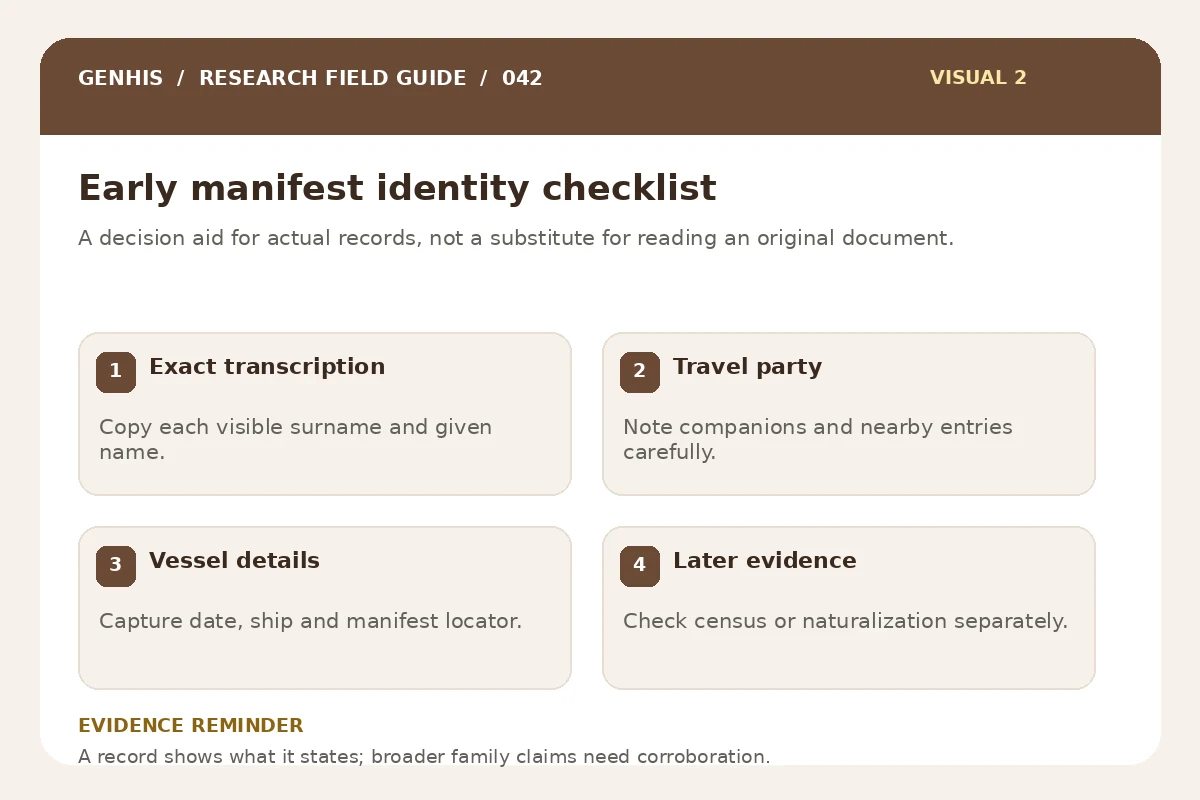
A hypothetical 1867 arrival lists two people named Thomas Kelly of roughly similar age on separate vessels. Rather than picking the one whose indexed age matches a family story, check each ship, arrival date, companions and later New York residence. A matching child or spouse traveling nearby strengthens the case, but seating on the same page does not itself establish kinship. The example is fictional and illustrates how evidence should be tested, not a real historical identification. Our guide “New York and New Jersey Passenger Lists, 1600–1825” shows how to check the source.
Early manifests often supply less information than later passenger documents. Build a compact matrix of candidate name, exact page, age as recorded, possible travel party and independently known facts. Note where no birthplace or relative field exists. If a candidate is plausible but not uniquely distinguishable, write “possible match” and pursue church, census, county or citizenship documents. Unknown information should remain unknown, not silently supplied from a family tree.
Account for early coverage gaps and alternate ports
Not every person entering the United States reached New York. Other Atlantic and Gulf ports had their own arrival systems, and overland travel might not appear in the New York passenger sequence. NARA directs researchers by port, and coverage can be incomplete even when a broad date range is advertised. When a surname search returns nothing, review the exact collection description and the archive’s statement about missing years before drawing any conclusion.
If the family’s first known home was far from New York, use naturalization petitions, marriage records and period newspapers to identify a plausible route; never infer a specific vessel merely from a family legend. Search for other relatives who arrived later and might name a former home. Record each negative search as a bounded claim: “no candidate in this provider’s indexed New York lists, years X–Y,” not “no immigration record exists.” A similar decision comes up in our guide “Grosse Île Immigration Records”, which explains how to find deaths, ships, and sources.
| Year window | Search basis | Avoid this mistake |
|---|---|---|
| 1820–1854 | New York customs passenger lists | Calling all records Castle Garden station files |
| 1855–1890 | Castle Garden-era New York lists | Treating each list as an interview transcript |
| 1890–1891 | Transitional New York/Barge Office era | Assuming Ellis Island was already operating |
| From 1892 | Ellis-era New York arrival collection | Using an 1820–1891 index without checking scope |
Build a citation and a responsible arrival hypothesis
A reusable citation should identify the passenger as written, year and exact arrival date, vessel, page or list number, record type, collection and original custodian when given. When a digital platform changes interfaces, those archival identifiers remain useful. Archive an image or legal citation according to site terms and preserve a typed transcription that distinguishes hard-to-read characters with brackets. Keep the spelling as transcribed separate from your preferred family surname.
Finally compare the arrival with a contemporaneous census, residence, marriage or church record. A manifest establishes that a name appears on a particular ship list; it does not by itself establish the passenger was your ancestor or that their surname originated in one country. If the evidence conflicts, identify what further record would distinguish two possibilities. A documented unresolved case is a stronger starting point than an unverified pedigree.

How We Research: jurisdiction, source provenance, and uncertainty
We checked the Ellis Island Foundation’s station chronology against NARA’s New York passenger-list series and the stated source scope of FamilySearch’s early-arrivals collection. The key editorial distinction is between a physical immigration station (Castle Garden, 1855–1890), the short Barge Office transition and digitized customs manifests that begin earlier. The Thomas Kelly scenario is an invented comparison exercise. Repository descriptions do not guarantee that a particular family name, vessel or year is preserved.
Authoritative record sources and repository limitations
www.statueofliberty.org — source guide. The Ellis Island Foundation dates Castle Garden service to 1855–1890 and explains Barge Office transition. The named custodian documents record-series scope, not the biography of an individual migrant.
www.familysearch.org — source guide. FamilySearch describes pre-Ellis New York passenger lists based on M237, 1820–1891 subset. The named custodian documents record-series scope, not the biography of an individual migrant.
www.archives.gov — source guide. NARA lists the New York M237 passenger-list series and related discovery resources. The named custodian documents record-series scope, not the biography of an individual migrant.
www.archives.gov — source guide. NARA clarifies source fields, port-of-arrival arrangement and gaps in federal passenger arrivals. The named custodian documents record-series scope, not the biography of an individual migrant.
More Records and Archives Guides
Privacy, disclosure, and the limits of this guide
Historical passenger-list availability and access vary by archival series, scanning project and repository. This guide offers source criticism, not immigration or citizenship legal advice. Official archival links are educational references without a claimed paid referral or institutional endorsement. See the GenHis affiliate disclosure. Do not combine a historical surname hit with sensitive personal details about living relatives.
Yes. Passenger-list holdings predate the 1855 opening of the Castle Garden immigrant station. A database named for the era may cover earlier lists.
No. Castle Garden ended immigrant-station service in 1890 and the Barge Office served during the transition before Ellis Island opened in 1892.
Collection names are convenient era labels. The underlying New York customs manifest series extends earlier than the station itself.
Not reliably. Early list formats vary and detailed hometown or birthplace columns may be absent. Confirm origins in other records.
No. A spelling variant, imperfect index, different year or missing surviving list can explain the result. Review the source inventory.