
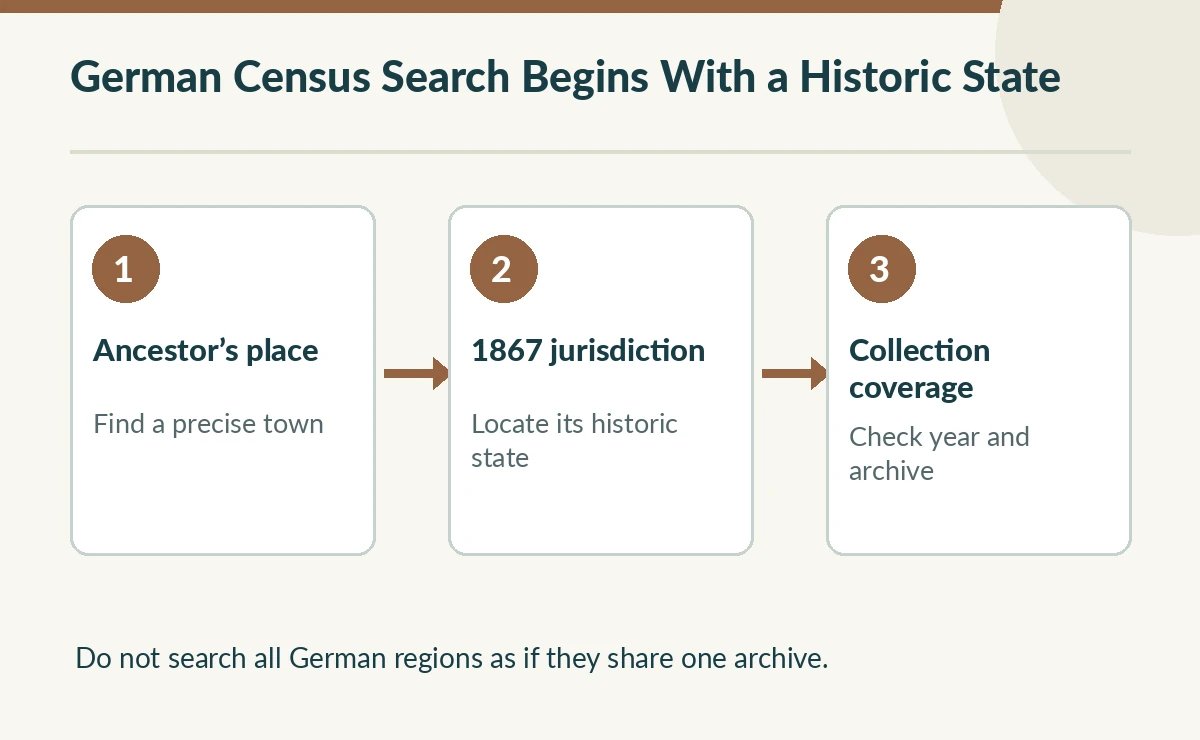
“German census records” is not the name of one continuous, searchable national database. For a nineteenth-century ancestor, identify the historical state and locality first, establish which enumeration years and household sheets survive, and search the archive or digital collection for that area. Mecklenburg-Schwerin’s 1867 census is a useful concrete example: its surviving forms include a named household list, a population summary, and a supplement for temporarily absent people. A result for Mecklenburg does not imply equivalent records exist for Saxony, Bavaria, Prussia, or every town in modern Germany.
Establish the historic state before searching a surname
A place in a U.S. immigration document may say only “Germany” even if the family left a duchy, kingdom or province with its own administration. Find the village from a passenger list, naturalization paper, church certificate or a well-sourced family letter. Compare contemporary gazetteers and historic maps so the place is not confused with a similarly named modern municipality. Record both the jurisdiction at the census date and its present-day archive region. This state-first work determines whether an enumeration is even a plausible next source.
Use Mecklenburg-Schwerin 1867 as a documented case
FamilySearch identifies a digitized 1867 census for the Grand Duchy of Mecklenburg-Schwerin and notes that the original materials are held by the Mecklenburg state archive in Schwerin. The indexed collection is a search entry point, not proof that every German settlement is represented. Where a result appears, inspect its location and enumeration district. The 1867 entries belong to the territory and administrative structure of that year. Do not expand the collection’s geographic coverage because an ancestor spoke German or later lived inside Germany’s modern borders.
Tell the three Mecklenburg census forms apart
The Bevölkerungstabelle gives household heads and numerical information about others. The Zählungsliste lists individual people and can supply birth details, marital status, occupation and religion. The Nachtragsliste records people temporarily absent from their regular residence. If you inspect only a household head on a summary, you may wrongly believe no named children were recorded; if you inspect only the main list, an absent worker may appear missing. Search the associated list type before drawing a conclusion about the complete dwelling. For a related choice, see our guide “1881 Canada Census”.
Decode the filing district, not merely the town name
Mecklenburg’s 1867 towns were arranged under enumeration districts such as Ritteramt, Domänenamt, Klosteramt or Stadt. These administrative terms identify the historic place hierarchy used by the collection; they are not evidence that a named individual owned a manor or worked for a monastery. Copy the district label with the person’s location and image number. A vague modern place translation can point to the wrong parish and make future work impossible to reproduce. For a difficult match, compare the adjacent households within the same district.
Separate residents from temporary absentees
The supplementary Nachtragsliste helps explain why a person who belonged to a home might not appear in the expected position on the main list. It should not automatically be interpreted as an emigration record: temporary absence and permanent departure are different claims. Compare the name, sex, marital status, likely birth information and household location across list types. If a second person has an identical surname and age, keep both candidate identities open until a church entry or civil document distinguishes them.

Check originals when an index smooths over handwriting
German surnames can be misindexed because of old scripts, spelling variation and locally used given names. Search alternate vowels, abbreviated names and likely phonetic forms, then inspect the original manuscript image when access permits. Record the exact old spelling and your modern reading in separate columns. If handwriting is uncertain, mark the letter as uncertain rather than silently correcting it to match an inherited pedigree. A searchable index may also omit contextual notes or the heading showing which kind of form you are seeing.
Know what a 1867 census does not establish
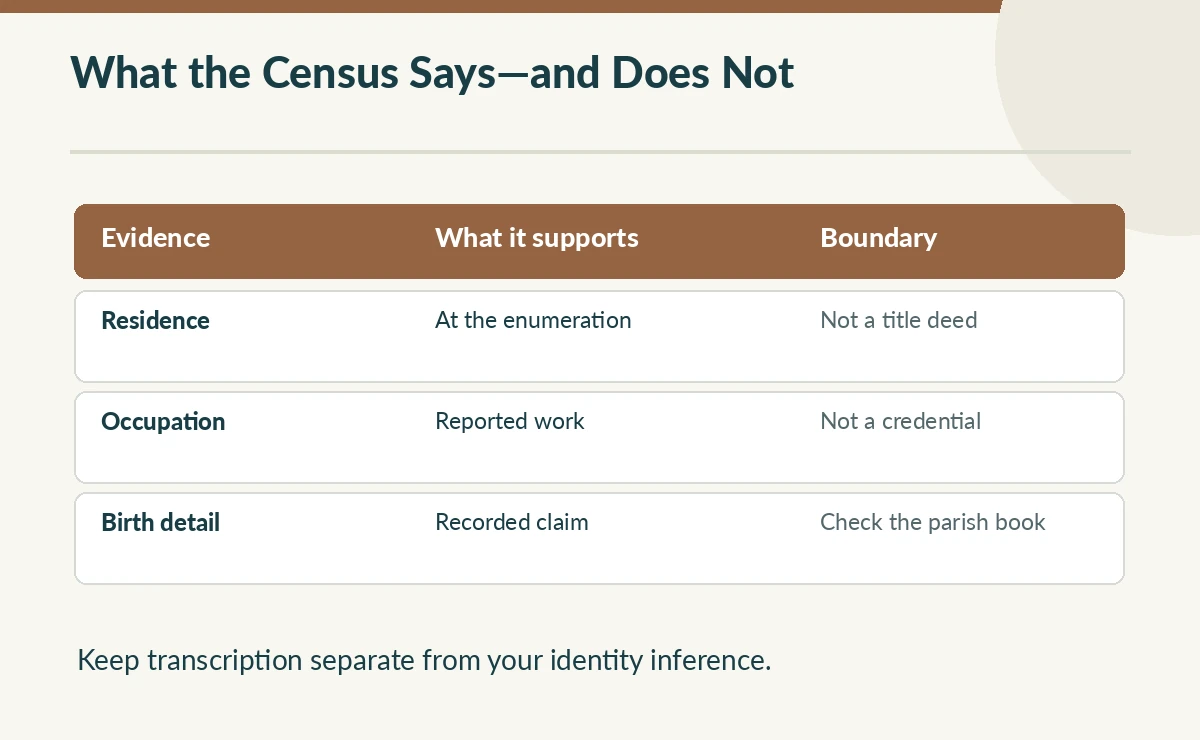
Household inclusion can support a reported residence at a census moment; it does not prove a birth event, baptism, citizenship change or final emigration date. Occupation tells you how the enumerator classified work, not whether the person held a formal qualification. Religion is a recorded affiliation and is better used to choose the next parish archive than to prove a particular sacrament. Where a precise birth date appears, compare it with a contemporaneous church book instead of assuming a later family story must be wrong.
| Question | Evidence to check | Do not assume |
|---|---|---|
| Identity | Name plus independent family clues | Every namesake is the same person |
| Date | Original field and its event label | A later record gives the exact date |
| Coverage | Place, years and document type | A failed index search proves absence |
| Access | Custodian and current restrictions | All original pages are downloadable |
Use church and civil records when no enumerations remain
If the relevant historical state has no surviving named census for a year, do not treat that as a negative finding about the ancestor. Shift to available baptismal, marriage and burial registers, local residence registers, tax lists, city directories or civil registrations appropriate to the place and date. Civil-registration start dates varied by German state before national unification; avoid using one Prussian date to rule out all earlier local records. A family’s apparent gap may be a preservation problem, not a migration event. For a related choice, see our guide “Jamaica Historical Birth Records”.
Document a negative search with its geographic boundaries
For each attempted census search, record the historical jurisdiction, enumeration year, collection coverage, names and spelling variants, record form searched and whether images were browsed. A “no hit” from the Mecklenburg collection says nothing about a family in Württemberg. For an unresolved identity, note what alternative original would falsify your current match. The most useful conclusion from a failed search is often a revised archive destination and a clearly bounded statement of what was actually checked.
To avoid catalog false negatives, note whether the collection uses a browse hierarchy rather than a complete surname index. Search by original place spelling, then move down through archive district and locality folders. An image-only collection may contain usable evidence that a global name search does not expose. Record the exact collection and which pages were reviewed so another researcher can repeat or expand the attempt.
More Records and Archives Guides
How We Research Regional German Enumerations
We used the catalog description for the Mecklenburg-Schwerin 1867 census to identify the three surviving document types, historic filing areas and named fields. Our search and proof steps are an original explanatory method, not a claim that a single nationwide German index exists or that FamilySearch offers every image without access conditions. Check the primary references directly: Official archive guide. Original collection or archive information. Additional access guidance.
This article offers research methods, not guaranteed records or paid recommendations. We do not claim an affiliate relationship with the listed archives or services. Read our affiliate disclosure for site-wide information.
No comprehensive single name-search resource covers every German state and year; look for collections tied to a historic jurisdiction.
In the cited Mecklenburg collection, it is the named individual or household list, not the head-only summary.
It can list people temporarily absent from the principal household, helping avoid a false disappearance.
The collection description identifies the Mecklenburg state archive in Schwerin as custodian.
No. Treat it as a reported clue and compare a parish or civil registration made nearer the event.