
Approximately 24 million men registered under the United States’ World War I Selective Service system in 1917–1918. Their cards can preserve birth details, an address, work, citizenship or a signature. Search by name and the state or local draft board, then inspect the correct card version and the original image. The National Archives expressly warns that a registration card is not a military service record: some registrants never entered the armed forces, and some people who served did not register.
Check which of the three registrations applies
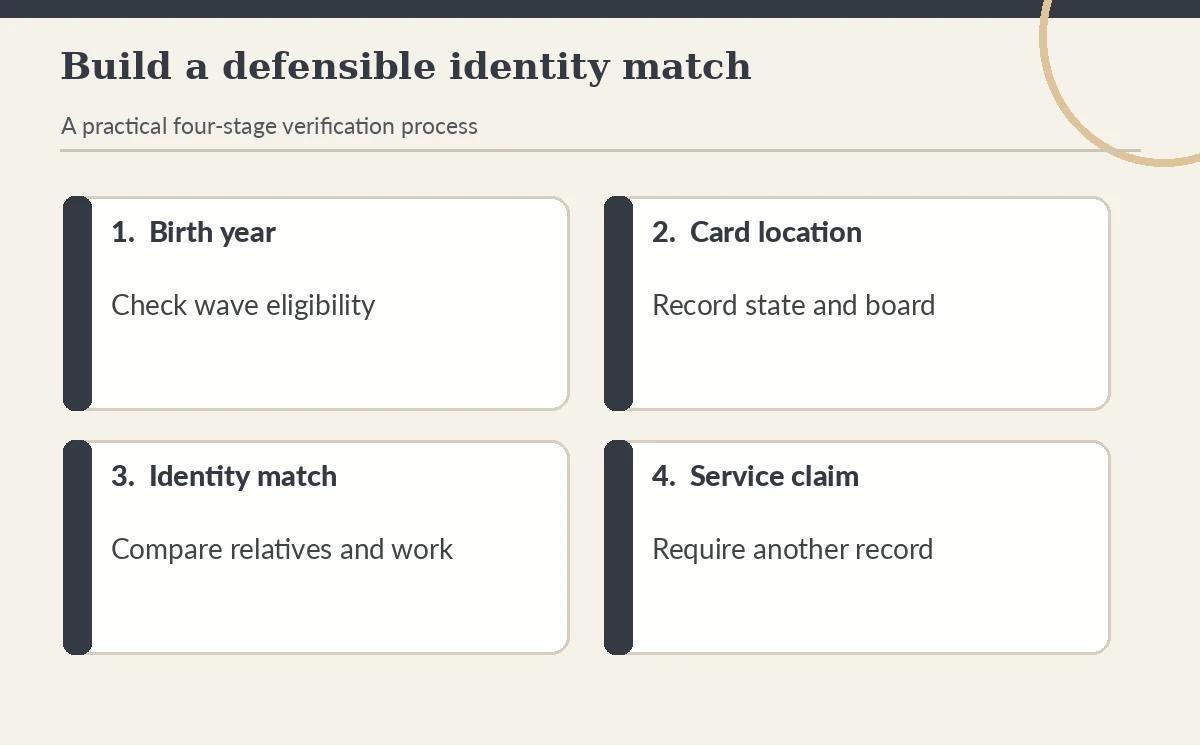
The National Archives identifies three key registrations. On June 5, 1917, men roughly ages 21–30 registered; June 5, 1918 covered men who had reached 21 since the earlier registration, with a supplementary date on August 24; and September 12, 1918 expanded registration to men ages 18–45. The exact form questions differed by wave. Establish a likely birth year and the date of registration before expecting any particular question or family-contact field.
A birth year alone does not guarantee a specific card appears in the surviving records. Residence, citizenship, exemptions and the timing of registration matter. Build a three-row eligibility worksheet and mark the wave most likely to apply. If a card seems missing, consider name variants, a changed address and the correct draft-board jurisdiction before concluding the man did not register. The first search should be an attempt, not a verdict on military participation.
Search through the local board rather than a modern county assumption
NARA describes the cards as organized geographically by state and then county or city and local draft board, with exceptions in some states. This arrangement is a clue to the registrant’s residence at the time of registration, not necessarily his birthplace or where he later enlisted. People living in major cities may have been assigned to one of multiple boards. A mistaken board location can hide an otherwise straightforward card.
Record the searchable name, age or date of birth, address if present, state, locality and board identifier. Repeat with initials or alternate spellings where indexing is uncertain. Once the image appears, read both sides if available and check that the board information matches the result. Preserve the original order or serial numbers as documentary identifiers; they are not the same as a later military service number.
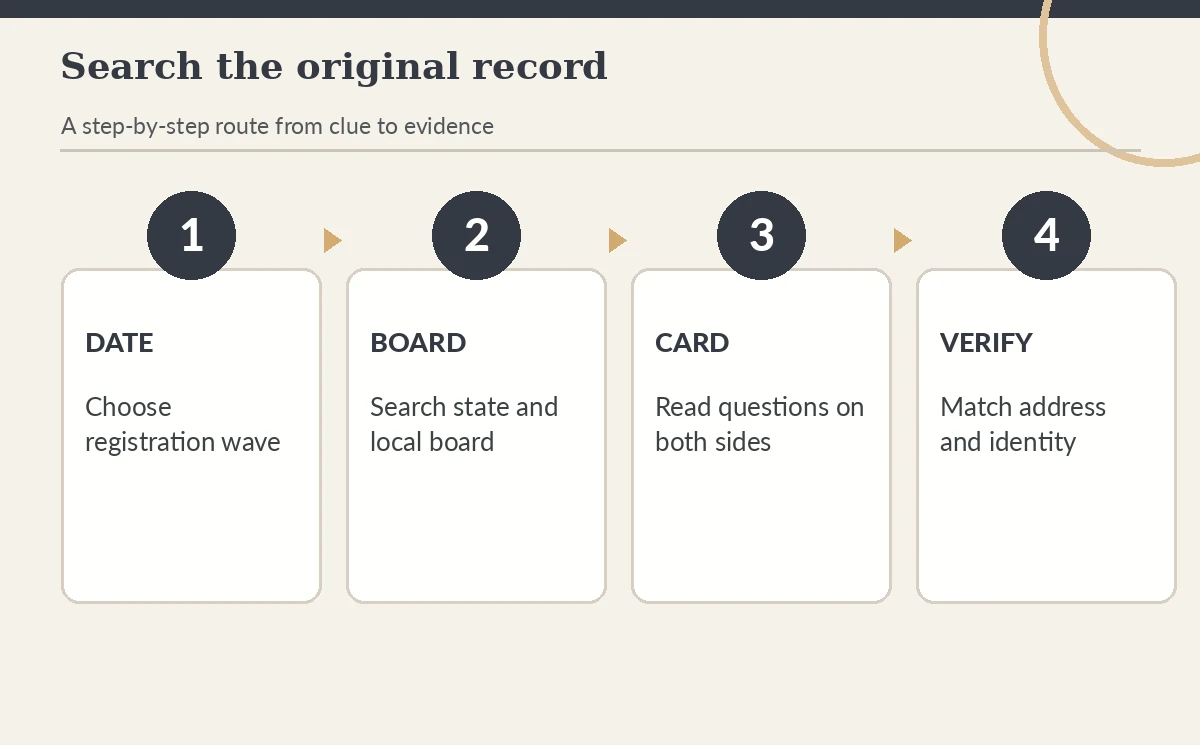
Identify which questions the printed form actually asked
Depending on the registration wave, a card may report full name, date and place of birth, occupation, employer, citizenship, physical description, nearest relative and signature. The National Archives notes that content varies. Do not treat a blank relative field on a version lacking that question as evidence that the man had no spouse or parent. Copy the printed question beside the handwritten response whenever wording could affect interpretation.
An employer or occupational address is a clue to work and residence, not proof that the person remained at that job during the war. A reported citizenship category must be interpreted as a historical administrative status, not a modern immigration ruling. The physical description may help distinguish same-name men, but it is not a substitute for documentary family links. Preserve disputed spellings exactly as written.
| Registration | Who was targeted | Research caution |
|---|---|---|
| June 5, 1917 | Men 21–30 (commonly stated) | Not all were inducted |
| June 5, 1918 | Newly 21 since 1917 | Includes Aug. supplement |
| Sept. 12, 1918 | Men 18–45 | Questions differ by card |
| Any card | Person who registered | Not a service history |
Separate registration, classification, induction and service
The most important proof boundary is explicit in NARA’s guide: draft registration cards contain no service history. Registration, local board classification, a call to report, actual induction and later military duty are different events. The presence of a card alone does not justify calling the man a veteran, declaring a branch of service or assigning him a combat unit. Nor can the absence of a card rule out military service. For a related choice, see our guide “1942 Fourth Draft Registration Cards”.
If military service is the research question, check relevant federal or state service files, unit records, discharge records and pension sources as separate classes. A family story may be broadly true but linked to the wrong person, or may refer to wartime industrial work instead of military duty. Put each assertion on an evidence chart that names the particular record supporting it. Keep a registered-only conclusion when no service document has been located.

Compare same-name men using local evidence
For a fictional example, two “James Miller” cards might show close birth years but different employers and local boards. Create separate candidate rows for each card with exact birth date, address, occupation, nearest relative when asked, and signature. Compare these with a 1910 or 1920 census, marriage certificate, city directory and a known family address. One matching birth date may still be reported incorrectly on another document; use several independent details.
A good decision is reversible. Record why Candidate A matches and why Candidate B conflicts; do not erase rejected candidates. If a card names a nearest relative, test that relationship independently rather than presuming the relationship from proximity. Note whether the card came from the first, second or third form version, because the differences in printed questions determine what evidence is even available.
Cite WWI draft cards by board and original registration image
Cite National Archives Record Group 163 / microfilm publication M1509 as appropriate to the card and the actual online image, giving the named registrant, locality and board, registration date and any record locator shown. Avoid adding a roll or film number unless the source actually supplies it. Retain the image platform and retrieval date; a search result without an original card is not enough to assess transcription mistakes.
A precise family-history statement says that a named man registered with a particular local draft board on a specific date and reported defined personal information. Add a separate, independently cited statement if military service is established. If the service question remains unresolved, say so explicitly and name the next repository search. This preserves the useful life-history details on the card without inventing a war record. For the next step, our guide “World War I Draft Registration Cards” explains how to read all three forms without assuming service.
How We Research U.S. WWI Draft Registration Cards
GenHis starts with the official archival description and distinguishes an index, the original record and any inferred family claim. For this guide we examined the repository instructions, stated date coverage, available search fields, documentary limits and relevant historical terminology. The sample identity checks are hypothetical and not records of identified ancestors. This is historical research guidance, not a guarantee that every record survives, is indexed or is free to obtain.
More Records and Archives Guides
Official archives and collection guides for WWI Draft Cards
NARA primary explanation of registration waves, fields, geographic arrangement and non-service caveat (archives.gov).
NARA genealogical overview of draft cards and other World War I record classes (archives.gov).
NARA educational context for draft cards and the distinction between registration and induction (archives.gov).
Editorial disclosure: This guide includes no paid recommendation or verified affiliate partnership. See the GenHis affiliate disclosure. Record holdings, image availability, access restrictions and prices can change. Verify them with the cited repository before ordering documents; protect information about living people and present uncertain family conclusions as hypotheses.
No. NARA explicitly distinguishes registration from actual military service.
The rules and registration dates changed in 1917 and 1918, so questions differed.
Begin with the state and local draft board where the man registered.
No. Draft board serial or order numbers are administrative identifiers.
Yes. Not every person who served in the military registered for this draft.