
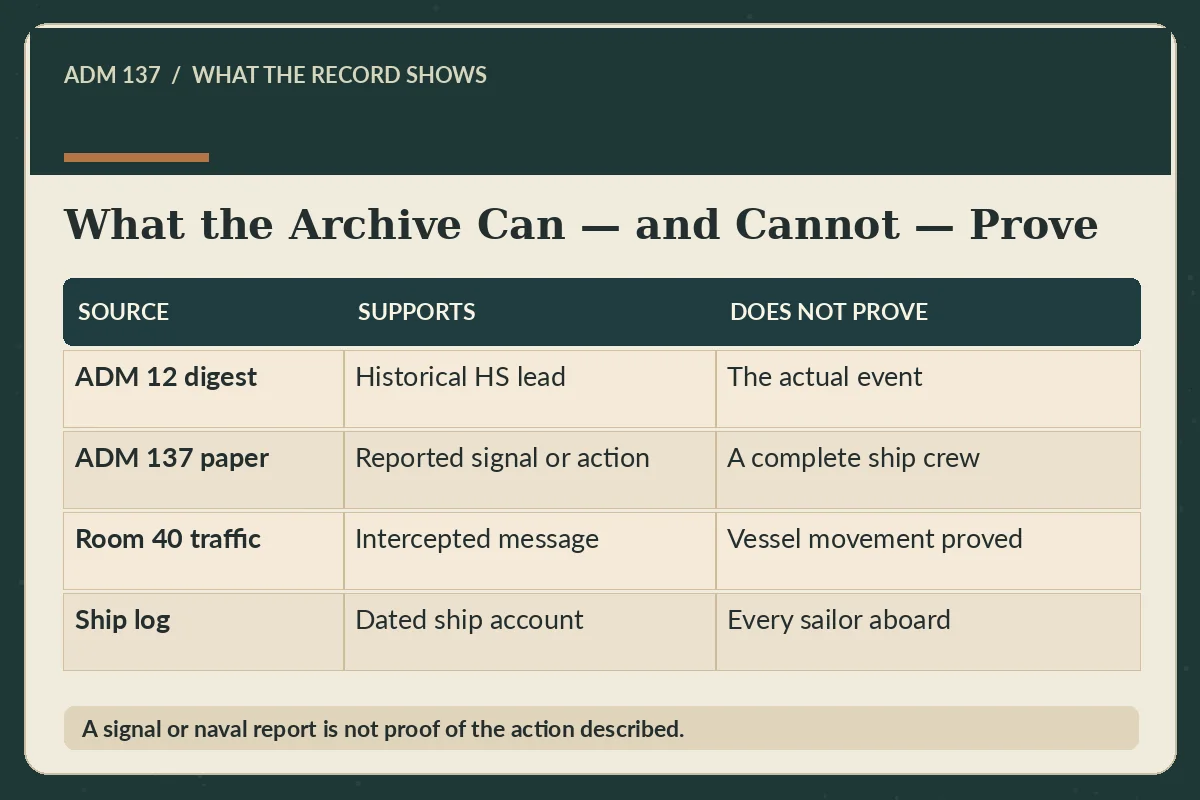
ADM 137 contains materials assembled by the Admiralty Historical Section for research into Royal Navy operations during the First World War. It includes reports, telegrams, operational accounts, convoy and blockade files, and some naval intelligence material; it is not a full register of every sailor aboard a ship. The National Archives’ naval operations guide distinguishes HS, HSA and HSB case material. The most reliable search often moves from an ADM 12 index or digest reference through an HS number into an ADM 137 piece, then independently tests what actually occurred.
Start With Ship, Station or Operation
Define the event by ship name, squadron, station, convoy or operational subject and a realistic date range. Large-scale naval operations left overlapping reports, many of which were grouped for historical writing after the war. These retrospective compilations preserve valuable contemporary papers, but their physical arrangement is not necessarily the original working order of every signal. Keep the record’s original creation date separate from the later Historical Section filing date.
When researching a named sailor, first establish the vessel and posting dates through muster, service or other named records. Only then search a ship’s operational context in ADM 137. A sailor’s presence on a vessel in one month does not prove participation in every action described in the station’s files that year. Begin an evidence notebook with the event, asserted person-level connection and existing proof for each.
Read HS, HSA and HSB as Provenance Clues
The archival guide explains the principal strands used to compile the Official History: HS files from Admiralty Secretariat records, HSA files from Grand Fleet and naval commands, and HSB files chiefly from the Naval War Staff’s Trade Division. These prefixes reflect different archival origins and purposes. A trade-route memorandum may be relevant to a convoy without containing a ship captain’s firsthand statement.
Record any HS, HSA or HSB label, the document date and the body that created it. Later copies can summarize earlier messages or include extracts rather than the whole exchange. Treat a report written at headquarters as evidence of what headquarters was told, not automatically of conditions seen at sea. If several sources repeat one original wireless message, they are not independent witness accounts.

Use ADM 12 to Locate the Correct Piece
The National Archives describes ADM 12 index and digest volumes for 1914–1919, including the paired A and B sets used from 1915. Many references point to ADM 137 Historical Section files. An index subject heading or correspondence number may ultimately supply an HS number, which can be searched in Discovery as a former reference. Retain the intermediary index citation so another researcher can reproduce the route.
Do not turn an HS number into a made-up ADM 137 piece by guesswork. Search the historical reference as directed, confirm the result’s full piece identifier and check the title and dates. If an entry cannot be matched, try the printed key available at Kew or alternative subject terms. Index material is a finding aid; always inspect the underlying report before quoting the alleged naval event.
Separate Wireless Intelligence From Naval Observation
Room 40 intercepts and decrypts occur among First World War naval intelligence materials; an intercepted signal may reveal what a sender communicated rather than an externally verified event. A report based on decrypted traffic can include translation uncertainties or delayed intelligence. In ADM 137, distinguish a received message, a decoded text, an Admiralty assessment and a commander’s response. They represent different evidential stages, not interchangeable confirmations.
An intelligence message about an intended sortie does not prove the ship sailed, while a successful interception does not prove the Admiralty acted upon it. Note when the message was sent, received, deciphered and disseminated if the document provides those details. Match the incident against fleet orders, station reports and actual ship logs rather than assuming every warning produced the outcome recorded in later popular accounts.
Check Convoy Reports Against Ship Logs
An ADM 137 convoy compilation can link signals, route instructions and operational summaries across many vessels. It may omit ships that did not submit papers or may focus on incidents judged significant by compilers. When a family history claims a ship met a submarine or escorted a convoy, compare the relevant operational reports to dated ship logs and vessel movement evidence. A planned route is not proof the voyage followed it without deviation.
Build an event ledger with columns for file number, report creator, event time, ship or convoy identifier, stated action and independent comparison. Preserve terminology such as ‘sighted’, ‘engaged’, ‘believed sunk’ or ‘lost contact’. A reported torpedo attack, a claimed strike and a subsequently verified sinking belong in different columns. Identical narrative wording across sources may show copying, not independent corroboration.
Avoid Inventing Individual Naval Service
Many ADM 137 files concern ships, flotillas and commands rather than personnel. A document mentioning a ship does not provide its complete crew at the time. If a relative is not named, seek individual service papers and relevant muster or pay series, then build a date-based bridge to the operation. Crew transfers, hospitalization and temporary assignments can break the apparent link between a unit’s history and a person’s activity.
If a named officer appears in an operational report, distinguish his role as author, witness, addressee or subject. None of these automatically proves that he issued an order, saw the event or was aboard the ship. When a statement is secondhand, cite the person who transmitted it and the original source if named. Make clear whether you have identified the person independently or only found a matching surname.

Document Archival Layers and Gaps
The printed key to ADM 137 and the ADM 12 digest can remain necessary even when Discovery has a modern item description. Some files are available through reading-room consultation rather than immediate image download. Cite the full ADM 137 piece and any individual folio or page, together with the historical HS code where useful. Include your search path, rejected leads and notes on missing enclosures.
A precise conclusion might read: ‘The Admiralty compilation records receipt of a signal about this convoy, and the ship log independently confirms its arrival at that port; individual crew service was not established.’ This prevents a plausible wartime narrative from being overstated. A record gap is not proof that the voyage or event never occurred; it is a documented limitation on what the current evidence can show.
More Records and Archives Guides
How We Research Sources and Boundaries of Proof
Our research method starts with the official subject guide and compares it with a second archival source. We record the holding archive, series, piece, document date, compiler and whether the document itself was inspected. A catalogue description is a lead, never a substitute for reading the original. We distinguish an administrative statement from a later event and a plausible interpretation from independent confirmation. Not every person, date or place can be proved from a surviving record; damaged, missing or unindexed items are noted explicitly. For information about our commercial relationships, review the affiliate disclosure.
No. It holds operational and Historical Section material rather than complete crews.
It is a historical Admiralty file or case reference that can help identify an ADM 137 piece.
Yes. Many First World War digest entries reference HS material now in ADM 137.
No. A planned movement requires independent operational or ship-log confirmation.
Not necessarily; both may derive from the same original message.