
Chancery Ancient Deeds Series C, preserved as C 146 at The National Archives, contains property documents reaching across the medieval and early modern centuries. The Archives’ land-records overview gives approximately 1100–1695 for the series. A deed may document a grant, agreement or appointment of an attorney, but it does not by itself show uninterrupted ownership, residence on the land or a biological relationship between everyone named. The practical first step is to identify the transaction and the precise property, not to attach a surname immediately to a family tree.
The language in a deed can carry several legal roles: someone grants an interest, someone receives it, witnesses attest, and an attorney may be instructed to deliver seisin. A witness is not automatically a relative or adjoining landholder. A person named in a later endorsement could be a clerk or custodian. Preserve original terms and expand abbreviated names cautiously; the apparent identity of two people across deeds requires dates, offices, property and other independent identifiers.
Search Series C by land, person, and date
The Archives’ guide to religious houses maps the old letter code C to C 146 within a much larger set of Ancient Deeds. Not all historic deeds are in this one series: related groups include C 147 and C 148 and records across Exchequer, Duchy and other holdings. Search the catalogue for the locality, variant place names, grantor or grantee, and phrases such as ‘ancient deed’ or ‘letter of attorney.’ A narrow surname search can miss a deed indexed chiefly under land or jurisdiction.
Copy the full series and piece reference, the date displayed in the catalogue and any source calendar or translation that explains the description. An approximate or editorial date in square brackets is not identical to a dated clause in the original parchment. Medieval dates can be expressed through regnal years or church feast days; when converting, record the conversion rule and uncertainty. Check the image or original before treating a calendar’s modernization as the original wording.
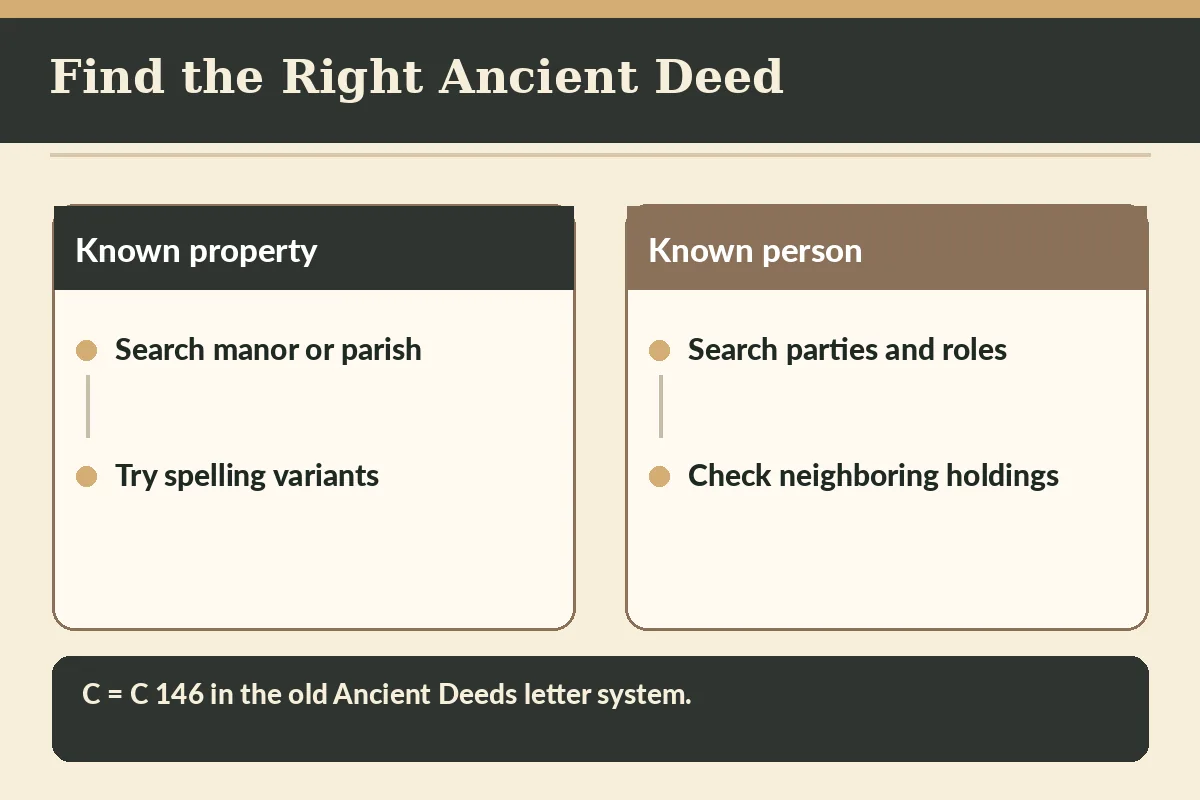
Interpret legal roles before drawing a pedigree
For each document, use a role table: grantor; recipient; feoffees or trustees; witnesses; attorneys; and any institutions named. Write the evidence for each role beside the name. One person can have several roles in different transactions, but that does not establish continuity unless the individual can be identified. A repeated surname is suggestive only after a network of dates, locations and associates has been compared. Beware a contemporary vicar or other officeholder being mistaken for a member of the landowning family.
Some documents expressly authorize delivery of seisin, a historical mechanism for transferring possession. That authorization is not necessarily a separate surviving record that delivery took place. Likewise a grant of rent is not the same thing as a grant of the entire estate. Keep a column for the interest transferred: land, rent, right, term or authority. If the wording is beyond your ability to interpret, cite it accurately and seek qualified paleographic or legal-historical help instead of inventing an unambiguous modern ownership claim.
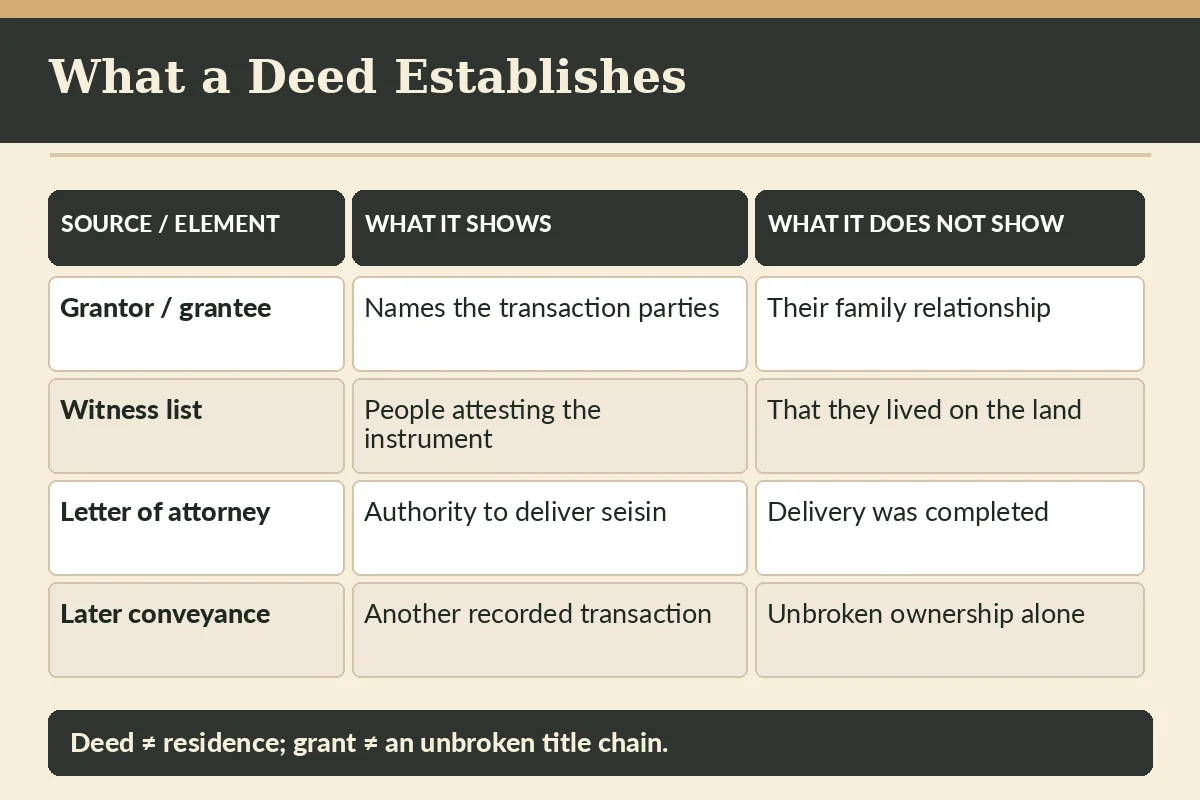
Match the property when place names change
Place identity requires equal care. A manor name may be spelled differently over time; a parish, hamlet and manor sharing a name need not have identical boundaries. Transcribe every location in the document, including county and neighboring holdings, before choosing a modern map point. Compare multiple independent place-name sources where possible. A modern address or pin is an interpretive aid, never a substitute for the boundaries or tenure language of the original deed.
A grant covering several manors may describe rights in more than one county. Do not force all property into the grantor’s supposed home parish. Note which properties belong to the legal subject of the deed, which are merely mentioned as neighboring landmarks, and which are pledges for payment. Keep a separate map layer for each level of certainty. Historical jurisdiction changes and copied place names can make a neat single-line family narrative misleading.
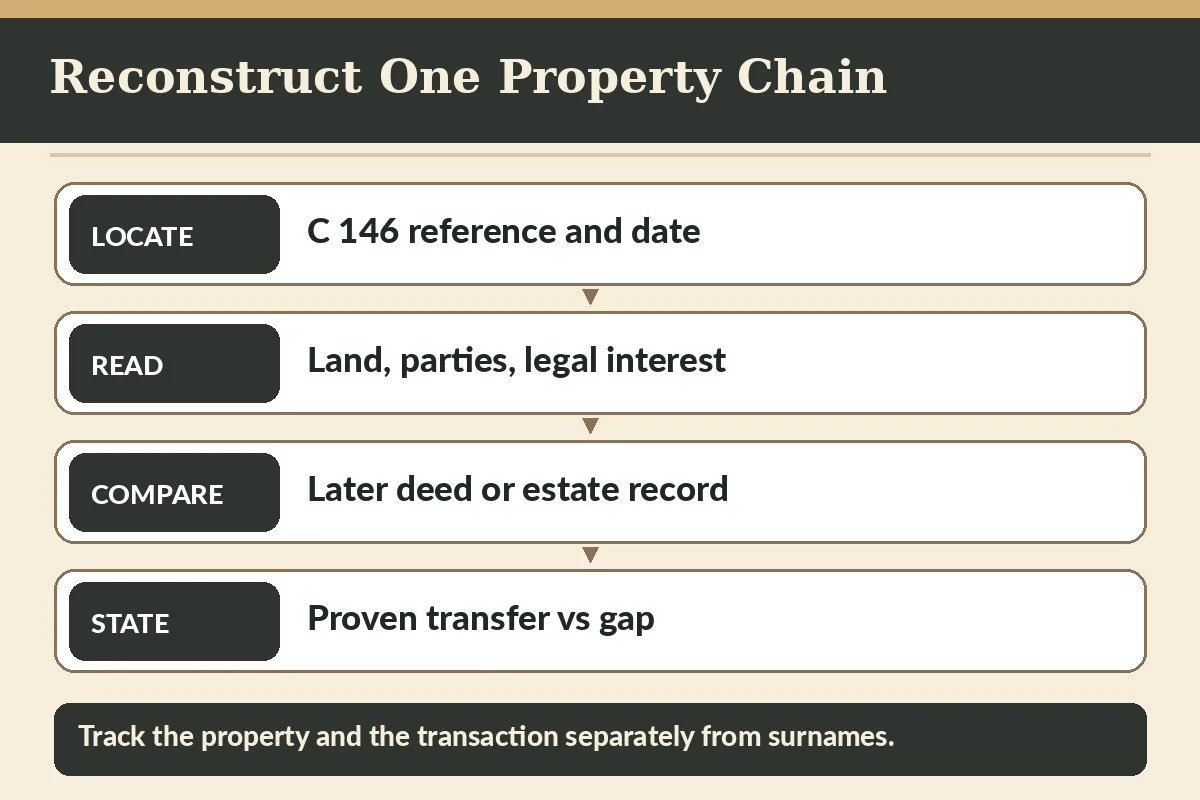
Build a chain instead of relying on one deed
One deed establishes a documented transaction, not an uninterrupted chain of possession. Look for later conveyances, leases, manorial records, estate accounts, litigation or tax records appropriate to the locality and century. If a later deed names an heir, distinguish its assertion from a proved parent-child connection. A will, inquest or parish source may answer a genealogical question that the original conveyance was not designed to settle. State explicitly where the chain stops.
Compare successive documents with a common property-description key: manor or tenement name, neighboring land, parties, interest, date and original reference. If the parcel changes size or tenancy, the chain may concern related property rather than the same holding. If a deed is a counterpart or later transcript, record the relationship to the earlier instrument. The same seal impression or witness formula does not automatically make two instruments duplicates.
Imagine a deed in which A grants land to B and C, witnessed by D. The safe initial statement is that the document records a grant naming those roles. It is not yet sound to say D was A’s brother, that B lived in the manor or that C’s grandchildren retained it. A letter of attorney authorizing delivery adds a different kind of evidence, not a birth certificate or an occupant list. This restraint makes subsequent matches much easier to test.
Create a ledger of positive, disputed and untested links. For each claimed link between deeds, write the exact shared features and potential contrary facts. Record negative catalogue searches as search history, not as proof of absence; document survival is uneven and many private or local deeds never entered central custody. Where a source is only described in an old calendar, distinguish the editor’s abstract from the full legal text.
More House and Local History Guides
How We Research Chancery Ancient Deeds
This account follows The National Archives’ land ownership and deeds overview and its guide to religious-house lands. They establish where the C letter-code material sits among dispersed deeds; they do not authenticate a particular family’s claim. Verify each reference, calendar and, when needed, translation against the document consulted.
We treat a deed as evidence of the action recorded and its legal language, then require separate evidence for delivery, possession, heirship or residence. We do not silently normalize medieval property boundaries, convert an approximate date into an exact one or assume kinship from a shared name. Review the site’s affiliate disclosure before any external commercial research service is considered.
It is the Chancery Ancient Deeds Series C, covering a long span from approximately 1100 to 1695.
No. Witnessing establishes a role in a document, not biological kinship.
No. Check the interest transferred and independent evidence for delivery or subsequent possession.
They are dispersed among several series, including C 147, C 148 and Exchequer and other department collections.
No. A supplied date may be an approximate modern conversion or editorial estimate; check its basis.