
WORK 14 can reconstruct a monument’s official preservation and guardianship history through administrative files. It does not automatically establish when an ancient wall was first built, who owned the land, or whether a proposed repair was carried out. Match the exact site and period, then distinguish an official discussion from a completed intervention.
Use WORK 14 for the Monument’s Modern Paper Trail
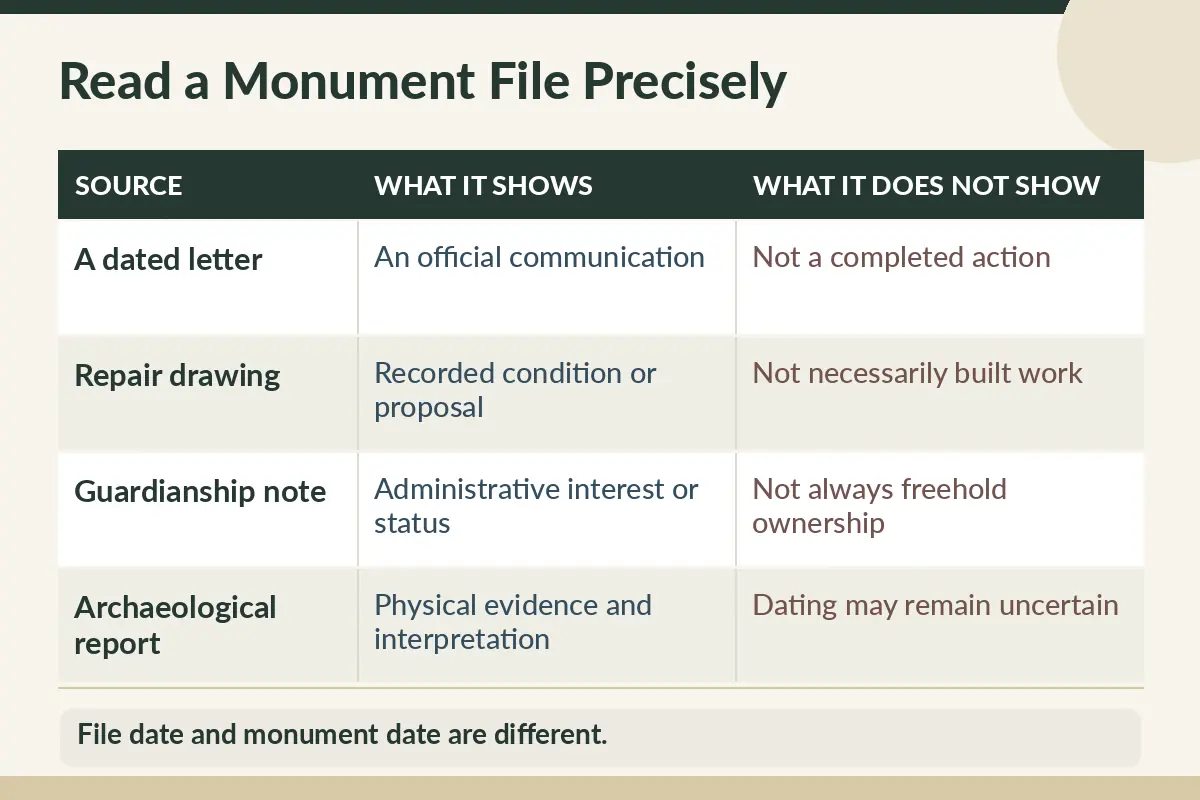
WORK 14 is an Office of Works and successor-department series relating to ancient monuments and historic buildings. Its practical value lies in reconstructing the administrative history of a site: when officials became involved, what condition they reported, what repairs they discussed and what decisions followed. It should not be confused with a medieval building account, a comprehensive archaeological excavation archive or an ownership register. A letter from 1939 about a prehistoric site dates the letter, not the structure being discussed.
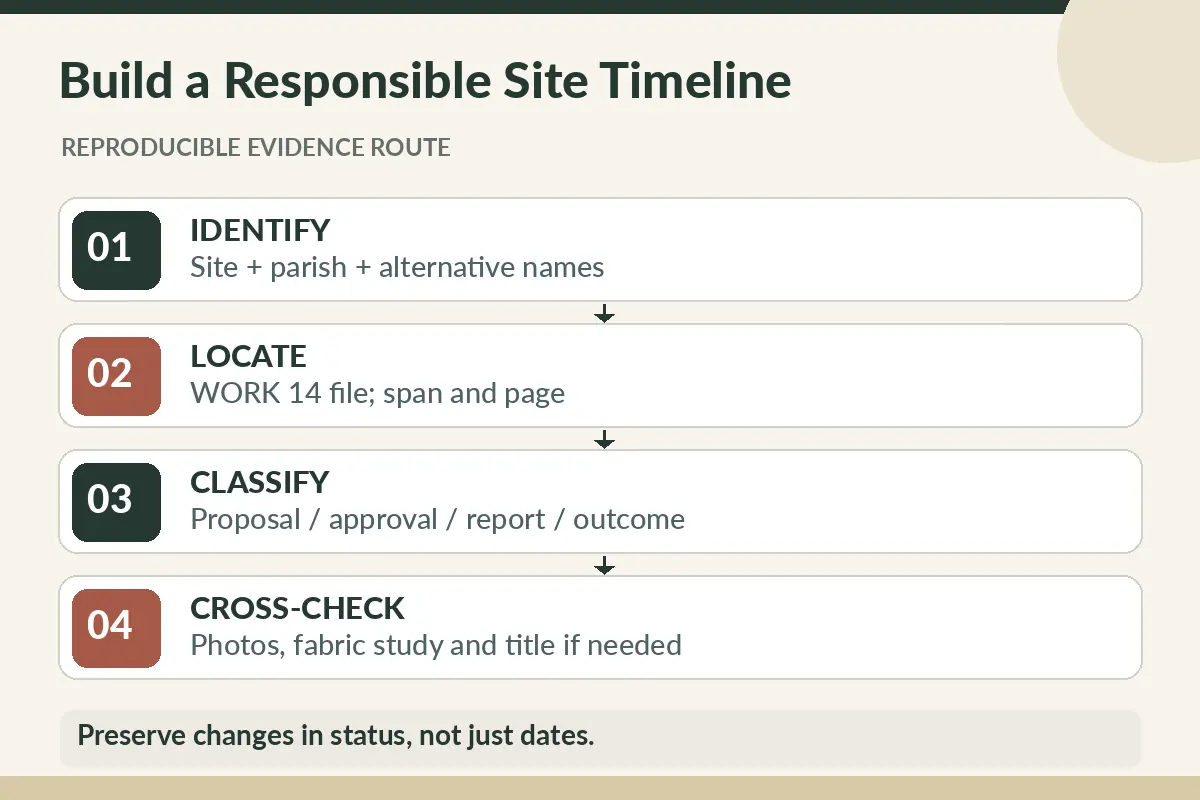
Begin with a specific monument and a modern period of interest. Use the established site name, the parish or district, county and any alternative names. The same term may describe both a broad archaeological landscape and a particular monument within it. If the research question concerns guardianship, define the public authority and approximate transfer date; if it concerns physical conservation, identify a suspected inspection, repair or alteration. A narrow question is easier to test than a request for “the whole history of the castle.”
Distinguish Guardianship, Ownership, and Scheduling
Official involvement can take different legal and administrative forms. Taking a monument into guardianship is not identical to acquiring the freehold, and an official discussion of preservation is not proof that a proposed repair occurred. Do not treat a designation, a consent process, or a ministry visit as evidence that the institution owned every part of the site. When the file contains correspondence between a public authority, a landowner and conservation staff, identify each speaker’s role before attributing a decision.
For a twentieth-century case, build a three-column ledger: stated status, documentary support and unresolved land-title question. A file may document a proposed arrangement that was never signed, or a maintenance duty without conveying land. If ownership is important, search dated deeds, land records and the current custodial history separately. If the question is a building’s original date, seek archaeological analysis, architectural fabric studies or earlier plans rather than inferring it from the first WORK 14 entry.

Find the Correct File Through Place and Period
Use the Discovery catalogue guidance to search a monument name and restrict the reference to WORK 14. Check spelling variations, neighboring hamlets and local administrative divisions, especially when a ruin has been known by several names. Because Discovery indexes descriptions rather than every word inside the manuscript, a disappointing name search is only a search result, not evidence that no relevant correspondence survives.
Once you find a plausible description, copy the complete WORK 14 reference, covering dates and title. Confirm whether the file is held by The National Archives or another institution before planning access. Read the file in sequence if possible: incoming requests, internal annotations, plans, later decisions and enclosures may be physically separated or filed by an office arrangement. A striking single page can misrepresent the final outcome if the next letter records refusal, delay or a change of proposal.
Compare Plans, Inspections, and Physical Remains
A plan attached to a conservation file may show proposed work rather than the building exactly as it stood. A condition report may describe damage observed on a particular date, while an engineering sketch may recommend a treatment that was not adopted. Record a drawing’s purpose, author or department, date and revision state when those are available. A modern restoration line should not be labeled “medieval wall” merely because it appears beside medieval masonry in the same file.
English Heritage cites WORK 14 for the twentieth-century history of Kenilworth Castle following state ownership in 1937. That is a useful model: conservation correspondence can illuminate the modern management of a historic place, whereas earlier castle history depends on different classes of evidence. Compare observations with photographs, archaeological reports and dated official site histories. When a wall changed appearance between images, test whether the change represents repair, removal, excavation, demolition or simply a different camera angle.
Read a Named Example Without Generalizing It
A National Archives educational source publishes a letter dated June 8, 1939, from the British Museum concerning Sutton Hoo, reference WORK 14/2146. It illustrates the kind of official communication that can survive in this series: a discovery being reported, expert concerns being discussed and information circulating between institutions. The letter does not by itself reconstruct the entire excavation sequence, determine every artifact’s provenance or resolve every subsequent custody question.
Use examples only to learn what questions to ask of your own file. If one monument has detailed correspondence, do not assume a neighboring monument has an identical paper trail. File creation depended on official involvement and administrative priorities. A local site may have rich county archaeological reports but little central government material, or the reverse. Record whether a statement comes from a contemporary eyewitness, a later professional assessment or an administrative summary.
Produce a Preservation Timeline With Honest Limits
A sound finished timeline lists each dated event with its source and status: proposal, authorization, inspection, work reportedly undertaken, completed repair, or later description. Keep the original monument’s construction date in a separate field, supported by archaeological or architectural sources. If an official letter names a contractor or visitor, that may be evidence of correspondence but not a complete employment history or proof that the person owned the property.
At the end, write the narrowest defensible conclusion. For example: “A WORK 14 file records a ministry discussion of repairs in 1947,” not “The entire site was restored in 1947,” unless a completion record supports that claim. Include the archival reference and the place identifier so future researchers can find the right site. When files are inaccessible or incomplete, note exactly which series or local archive you will consult next, and preserve unsuccessful searches as part of the research log.
More House and Local History Guides
How We Research and Check the Archival Evidence
We checked the archival descriptions and record-family boundaries against these sources: The National Archives; English Heritage; The National Archives; The National Archives. The cited guides support the series and period statements but cannot authenticate an unknown item, family relationship, particular named worker or undocumented file that we have not examined. A catalogue result is a finding aid. Read the original where access permits, record the full reference, and cite each separate factual claim at the level of its actual evidence.
Our evidence rule is simple: quote a source for what it records; label any deduction as a deduction; and leave gaps visible until an independent record resolves them. These guides are informational and do not imply that records are online or free in every case. Commercial relationships, when applicable, are explained in our affiliate disclosure; none of the research routes above requires an affiliate purchase.
Not simply from the file date. It primarily documents later official dealings with monuments; use construction, archaeological or architectural evidence for the original building phase.
Not necessarily. Guardianship, legal title and other designations are different questions and may require deeds or statutory records.
Discovery searches catalogue descriptions, not all words in every file. Try alternative names, places, dates and browsing within WORK 14.
It may show the existing condition, an option or an approved proposal. Identify its date, annotations and purpose before claiming the work happened.
No. Check minutes, approvals, subsequent correspondence or completion evidence before describing the action as done.