
Recognize Two Historical City Names and Two Registrations
For British families in Norway, The National Archives identifies the Oslo (historically Christiania) consular registers in FO 529/1–14. These cover specified births, marriages and deaths, but they are not Norway’s universal civil registration. Begin with the family’s event and date, then ask whether it may have been reported through a British overseas channel.
A document describing “Christiania” and one using “Oslo” may refer to the same city at different historical times. Do not assume identical streets, jurisdictions or record procedures across all decades. Retain the place name exactly as written in the record, then add a modern standardized locality for searching and mapping only after you have understood the context.
A name found in a British consular register can be valuable for reconstructing a household abroad, yet it does not automatically prove British nationality for every person named or establish a complete Norwegian legal event. Keep the local registration question separate. It may require a Norwegian archive, church book or civil authority rather than another British index.
Use Event-Specific Coverage Instead of One Date Range
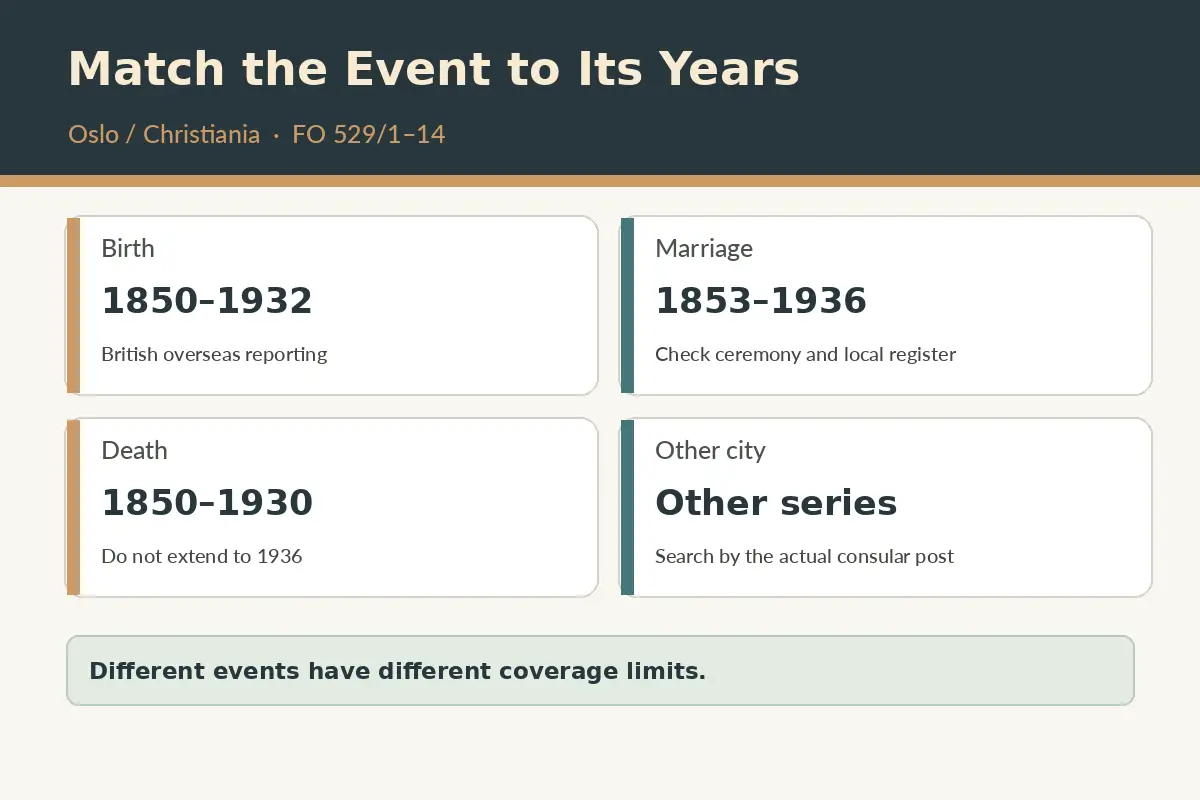
The National Archives appendix gives Oslo/Christiania births as 1850–1932, marriages as 1853–1936 and deaths as 1850–1930, within FO 529/1–14. These are not interchangeable ranges. A 1934 marriage may lie within the listed marriage coverage; a 1934 birth or death should not be assumed covered on that basis.
Use three columns: the event alleged by family tradition, the year, and whether the type-year combination sits inside the archive’s listed period. Then browse the catalogue for the correct FO 529 piece rather than guessing from the collection number. An archive series reference is a search destination, not a promise that the particular event was reported.
The source describes these as British-subject registration materials and advises searching General Register Office overseas indexes first. Indexes are a discovery tool, not necessarily the primary evidence. If the name is absent, try historical spelling and examine plausible pieces; missing reports and transfers mean no single index is complete.
Compare Consular Records With Overseas GRO Indexes
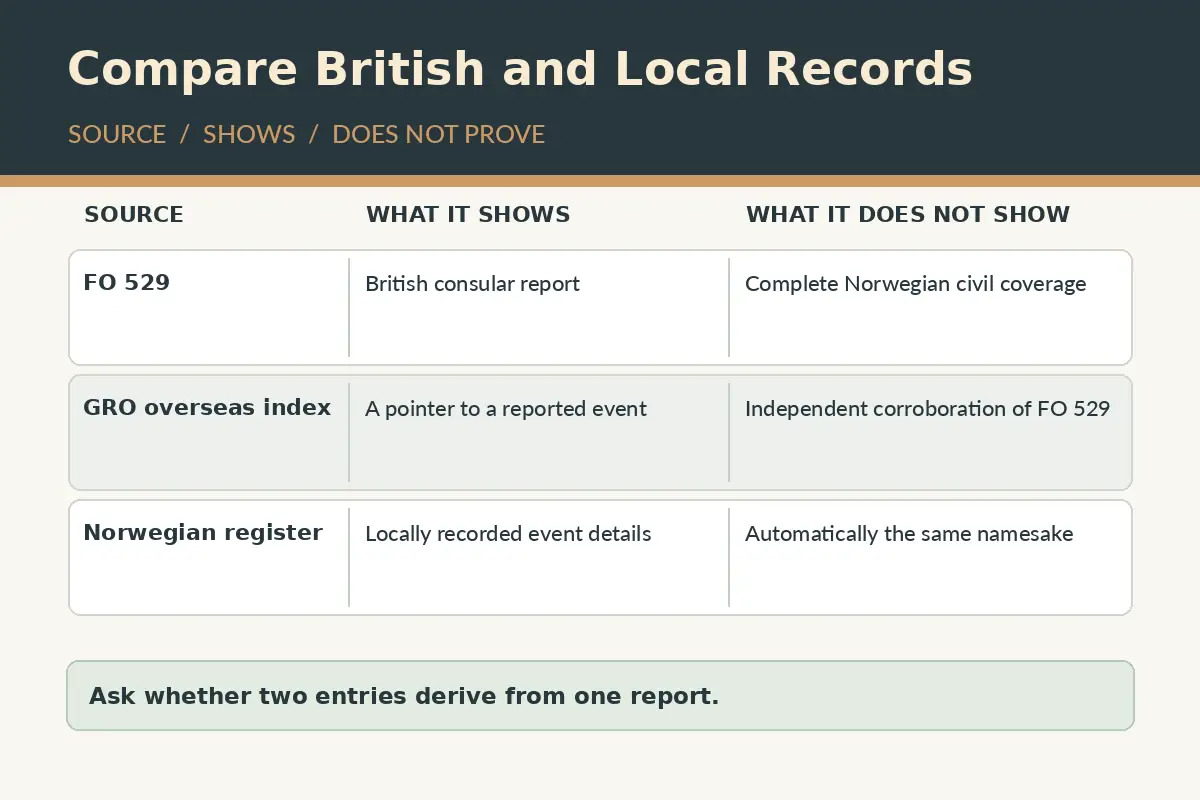
The National Archives explains that many overseas birth, marriage and death entries were sent back to the General Register Office, so an FO 529 entry and a GRO overseas-index line may describe the same event. They are not two independent witnesses to the event just because they appear on different websites. Establish whether one is a copy or derivative of the other.
Write a two-column comparison: original or copied consular register entry on one side, GRO reference on the other. Reproduce the spelling, dates, addresses and relationships only if those particulars actually appear. If a GRO certificate can be ordered for a matching index reference, treat it as another document requiring analysis rather than assuming it resolves every question.
Record competing entries for people with common surnames separately. A British trader and a British clerk living in Christiania could share a first and last name. Use the spouse, occupation, address or sequence of events where available to test identity. Similar names and the same city do not themselves establish parentage or a continuous household.
Seek the Norwegian Event and Its Own Evidence
The archive’s overseas registration guide warns that local registration rules may have applied in the foreign country and that records may exist there independently. For a marriage, check the jurisdiction and ceremony in Norwegian records if available. A British notification may have been prepared after the event rather than serving as the authority by which the marriage occurred.
For births or deaths, the same principle applies: an overseas entry may record information reported to British officials and later entered into a national index. Look for the contemporary Norwegian event record, paying attention to parish or civil boundaries, historical scripts and translated names. An inability to find the local record is a research gap, not proof of fabrication.
Imagine a hypothetical 1891 Christiania family whose first child appears in FO 529 and whose second appears only in a Norwegian church record. A British reporting gap could explain the asymmetry; it does not justify erasing the second child from the tree. Keep each child’s event evidence and exact record origins distinct.
Build a Cross-Border Timeline Without False Continuity
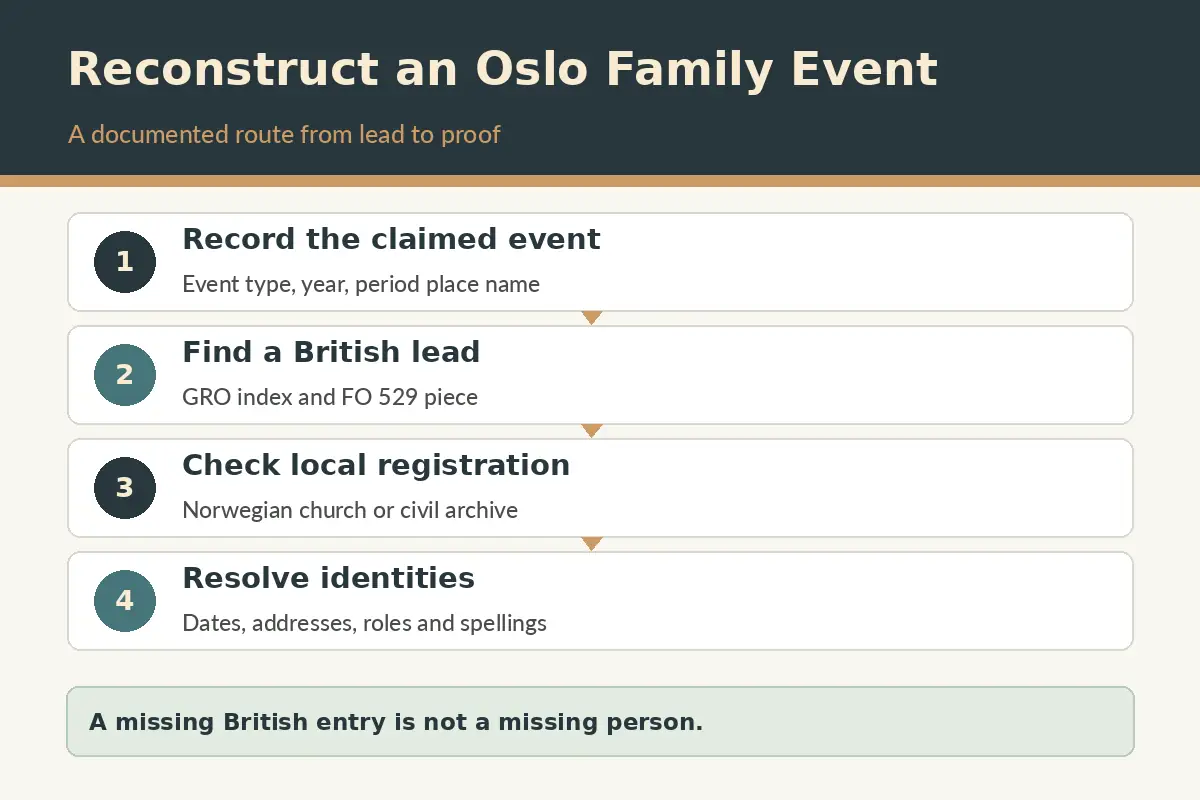
Construct a timeline with at least five fields: event date, date entered or reported, historical place name, record system and original citation. A later consular transcript is not necessarily contemporaneous with the event. If a household moves from Oslo to Bergen, do not continue searching FO 529 as though it were a nationwide Norwegian register.
The date limits above apply to the Oslo/Christiania entries listed in the archive guide. Other Norwegian places have different Foreign Office references and ranges. A family member’s disappearance from the city register can mean migration, non-reporting, a change in record channel or an event outside the covered years; it cannot be read automatically as death.
Finish with a limited statement that names the exact entry and its reporting system. For example, “a British consular record reports a marriage in Christiania” is more defensible than “the British government proved the marriage and the couple’s nationality.” The next step is the local record or an independent family document that tests the same event.
More Place and Jurisdiction Guides
How We Research British-Norwegian Records
We take the FO 529 pieces and event-specific years from The National Archives guide to overseas vital events, then follow its distinction between British representative reports, GRO indexes, and records kept abroad. Its citation guidance supports recording each full FO piece reference.
The example family is fictional. We have not viewed an individual FO 529 volume, and availability depends on the exact item. Before using a paid index or copy service see the affiliate disclosure. Test one event against its own coverage dates before searching for an entire imagined family group.
A Foreign Office record series containing the Oslo/Christiania British consular vital registers listed by The National Archives.
The archive lists Oslo marriages in 1853–1936; births and deaths have different end dates.
They are historical names associated with the same city; use the period name in citations.
Not necessarily. An overseas index may derive from the consular information.
Check year and event coverage, spelling, another consular post, and Norwegian local records.