
King’s Bench Provincial Indictments can answer a precise archival question, but it must be read for the purpose for which the office created the record. The practical answer is to identify the relevant series and custodian, select the original item and its dates, then separate the explicit entry from every unverified biographical inference. This guide gives a source-specific search route and the evidence limits that prevent false family-history conclusions.
Define the Charge, County, and Court Term First
A provincial indictment before the Court of King’s Bench is a procedural record of an accusation, not by itself evidence that the accused was convicted. From 1675, the court’s Crown Side papers are divided by jurisdiction, and until 1844 the relevant out-county indictment or information files are in KB 11. A broad surname search will miss much of this system because the surviving docket and roll structures follow legal terms and procedural references.
Start with the alleged offense, historical county, approximate date and any trace of a court order. Be careful with a family story about an arrest: it may concern local sessions, assizes or King’s Bench, which were different courts. Define the legal proceeding before attaching a person to an indictment. Use place and term to route the search, then corroborate identity.
Read KB 29 as a Procedural Finding Aid
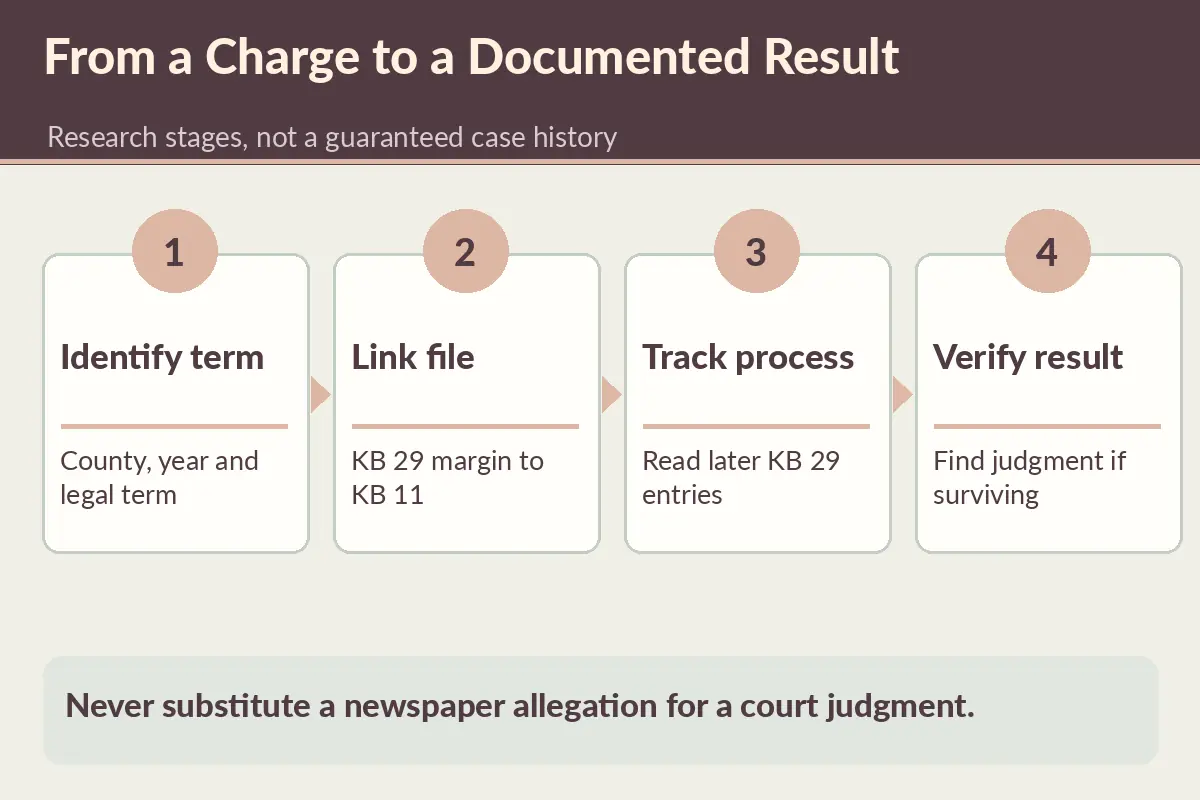
The controlment rolls in KB 29 summarize Crown Side business by legal term. Their first or bag-roll section registers suits or prosecutions begun in that term, and a marginal numerical reference can point to an indictment or information. The second, roll of entries, tracks proceedings after appearance. This structure explains why the first mention and last judgment may be separated by several terms or not found in the same place.
The National Archives guide distinguishes KB 11 for out-county matters until 1844, KB 10 for London and Middlesex, and KB 12 for all counties after 1845. Do not follow the KB 11 path merely because the accused later lived outside London. Use the original jurisdiction and date. Keep the KB 29 marginal number, term, county and page in a single research row.

Find the Indictment Without Turning It Into a Verdict
Having identified the marginal reference, look for the corresponding KB 11 file and check the record’s full description and access conditions. The indictment may state allegations, people, places and legal formulas. Such wording is evidence that the charge was recorded; guilt remains a different question. Some files contain informations, writs, jury material or associated procedural papers, so identify the paper type rather than labelling the whole bundle an indictment.
Compare every name and role carefully. A victim, prosecutor, witness, attorney and defendant can all appear in one case. Record which role belongs to the ancestor and whether any identifying occupation or residence is explicitly stated. Avoid merging defendants with matching names without chronological and geographic support. If the paper is undated or abbreviated, cite the legal term under which it was filed.
Trace Appearances and Outcomes Across Terms
The roll of entries in KB 29 can record appearance, pleading and later steps for a case that proceeded beyond summons. Since proceedings could extend across terms, examine successive rolls before claiming that a docket entry was the final disposition. The Archives also points to crown rolls in KB 28 and other final judgment material for certain periods. A case disappearing from one index is not proof of acquittal or conviction.
Keep process entries distinct: accusation, summons, appearance, hearing, judgment and enforcement are not interchangeable. It is reasonable to report an unknown outcome when the necessary section is missing or no entry can be linked. If a later newspaper or biographical account asserts guilt, corroborate the judgment independently and state the newspaper’s status as reporting, not the court’s own order.

Know When Other KB Series Apply
London and Middlesex matters before 1845 commonly route to KB 10. After the mid-1840s reorganization, KB 12 covers indictments from all counties. For some earlier London cases, KB 15 process books offer an alternative pathway, though the Archives warns that they may omit cases. The controlment roll provides a procedural key; it does not promise that every original charge or outcome survives intact.
A prosecution described in modern terms may in fact have been a civil matter, or it could have moved to the King’s Bench from another jurisdiction. Examine whether a writ of certiorari or another transfer appears. Do not infer that the underlying original local court documentation has been examined simply because the King’s Bench entry mentions a transferred matter.
Reconstruct an Identity Without Namesake Errors
Suppose a fictional county newspaper mentions “John Brown” accused of forgery in 1802. The newspaper does not by itself identify which John Brown, and a KB 11 indictment for the right county may still concern someone else. Look for occupation, parish, associated names, procedural dates and known residence. Treat name spelling as one clue among several. A legal description may use historical occupational titles and spellings.
Document every candidate separately. Where the indictment names witnesses or sureties, do not automatically convert them into relatives or business partners. Seek independent parish, tax, directory or probate evidence before accepting a relationship. The answer can remain “a candidate charge in this county” until a distinctive match is established.
Understand Court Terminology and Transcript Limits
The term “information” has a technical legal meaning and may not correspond to an ordinary witness statement. Legal Latin and formulaic language can obscure the difference between a pleading and a judgment. Copy crucial passages exactly before translating them; if a later calendar shortens the text, note what was omitted. Pay particular attention to negative or conditional wording and to marginal later annotations.
When reading a photograph of an entry, include both the original heading and relevant adjacent procedural notes. An indexed summary can make a case appear settled because it prints one date, even when later entries matter. Describe whether you examined the original image, a transcript or a catalogue description. Cite them separately when they disagree.
Finish With a Charge-to-Outcome Evidence Table
For each case, maintain fields for county, legal term, KB 29 reference, KB 11 number, role, alleged offense, progression and independently verified outcome. Place every quoted assertion in its evidential category. Link only those entries that share reliable procedural markers; a common name alone is not an index key. Log unsuccessfully searched terms and file gaps to keep absence from being exaggerated.
A robust conclusion might say: “A prosecution for the stated offense was begun in this court term and linked to this indictment; the outcome has not yet been located.” It should not say the person was punished or imprisoned without the necessary judgment and other records. This route makes even an incomplete criminal file valuable without accusing an ancestor of an undocumented crime.
How We Research the Original Series and Source Limits
Our research begins with the custodian’s official guidance and the related archival description. We check series titles, date ranges, administrative purpose, historical jurisdictions and the named person’s role before converting a finding aid into a claim. An online index, a digitized item and a scholarly transcription are described separately. When two names may refer to different people, we preserve both candidates, compare original documents and record which independent detail could settle the question. These diagrams show research logic, not facsimiles of authentic documents.
More Records and Archives Guides
Citations, Access Limits, and Affiliate Disclosure
The official archival sources establish the following specific scope: KB 29 controlment rolls point to KB 11 out-county indictments until 1844; proceedings and judgments require further tracing; Historical KB 29 and changing KB 9/KB 10/KB 11 division. Check individual item access and current copying rules; a catalogue entry is not a promise that every leaf is digitized or name searchable. Record the repository, series, item, date, folio or page, original headings, and exact retrieval path. Log missing results by the years and places actually searched rather than inferring that no event occurred. See the site’s affiliate disclosure before using commercial links.
No. It is part of the accusation process; locate the later judgment or disposition.
KB 11, using the case reference and jurisdiction found in KB 29 where possible.
Appearances and subsequent steps may be recorded in later terms rather than with the first charge.
Generally they used KB 10 before 1845; verify jurisdiction and period.
Not without distinguishing evidence such as occupation, residence, associates and dated records.