
Stationers’ Hall COPY 3 Registers: Trace Books, Music, and Rights Holders is a guide to one identifiable archive series, not a substitute for the original record. Start with the official series guidance, identify the correct custodian and date range, then separate the administrative event actually recorded from the person or family claim you are trying to prove. The research tables below distinguish what is evidenced, what remains uncertain and which next document would test the claim.
Choose a Work Type Before Searching Stationers’ Hall
The National Archives holds Stationers’ Hall copyright registers in COPY 3, with separate classes including literary books, commercial publications, musical and dramatic works, photographs and artistic material. This guide concentrates on literary and musical registration rather than the deposited photographs discussed in COPY 1. Begin by identifying the original work type, approximate year and possible proprietor.
A local family business might have registered a printed label while a relative published a song. Those are different administrative categories even if the same surname appears. A book may have appeared in several editions and editions do not necessarily share the same registration date. Record edition, publisher and title-page wording before assuming there is a single obvious search target.
Know Which Years and Books Registers Survive
The Archives lists Books, Literary and Commercial registers in COPY 3/1–29 for 1842–1883, and Books, Literary registers in COPY 3/30–62 for 1883–1924. Separate index references and assignment registers also exist. These are precise catalogue routes, not a promise that every published book or piece of music was registered.
For a title outside the named date bracket, identify the relevant later category or a different custodian rather than forcing the record into these series. The category boundary matters: printed music could appear in a books-related register, while dramatic and musical entries have another route. Confirm the register’s own heading before calling a record literary or dramatic.

Why a Search-Engine Title Query Often Fails
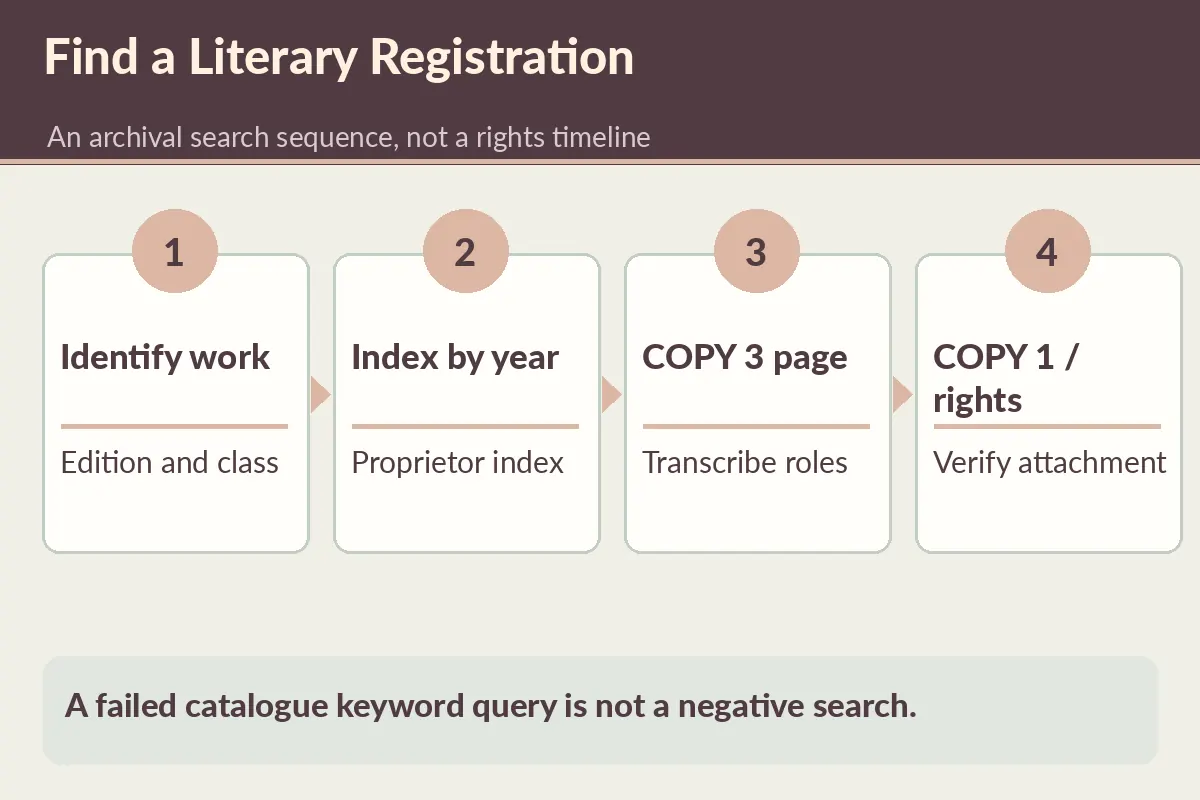
COPY 3 entries are organized chronologically. The National Archives states that their online catalogue does not provide keyword searching within these register volumes. Original alphabetic indexes exist for some registers, often arranged by copyright proprietor, not by author or the modern title. These paper indexes lead to a volume and page and may require research at Kew.
If no title result appears in Discovery, that is not evidence no entry exists. Start with a realistic year or month, then the work class and candidate rights holder. A publisher might be the proprietor instead of the writer. Maintain separate searches for a maiden name, pseudonym, publisher’s trading name or successor business when supported by other documents.
Read Registration and Authorship as Different Claims
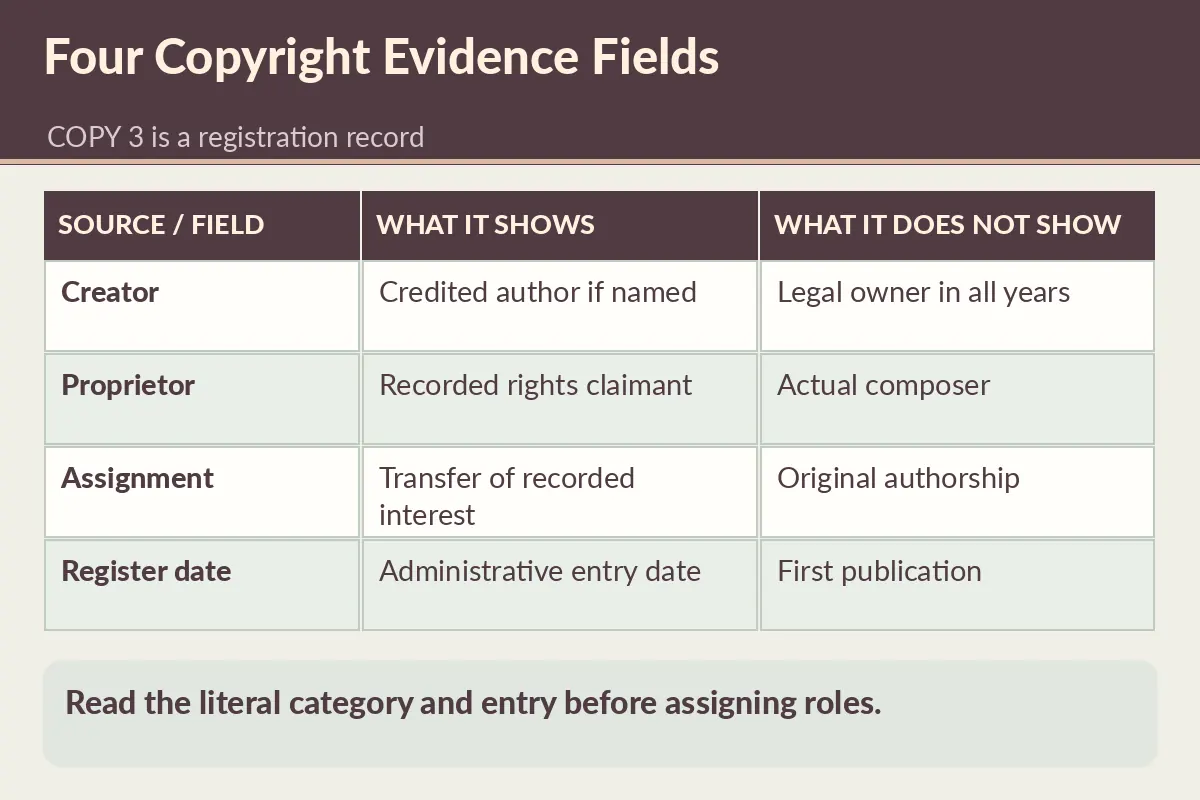
A COPY 3 entry can help identify the named proprietor, work, registration date and administrative particulars. However, the person who registered or held the rights need not have created the work. Assignment records can record a transfer of interests but do not by themselves prove that the assigned proprietor wrote or illustrated the original work.
In a family-history research log use fields for creator as stated, copyright proprietor as stated, publisher or representative, register date, work title and volume reference. If the entry names only a firm, do not assign a named family member as author because that person owned the business. Look for a title page, contract or correspondence independently.
Use the Paper Index and Volume Together
For books registered before 1883, the guide identifies original indexes including COPY 3/81 and COPY 3/91; after 1883 other literary indexes are in COPY 3/82–90. Follow the applicable original index to a volume and page. Browse around the entry if the page numbering or alphabetical reference looks ambiguous.
An index reference is a pointer rather than a facsimile of the registration. Transcribe the original entry in the register and describe any handwritten correction, attached notes or separate assignment. Some categories have different numbering conventions, so record exactly how you obtained the reference instead of copying a number without its register context.
Understand the Relationship to COPY 1 Deposits
COPY 1 contains original entry forms and in some cases annexed examples of registered works; COPY 3 holds registers. The phrase “Copy Annexed” in a register can signal that a copy of the work is attached to an entry form. That does not mean an attachment exists for every registered work. COPY 2 holds different label-book material.
Use those distinctions to plan a source chain. First locate a COPY 3 register entry and copy its reference. If the wording indicates an annexed item, examine the appropriate COPY 1 material. If the subject is a photograph, follow the photography-specific guide rather than assuming the literary register contains the original print.
Check Changes of Ownership With Assignment Books
Assignments can change the named rights holder without changing the identity of the original creator. The Archives provides registers and indexes for assignments associated with different date spans; the exact route depends on the class of work and the date. Preserve the distinction between initial registration, later transfer and subsequent reprinting.
A family firm could acquire a catalogue of titles and appear repeatedly without having authored any of them. Conversely, an ancestor could have written a work while a publisher registered it. Search publication notices, surviving publisher correspondence and estate or company records before concluding what financial or creative role a relative held.
Hypothetical Test: An Unknown Songwriter
Suppose an 1889 sheet-music title carries a family surname and a publisher’s address. A COPY 3 index points to the publisher as proprietor, and the register confirms the title. These facts support registration and ownership as recorded, not a claim that the proprietor composed the music. Compare the printed score for a credited composer and independent publisher agreements.
A negative result after searching the composer’s name may mean the correct index key is the proprietor. If a register date differs from the publication year, retain both rather than silently making them identical. Your final finding should cite the register volume, page, title and administrative role separately.
How We Research This Record Set and Its Limits
We first inspect the custodian’s archival guide and its second source description. We confirm the series title, date spans and document creator, then distinguish indexes, piece-level descriptions, images and secondary transcriptions. A description without the item is a lead rather than an inspected original. For every person-level assertion we ask which field records the event, whether the writer witnessed it, whether a contemporary correction exists and what independent source could identify a same-name alternative. We record negative searches with precise coverage rather than claiming an event never happened. Diagrams illustrate workflows and are not reproductions of historical documents.
More Records and Archives Guides
Archive Access, Citation, and Affiliate Disclosure
The first archive reference supports this scope: COPY 3 original indexes and chronological categories, 1842–1924 literary works and registration fields. The second archive reference supplies this additional distinction: Copyright registers are not online-catalogue keyword searchable; owner indexes point to volume and page. Consult the item-level catalogue record before assuming a particular volume is digitized, name indexed, open to the public or available to order. Note the series and piece, manuscript page or folio, relevant column headings, date, and access method used. Any fees are set by the provider and should be checked at the time of use. Read the site’s affiliate disclosure before using commercial links.
No. The National Archives advises category, date and original proprietor-index searching.
No. It may name a copyright proprietor or publisher.
The official guide lists COPY 3/30–62 for that period.
Usually the register is an administrative record; check relevant COPY 1 entry forms for annexed works.
Yes. Consult assignments and related registers, keeping original creator and proprietor distinct.