
WO 409 contains Durham Home Guard enrolment forms rather than a national Home Guard roll. Use dates, battalions and birth details, and follow the archive’s privacy rules. Begin with the custodian’s research guidance. See the GenHis affiliate disclosure before choosing an outside access provider.
Start With the Durham-Only Boundary
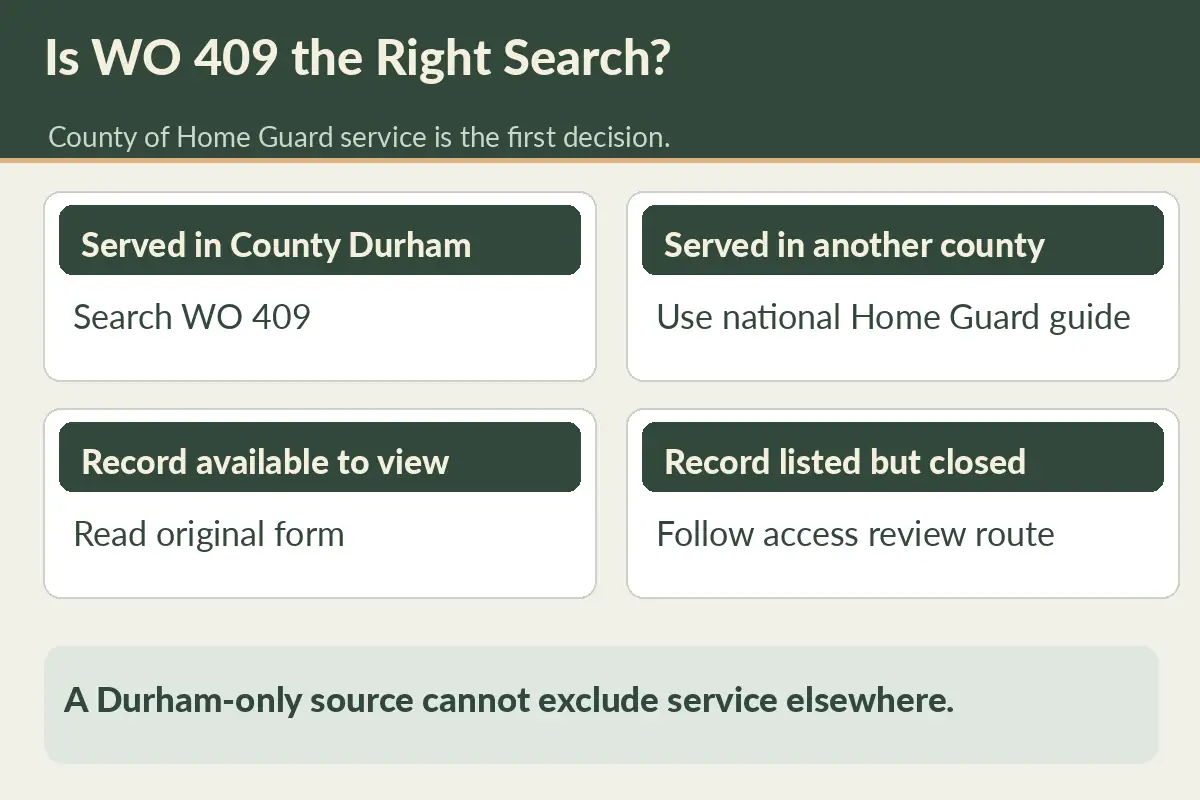
The National Archives describes WO 409 as enrolment forms for more than 80,000 people serving the Home Guard in County Durham in the Second World War. It is not a complete nationwide list of Home Guard service. The forms originated when participants joined local units, and a surviving record may name a person, date and place of birth, address and brief details of earlier military service. If family memory places the volunteer in Yorkshire, Surrey or Wales, a search confined to WO 409 may be fundamentally misdirected.
Establish a contemporary residence and likely Durham connection from directories, electoral evidence, letters, photographs or wartime documents. County names and battalion geography should not be inferred from present administrative boundaries alone. Record the source of the Durham assertion. A birthplace elsewhere does not disqualify a match: the volunteer may have moved before enrolment. Conversely a Durham-born man serving another county’s Home Guard is not automatically included.
Find the Enrolment Form in Discovery
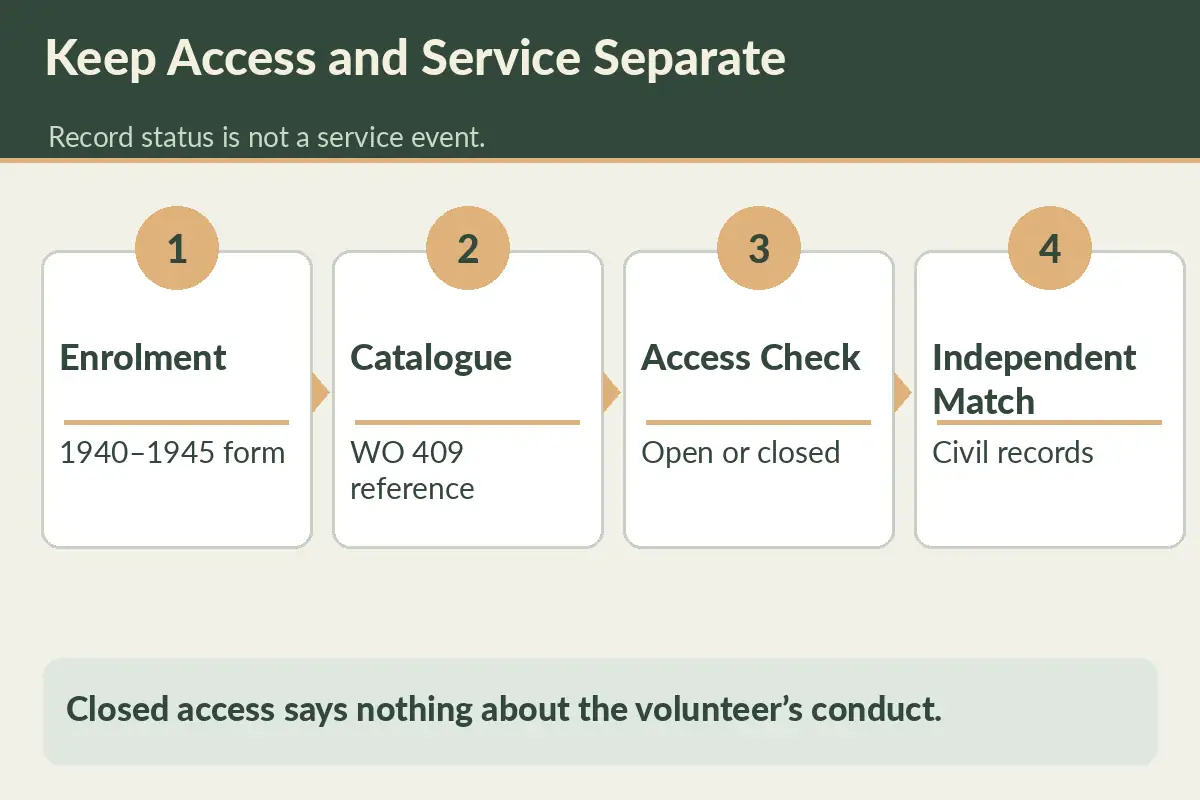
Search the WO 409 series by surname and given name, testing initials, middle names and spelling variants. The National Archives identifies these as enrolment forms completed when people joined the Durham Home Guard. A catalogue result may include a battalion and a date. Record that full file reference; an index snippet cannot show how the original form was completed or whether a later note changed the interpretation.
Compare possible candidates using birth date, birth place, wartime address and any known earlier service. Name alone will not settle a common-surname match, especially where multiple family members volunteered. If a photograph indicates a unit badge or battalion, check that evidence independently. The reported battalion is a service clue, not proof that the volunteer took part in a particular exercise or combat operation.
Treat Closed Records and Reviews Correctly
Some WO 409 records are closed where the documented date of birth falls within the archive’s privacy threshold, described in the guide as less than 100 years ago. A closed description may still be discoverable, even though the form itself cannot be downloaded. This is an access status, not evidence the person never served or did something sensitive. Do not bypass a closure by searching for illegally shared copies or circulating personal data about a potentially living individual.
The archive directs researchers to an official request or review route for closed files and may require evidence that the individual is deceased, with a search fee. Follow the current form and published requirements; do not assume that a relative’s age or personal assurance guarantees release. If access is withheld, preserve the catalogue reference and make a research note about the constraint rather than inventing missing details.
Understand What an Enrolment Proves
An enrolment form is evidence that the person supplied or was recorded with particular information at enlistment. It may support service membership and provide a valuable address or birth detail. It does not on its own prove every subsequent posting, active-duty attendance, long-term service or discharge date. A reference to former military service is a lead, not a substitute for the earlier service file.
Transcribe name, date, place, address, former service, date and organizational details, plus any corrections. Distinguish handwriting and later annotations from original applicant entries. For an unusual middle name, note exactly whether the form provides it; do not expand an initial without independent evidence. Keep uncertain readings marked as uncertain and retain the surrounding original wording in the research note.

Compare Home Guard Evidence Against Civil Records
A 1939 Register entry or local newspaper may corroborate address and age but provides a different kind of evidence. A death registration can help satisfy record access requirements and test dates; never assume public availability of a modern personal record. Use wartime city or county directories cautiously because publication may lag the underlying household survey. An enlistment address is an address at a recorded time, not proof of property ownership.
If two records show the same name and age, require a stronger link such as birthplace or a documented household. Note that people could move between units and localities; a single early form is only one snapshot. If independent evidence points to another county, change the record series search rather than treating the Durham collection as universal negative evidence.
Prepare a Responsible Family-History Citation
A clear citation records The National Archives, WO 409, full piece and item, the name as indexed and the exact source examined. Add the review or download date separately. Note whether you saw a catalogue description, open image or a response from an access request. The distinction matters when a record is listed but not visible. Avoid publishing a living person’s full date of birth or private address merely because it appears in a description.
Your conclusion can be specific without overreaching: “The Durham enrolment form records this person as a volunteer in a named battalion at a given date.” If you lack the full form, say it is a catalogue lead. If the identity match is uncertain, store competing candidates separately. The next research action is either an authorized access request, a battalion-context search or independent birth-and-address verification.
How We Research Durham Home Guard Wo 409
We start with the original legal or administrative question that created this source. First we verify the time and geographical reach of the collection, then inspect the exact item rather than substituting a name index. We transcribe dates and labels in their original setting, note who supplied the information, and test an identifying detail against a separate source. If the relevant item is unindexed, incomplete, destroyed or restricted, we report that condition distinctly from a genuinely negative search. The remaining unknown becomes a specific next-record request, never an invented fact.
More Records and Archives Guides
Official Sources and Research Limits
For the record group and primary arrangement see The National Archives research guide: States the Durham-only WO 409 enrolment scope, fields, closure policy and search procedures.. For an independent description of scope or access, see the related archive guide: Provides national Home Guard personnel context and other-county routes distinct from WO 409.. An archival call number is a pathway to the evidence, not proof of the facts inside a document that has not yet been examined.
No. The National Archives describes it as a Durham-only collection.
Typical fields include name, birth date and place, address and brief earlier military service.
It may be closed under the archive’s birth-date privacy rules.
The archive provides an access-review route, subject to its current evidence and fee requirements.
No. An enrolment document does not establish particular later activities without separate evidence.