
Search the People Named, Not Only the Compensation Claimants
Washington, D.C., records created under the April 16, 1862 emancipation law may name people who were formerly enslaved, their ages and descriptions, and the individuals who claimed compensation. The correct starting point is a named person and a dated petition, not an assumption that the claimant’s relationship to that person was legitimate, consensual or genealogically informative. Search the commission papers in NARA microfilm M520 and preserve every relevant name.
The National Archives account of D.C. emancipation explains the legal setting and distinguishes the compensation board from related court records. Treat this as an archive guide and historical context; the original petition itself is the source for an individual’s name, age and description. Avoid repeating nineteenth-century claim language as if it were a modern fact about a person.
Understand the April 16 and July 12 Filing Routes
The April 16, 1862 act abolished slavery in the District and offered compensation to qualifying former enslavers. Petitions under the initial law recorded schedules of people for whom claimants sought payment. A July 12 supplementary law provided other filing routes, including for people whose former enslavers had not filed and for certain people held by owners outside the District. These are distinct legal circumstances.
Label which statute a particular document used. The Archives explains that schedules filed under the original act and the supplemental act can be arranged differently. The date a document was filed does not by itself establish when the person first attained freedom in every legal sense. Do not replace the legislative history with an unsupported claim that the government paid compensation to the newly freed people.
Choose RG 217 M520 Instead of RG 21 by Accident
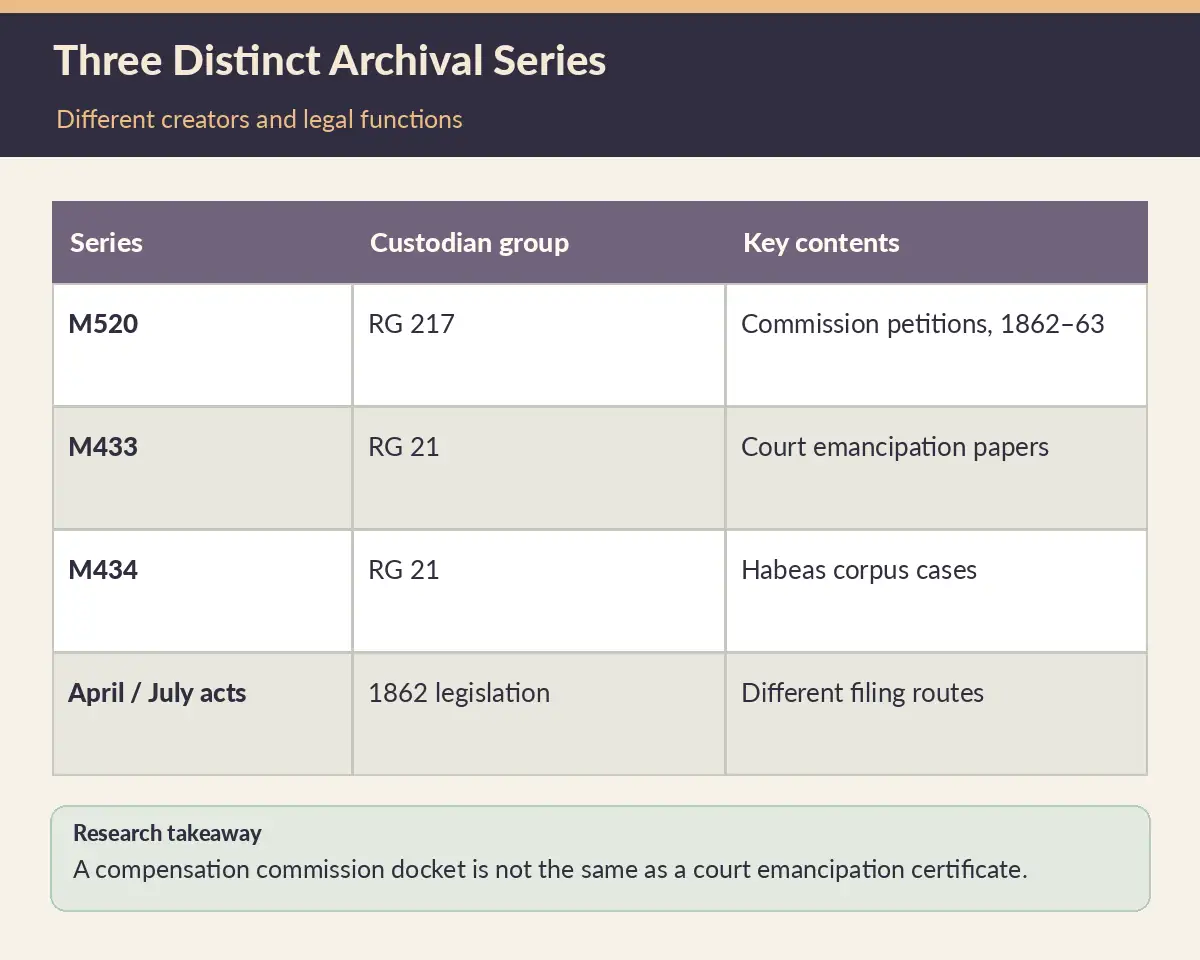
M520 contains records of the Board of Commissioners for the Emancipation of Slaves in the District of Columbia, 1862–1863, in Record Group 217. The Archives’ microfilm catalogue identifies six rolls. These are commission records, including administrative volumes and petitions; they are not identical to court emancipation papers kept in another record group.
M433 is the three-roll court series in RG 21, while M434 covers related habeas corpus records. Choosing the wrong series because it mentions emancipation can omit the relevant person or show an entirely different legal action. Record group, publication number and individual item are separate pieces of the citation. If one series lacks a person, the other may still merit a targeted search.
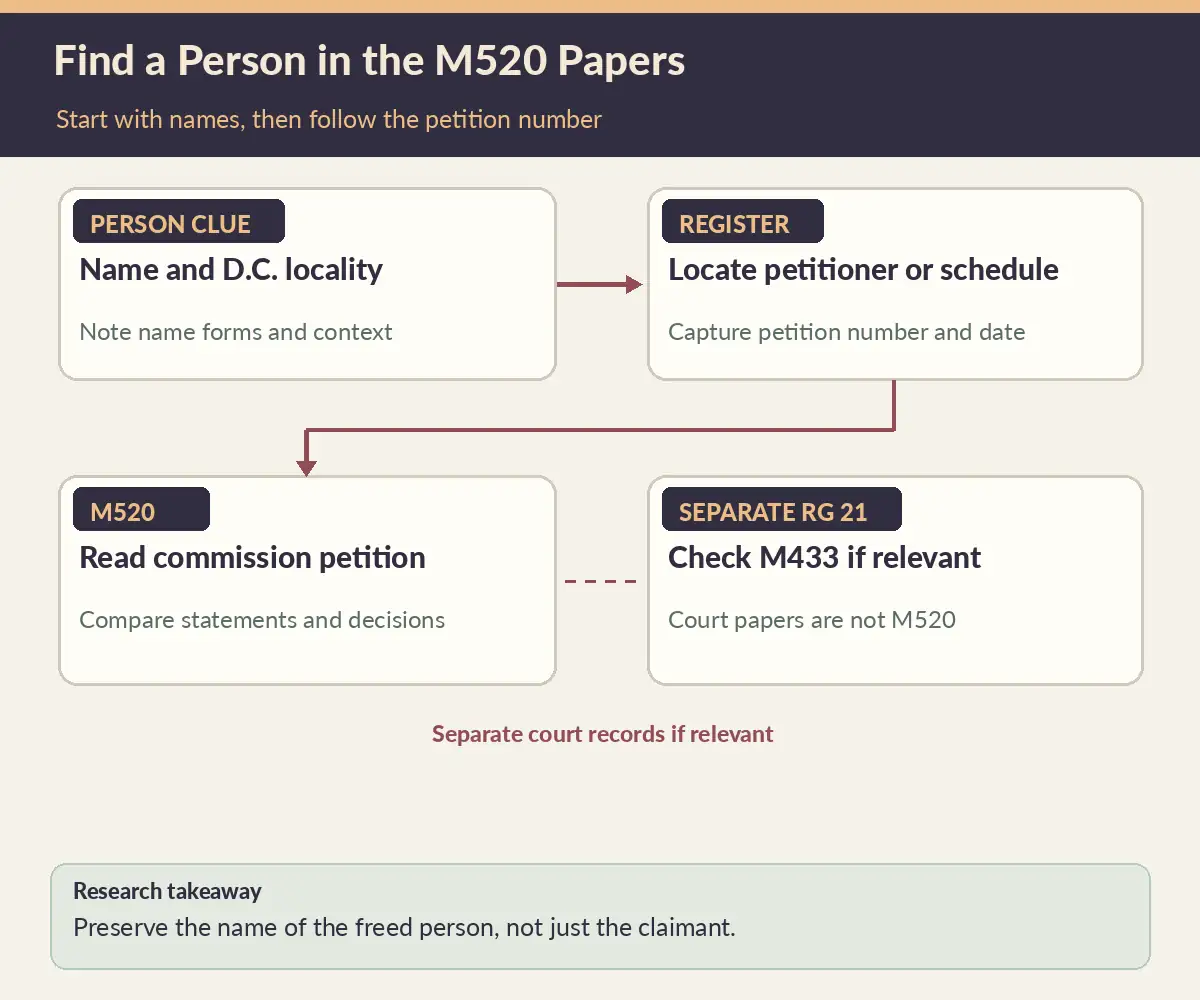
Follow the Petition Number and the Decision
An M520 search can proceed from an index or a register entry to a numbered petition and the commission’s action. Record the petitioner’s name, the freed people named, the filing date, petition number and any separately recorded award or decision. The claimant and the named people are not interchangeable search subjects: an archive item may be indexed under the person asking for payment rather than all people described.
A compensation decision answers what the commission accepted or awarded in an administrative process. It does not validate every assertion in the petitioner’s description of the past. Some claims were contested or limited, and records may have contradictory ages or spellings. Transcribe the original wording while identifying whose statement it was and the reason the document was created.
Record Physical Descriptions Without Creating False Identities
Some schedules give names, ages, complexion or physical descriptions and other identifying details. In this context such descriptions were produced through a coercive legal framework and are not neutral biographies. Treat each descriptor as the recorder’s or claimant’s words. A repeated given name, approximate age or physical description might guide a later census search, but does not alone prove the same person appears decades later.
Maintain a person-centered transcription sheet: individual’s recorded name, claimed age, description, petition context, original page and independent later identity evidence. Do not turn the commercial value assigned by an enslaver into a measure of a human being or into proof of lawful ownership. Interpret monetary amounts as historical administrative claims and decisions only.
Check Related Court Papers Without Merging Series
The federal court catalogue describes M433 emancipation papers and related manumission and fugitive-slave cases, arranged by particular filing categories. M434 includes habeas corpus matters. These series have their own creators and case purposes. An individual might appear in more than one type of document, but no automatic linkage exists merely because the surname matches.
If you find a court schedule and a compensation petition, compare the named person, date, residence, claimant and other detail. Show what each document says and what remains contested. A court filing generated under one statute and a compensation-board record under another should not be compressed into a single unlabeled source. The institutional distinction helps readers audit the historical inference.
Connect Names Carefully to 1860 and 1870 Records
The 1860 federal census and its separate slave schedules do not provide the same person-level coverage as later named household returns. Formerly enslaved people may be individually named in these D.C. legal schedules, providing an unusually important lead. Search the 1870 named census and available church, marriage, employment or property records for a plausible continuity of identity rather than forcing an automatic prewar relationship.
Consider a hypothetical Mary aged twenty in an 1862 petition and a Mary of approximately thirty in an 1870 neighborhood. The dates might suggest a match, but they also permit a namesake. Compare surname changes, household, residence, associates and independent sources. An enslaver’s surname cannot simply be assigned to the person as a stable lifelong surname without corroborating evidence.
Cite Claims, Context, and Later Evidence Separately
A useful citation gives National Archives, Record Group 217, M520, roll, petition number or identifying register page, document date, and the person named. If using M433, switch the reference to RG 21 and the correct roll. Record the name of the claimant as necessary to locate the document, but prioritize the people whose lives are being researched in your written narrative.
Create three evidence columns: words in the petition, the context or interest of the filer, and independent documents that corroborate or challenge an assertion. Mark unknown relationships as unknown. Protect descendants from ungrounded kinship assertions and do not publish sensitive information about living individuals. A careful result is an accurate archival lead, not a purported complete reconstruction of a family from one application.

More Records and Archives Guides
How We Research D.C. Emancipation Records
We first verify the historical law and correct federal record group, then locate the petition or court document that actually names the person. We transcribe what was recorded, identify the speaker and legal purpose, and test any age or relationship against separate documentation. We never treat a former enslaver’s assertion as an impartial determination of kinship or describe a government payment as compensation received by the formerly enslaved person.
Our audit keeps M520 commission material distinct from M433 and M434 court material and records gaps honestly. For transparency read our affiliate disclosure. No access link in this guide represents an invented affiliate agreement, and no official archive name implies endorsement of an individual family conclusion.
It reproduces six rolls of the 1862–1863 D.C. compensation commission’s records in RG 217.
No. M520 is a compensation board series in RG 217; M433 contains court papers in RG 21.
Qualifying former enslavers could claim government compensation; it was not compensation paid to freed people.
No. A claimant’s statement requires independent corroboration before it supports genealogical kinship.
Yes, they can name individuals and give clues, but identity must be compared with independent later evidence.