
Use the December 1910 Census as a Dated Household Snapshot
Norway’s nationwide census was taken for December 1, 1910. The National Archives of Norway explains that this enumeration was conducted across the country and was nominal, listing individual people. It can place a household at a dated location and report ages or dates of birth, but it is not an original baptism register or a guarantee of biological relationships. First identify the municipality and household from independent evidence, then search a name and likely age.
The 1910 census is unusually useful because full birth dates were requested, a change from the earlier 1900 census described in the Archives’ contemporary account. A complete day, month and year may look definitive, yet the date was reported to an enumerator and could be wrong or transcribed incorrectly. Treat it as a precise hypothesis, not an automatically verified civil fact.
Search the Person and Keep the Census Reference
The Norwegian National Archives publishes digitized historical census material through Digitalarkivet. Start with a forename and patronymic or surname variant, then use likely municipality or farm name to narrow results. If a digital index produces several people with the same birth date, retain them separately until residence, occupation and family context distinguish them. A name-search hit points to a census person record; it does not prove your proposed parentage.
Record the entry’s year, enumeration district, municipality, farm or street address, household identifier and any digital person or image reference displayed. Check the original scan whenever one can be opened. A full citation should let another researcher find the same schedule and read adjacent entries. If you only have a transcription, state that limitation in your notes rather than suggesting a manuscript image was examined.

Interpret Full Birth Dates Without Creating False Precision
Transcribe the 1910 full reported birth date exactly, then open a likely parish register for baptism or birth documentation. Not every person’s birth was recorded in the same parish where they lived in 1910. Check the place as well as the date; farm names and municipalities may have changed. A mismatch of a few days, or even a year, should be described and investigated rather than overwritten in a family tree.
A birth date on one census line may derive from a household informant, a copied enumeration statement or a later transcription. These are distinct stages. If a candidate’s church book reports a different baptism date, remember that baptism and birth are different events. Keep both dates, the precise wording and the uncertainty. Use other censuses or marriage records to determine whether the same person is involved.
Read Residence and Household Roles in Context
The 1910 schedule can report a group of residents under one household address, including employers, lodgers and servants. Do not infer that everyone in the list is biologically related. Record the role, occupation and place separately. When the person is away from home, investigate which location or status the census description actually reflects rather than assuming the first matching row shows a permanent move.
Match a 1910 household to 1900 or 1920 using several dated identifiers: partner, children, occupation, a known farm, and birth details. One identical name is weak evidence. A reported birth date that matches the parish book is stronger only when the geographical and family context also fits. Conflicting household relationships should remain visible until an independent event record resolves them.

Allow for Special Gaps, Including Ship Lists
A Norwegian Archives history of the 1910 enumeration describes lists intended for sailors aboard ships in Norwegian ports or waters, but states that those ship lists were not preserved. A person absent from a searchable household may have been traveling, enumerated somewhere unexpected or lost in a transcription. The missing ship-list category is a genuine scope limitation; it does not establish an individual sailor’s absence from Norway.
When your search fails, widen locality and spelling conditions, inspect nearby households or search a local record such as a seaman’s roll if it is relevant. Document whether you reviewed an index, a scanned census schedule or a separate maritime source. Avoid turning an archival survival note into an unsupported claim about any specific person’s service or whereabouts.
Treat Histreg Linked Identities as Research Suggestions
Norway’s Historical Population Register, Histreg, groups appearances of people across censuses and church books. The project explicitly notes that automated links can be incorrect and that some family links require correction. A combined profile is a convenient finding aid, not an original source establishing every relationship it displays. Open the underlying census and parish records for each claimed connection.
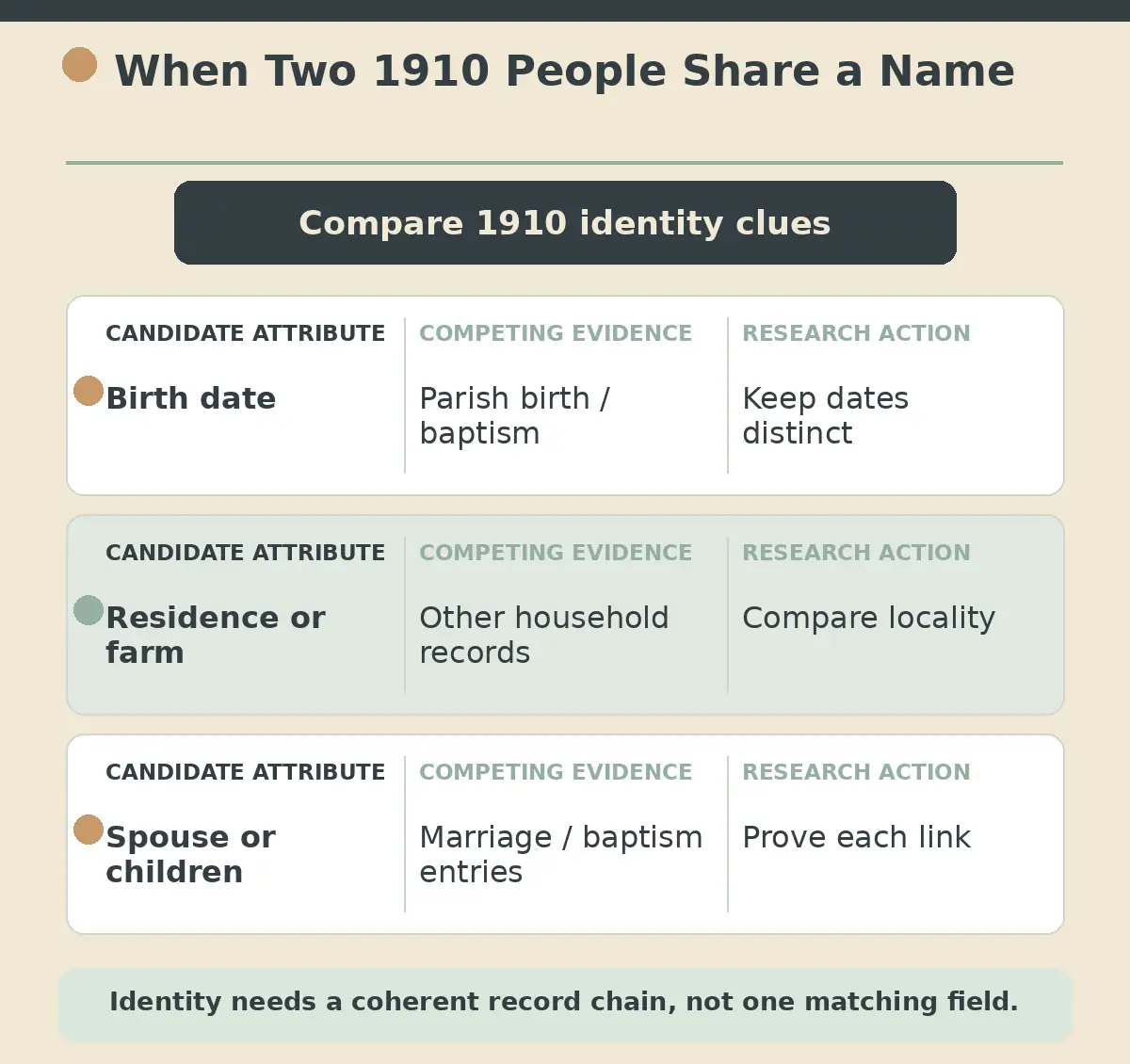
For two similar candidates, create parallel timelines with birth date, reported birthplace, residence, spouse and dated records. Do not choose whichever algorithm provides more connections. Prefer consistent firsthand or contemporaneous sources, and mark the status of each relationship separately. The research question should be whether two historical entries describe the same person, not whether the software has merged them.
More Records and Archives Guides
How We Research Norway’s 1910 Birth-Date Clues
We keep the census date, locality and original person reference together, copy the complete reported birth date and compare it to a church or civil record of the same person. We also assess whether a search result was derived from a transcript, a scan or Histreg’s linked person model. A person’s household residence in 1910 remains separate from an assertion about their birthplace or parents.
If records disagree, we preserve both transcriptions and seek a third dated source. An unsuccessful search is logged by index scope and geographic range, with special note of lost ship lists where relevant. We link the archive’s own research history and Histreg’s documentation and provide the affiliate disclosure without suggesting a data-access partnership.
The census reference date was December 1, 1910.
It requested full birth dates, a change from the earlier 1900 census; the reports still need corroboration.
The Norwegian National Archives states that the dedicated ship lists were not preserved.
No. Some links are produced algorithmically and may be wrong; verify each underlying record.
No. Compare household roles and independent baptism, marriage or later census evidence.