
Use Published Proceedings as a Lead, Not a Complete Court File
The Old Bailey Proceedings are published accounts of London criminal trials, digitized and searchable for 1674–1913. They may identify a defendant, prosecutor, witness or other participant, describe a charge, and report a verdict and punishment. They do not amount to a complete verbatim transcript of everything spoken in court. Begin with the report and its date, then decide which part of the claim needs examination in an independent record.
The National Archives explains that printed proceedings are often the easiest starting point for a pre-1972 Old Bailey case. A report might be a short summary or a detailed account depending on its period and the publisher’s practices. A name appearing in one report therefore proves only that the name was printed in that context, not that the person is your ancestor or that every detail is accurate.
Find the Person by Trial Date, Role and Offense
Start with Old Bailey Online. Search the surname alone, consider historical spelling variants and initial forms, then narrow by a plausible date or offense. Distinguish a defendant from a victim, a witness, a prosecutor and a person merely mentioned in testimony. Those roles carry very different evidentiary weight, and a namesake in the wrong role is not a match.
Where a family event supplies an approximate date, search a bracket around it rather than one exact year. Record the court session date separately from the date on which any printed pamphlet appeared. If you find no name, try an employer, street, occupation, associate or offense keyword mentioned in family evidence. The online name index describes a publication corpus, not every London offense or every historical arrest.

Record the Printed Report’s Identifying Details
Capture the title of the Proceedings, session date, report or trial identifier, original printed page when available, and a stable link or image citation. Transcribe the words attached to the name rather than modernizing them before analysis. Note whether the account quotes a witness directly, summarizes a statement, or narrates events in the publisher’s own voice. These are not interchangeable layers of evidence.
If an online transcript is difficult to parse, inspect the accompanying scan or printed layout where available. Searchable text can omit typography that separated trials, headings or verdicts. A citation such as “Old Bailey trial, 1810” is too vague to be reproducible; the reader needs the particular session and report identity. Photographing a printed page does not transform its editorial narrative into an original courtroom recording.
Separate Charge, Testimony, Verdict and Punishment
Create four fields for each trial: allegation or indictment, witness or defendant statements, stated verdict, and stated sentence or punishment. A charge is not a conviction. An acquittal is not proof that every assertion in the defense is true, and a guilty verdict is not a genealogical proof of every narrative detail. Where punishment is mentioned, ask whether the source records a sentence, a later commutation or an actual completed penalty.
Because the reports were selected, edited and sold as publications, coverage and detail changed over time. Some testimony and sensitive matters were abbreviated or omitted. When you cannot see a detail in the printed account, write “not reported” rather than “did not happen.” If a person with the same name also appears in a parish register, compare location, age, work and associated people before proposing a link.

Look Beyond the Proceedings for Court and Local Evidence
Use The National Archives’ Old Bailey guide to identify other criminal court records and the relevant date-specific custodians. The printed account can guide a search for indictments, calendars, or later punishment documents; do not assume a complete file survives for every printed trial. Newspapers can also offer a different edited description, but repeated newspaper paragraphs may simply copy the same source.
Check parish residence, occupational directories and civil records on both sides of the trial date. An accused person’s self-reported residence, a prosecution witness’s address and an archival catalog description may describe different moments. List those as independent dated claims, not a composite biography. Use a second source to test a crucial identity, marriage or death claim, especially where several same-name people lived in London.
Build a Participant-Level Identity Comparison
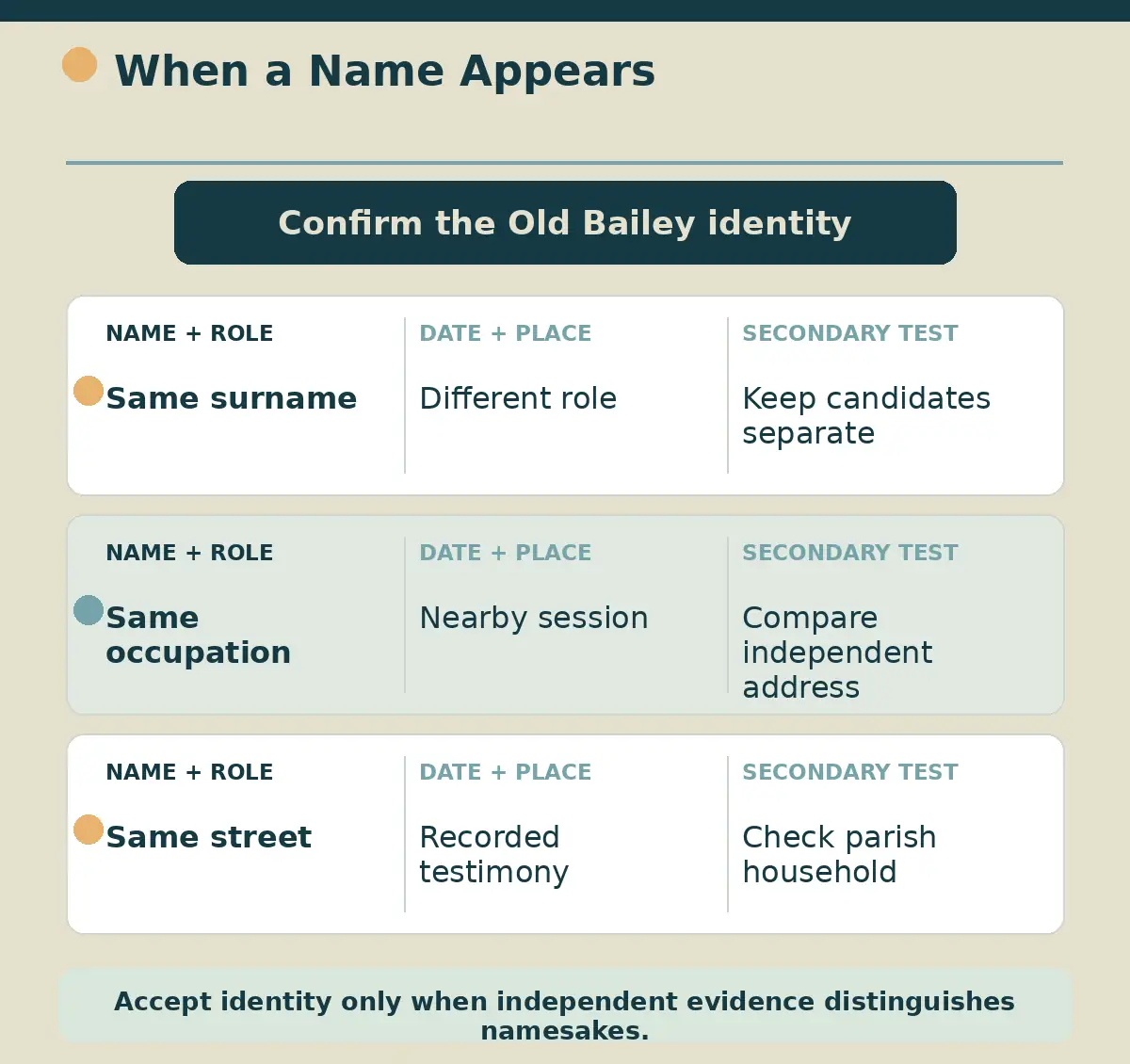
For each possible namesake make a row with role, session, reported age, residence, occupation, associates and evidence type. Compare these with the target family’s independently sourced facts. A matching surname and nearby street provide a lead, not a probability score that automatically proves identity. One conflicting age might be explainable; a conflicting role, date and workplace may exclude the candidate entirely.
A person named as a prosecutor is not thereby proven to own the disputed goods, and someone mentioned as a spouse may have been described that way by a particular witness. Preserve the speaker of each relationship statement. Cite every direct statement and record any absence of corroboration. This is especially important when a family story includes crime: avoid converting a report into a claim about a living descendant.
More Records and Archives Guides
How We Research an Old Bailey Report and Its Participants
We record search terms, roles and date limits before opening the original published account. We compare its searchable transcript with the page image when provided, cite the trial identifier, and keep testimony separate from the publication’s summary, verdict and later disposition. The method rejects a surname-only match and requires an independent household or locality source before assigning a case to a family.
For a contested detail, we mark whether evidence is contemporaneous, retrospective, edited, missing or merely repeated from another newspaper. We use the National Archives research guide to locate relevant court series rather than inventing a case file. Our affiliate disclosure explains site policies; no subscription or access partnership is asserted here.
No. The published accounts range from brief summaries to longer transcripts and are not complete verbatim court records.
Yes. Witnesses, prosecutors and victims may appear, but you must preserve each person’s actual role.
No. Distinguish the recorded result from testimony and from independently verifiable family facts.
Cite the court session and the report identifier, plus a page or image reference if available.
Check spellings, role, session and court coverage; Old Bailey publications do not represent every English prosecution.