
A genealogy place-name standard is a search and organization aid, not permission to rewrite what an old document says. Historical records can use former counties, parish names, languages, spellings and jurisdictions that no longer appear on modern maps. The official FamilySearch guidance recommends entering a place as it existed when the event happened where possible, then selecting an appropriate standardized place. Keep two separate fields in your research notes: the literal place reported by the source and the standardized search identifier, both attached to an event date and an evidentiary citation.
Transcribe the historical place before normalizing it
Copy the geographic wording exactly as it appears on the census, civil certificate, parish register, passenger list or family letter. Preserve abbreviations and spelling variants in the source transcription even when you believe the writer made a mistake. Then add a normalized display value in a separate field, explicitly labeled as an editorial interpretation. For instance, a nineteenth-century record might call a community by a parish name rather than by the present municipality. Replacing the original text with a modern county loses information about which court, registrar or church created the document. If the source provides only a broad county, do not fabricate a village. Record the source language when relevant; translating an expression for reader convenience should not erase the original form.
Use event dates to identify the relevant jurisdiction
An apparently stable town can pass between counties, provinces or states, or a parish can be reorganized while the church building remains in place. Choose the jurisdiction in effect when the birth, marriage, death, tax assessment or land conveyance was created. The FamilySearch Place Research Tool offers historical information, alternate names, basic information and related research links for a candidate place. Use those clues as a directory to actual archival finding aids; a standardized location alone does not tell you which surviving books cover a particular decade. In a research worksheet record event date, source place text, historic jurisdiction, present jurisdiction for finding a modern repository, and the source that justifies that conversion.
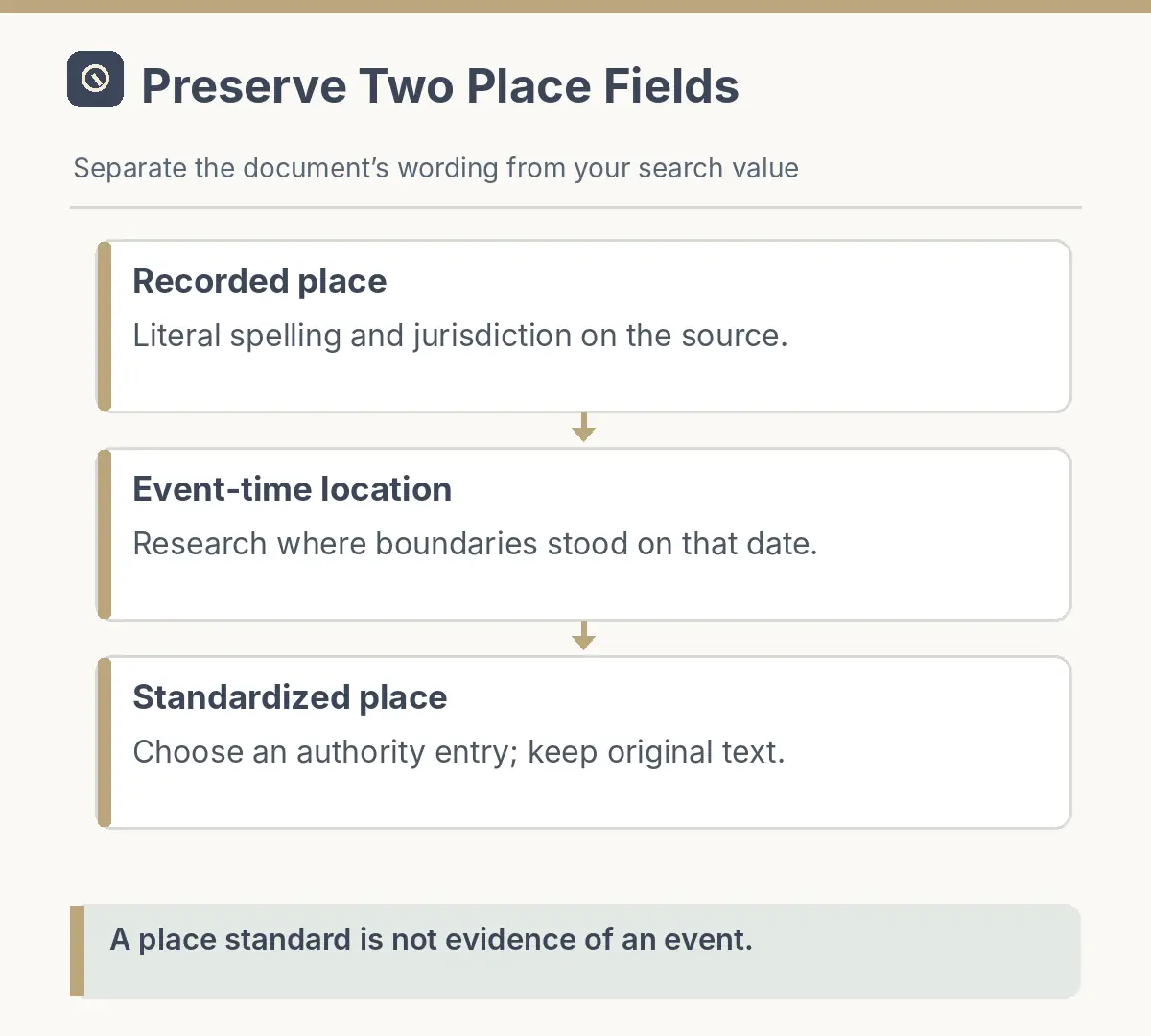
Separate the displayed location from its underlying place ID
FamilySearch’s place-standard instructions explain why selecting a standard improves record suggestions and disambiguation. A single visible place label may be paired with a specific standardized location, so two people can enter similar text but link different geographical identifiers. Check the hierarchy before selecting: country, province or state, county, city, and where applicable parish. Do not choose the nearest name just to remove an interface warning. If you cannot determine whether the correct candidate is a town or an administrative district, retain the literal wording and leave your interpretation qualified. Distinguish ‘no standard found’ from ‘the historical place did not exist’; reference databases are incomplete and updated over time.
Reject lookalike names using context rather than guessing
Names such as Springfield, Newport or St. Mary’s can identify many unrelated places. Build a shortlist of candidates with at least one supporting jurisdiction, nearby settlement, known ancestor residence or neighboring event. A place on a marriage record may describe the ceremony location, which is not automatically the couple’s birthplace or permanent residence. A passenger-list place-of-origin field can refer to a region, last residence or nationality depending on the particular form. Test the exact column heading before treating the entry as a birth location. Compare independent records for the same person and the date at which each claim was reported. If conflicts remain, keep both possibilities in a note rather than silently snapping the person to a single map pin.
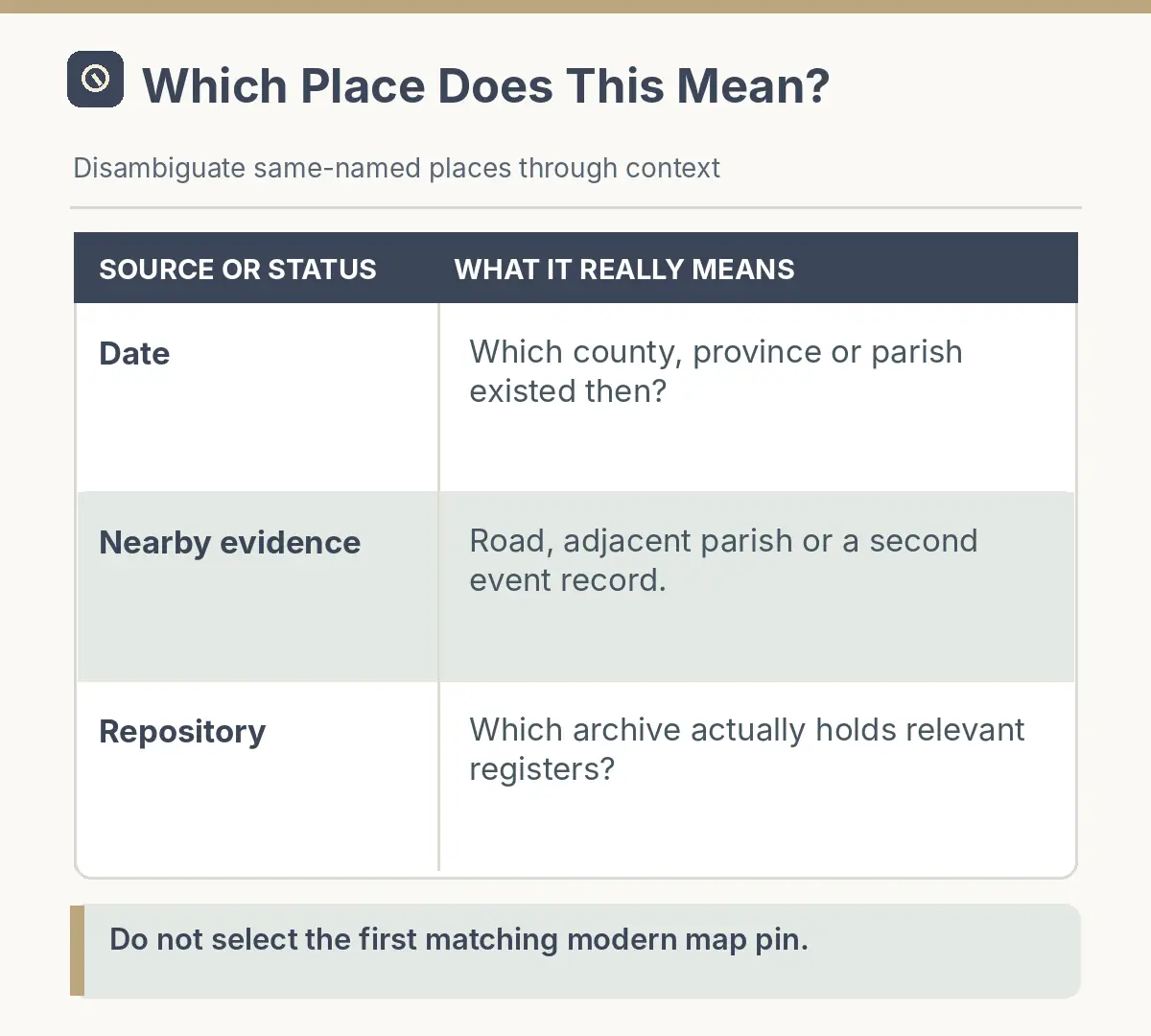
Search old variants when a standardized result fails
A failed search can reflect the way a particular archive indexed localities. Try the historical spelling, modern spelling, another language, an alternate parish, and a nearby larger district in separate queries. FamilySearch’s place-based record search guide provides access to collection descriptions, catalog entries and image-only materials through place filters. A standard place improves navigation but does not imply that every collection covering it has been digitized or indexed by name. Keep a search log containing the exact variant, geographic filter and repository searched, including no-result searches. This turns a failed location query into an actionable next hypothesis instead of an unverified claim that the ancestor never lived there.
Write citations that retain old and present-day place information
A good genealogical citation identifies the original record creator, the repository or database in which it was examined, the specific book or image reference, and the event’s recorded jurisdiction. For a historical parish register, name the parish as labeled in that source; if helpful, add its current administrative location in a clearly separate bracketed clarification. Do not manufacture a new repository name by translating the historic county into a modern one. When presenting a family story, you can put a contemporary map link beside a historic place transcription, but mark it as geographical context. A reader should be able to reconstruct which place was named by the document, which standard was selected for software searching, and what evidence supports the match between them.

Carry location uncertainty safely into GEDCOM exports
Software transfers can preserve a human-readable place string while changing or dropping the geographic identifier used by the originating tree platform. After importing a GEDCOM file, audit a sample of events that involve renamed towns, borders or repeated names. Confirm that the original place wording is still visible, that any map pin points to the intended community, and that the source citation still identifies the record-producing jurisdiction. Maintain an explicit note for unresolved place matches instead of choosing an incorrect standard simply to silence a warning. If a historical town cannot be placed more precisely than a county, a county-level location with a documented uncertainty is stronger evidence than a fabricated village coordinate. For a step-by-step method, see how to build a family tree timeline that reveals research gaps.
More Research Method Guides
How We Research Genealogical Place Standards
We use FamilySearch’s place-entry guidance to distinguish entered text from standardized selection and its Place Research Tool guide to confirm the fields available for alternate names and history. We do not invent historical county changes for a particular town or treat a system-selected standard as an eyewitness description. The research process favors literal transcription, event-time geography, documentary corroboration and a qualified modern search value. See our affiliate disclosure; this guide contains no affiliate links.
No. Preserve the original wording and keep the modern standardized identifier separately.
Keep the source transcription, record uncertainty, and follow the platform’s guidance for alternative names or missing places.
No. It helps identify a geographic location; the event itself still requires a relevant source.
Use date, historical jurisdiction, adjacent localities and independent evidence from the person’s life.
Collection coverage, indexing, alternate spelling or archive jurisdiction may be the limiting factor.