
German baptism records are normally found by historical parish and denomination, not by searching the surname across modern Germany. A baptism book may be called a Taufbuch, and an entry can supply parents, godparents, residence and a baptism date, sometimes also a birth date. The original handwriting matters. Start with a documented town, establish its Protestant or Catholic parish at the relevant time, then check Archion, Matricula or the responsible church archive. An index match is a useful lead, but baptism is not automatically equivalent to birth registration.
Identify the historical German parish before searching Taufbücher
Write down the town, period, confession and source of the place name. An immigrant record may name a kingdom, district or nearby larger town rather than the actual baptismal parish. Locate the relevant jurisdiction as it stood when the child was baptized. The Archion church-books guide stresses that church archive responsibility follows the parish and regional church; Catholic holdings generally follow diocesan custody. This is why a country-wide surname search alone produces both misses and false matches.
A historical village may have more than one congregation or may have been served by a neighboring parish. Keep alternate town spellings, the source date, nearby parishes and any evidence of the family’s denomination together. Do not infer religion from a surname. If the place cannot be located confidently, search an independently documented marriage, emigration record or sibling first. The correct parish is often the most useful result of the whole first research session.
Use Archion to locate Protestant baptism volumes
Open Archion’s church-book search and choose a place and year range, filtering for Baptism if appropriate. Its archive and location structure helps identify participating regional collections; note whether the relevant volume is actually digitized. Archion explains that looking up the existence of a digital book is free, while viewing many original images requires an access pass. Do not claim that a free catalogue hit means the manuscript page itself can be read free of charge.
If a likely volume appears, record the collection hierarchy, parish, label, year span, and the particular book or image reference visible. Check how entries are arranged: some registers list baptisms chronologically and others include separate indexes. Search surrounding weeks rather than expecting a perfect date match. A volume title such as “Taufen” identifies a register class; it does not confirm that the family’s baptism is inside it. Preserve a negative result at the book and year level, not just the portal name. Our guide “Pomeranian Parish Records” covers a related question.

Find Catholic registers through Matricula and diocesan catalogues
Matricula Online supplies historical church-register images from participating European church archives, including German collections. Its place search allows a location or diocese approach. A parish’s absence from that portal should lead to the relevant diocese or local archive, not the conclusion that no Catholic baptism took place. Coverage grows over time and local confidentiality rules determine the volumes that may be shown.
Once a book is found, separate its location metadata from its actual page images. Confirm that the displayed volume contains the right years and type of event, not an adjacent parish or a later copy. Matricula’s images are not public-domain decorations for a commercial blog: link to the institution and describe evidence rather than reproducing protected register images in this article. Record the source archive and page reference so later readers can inspect the original on the authorized site.
Decode baptism dates, parents, and sponsors on the page
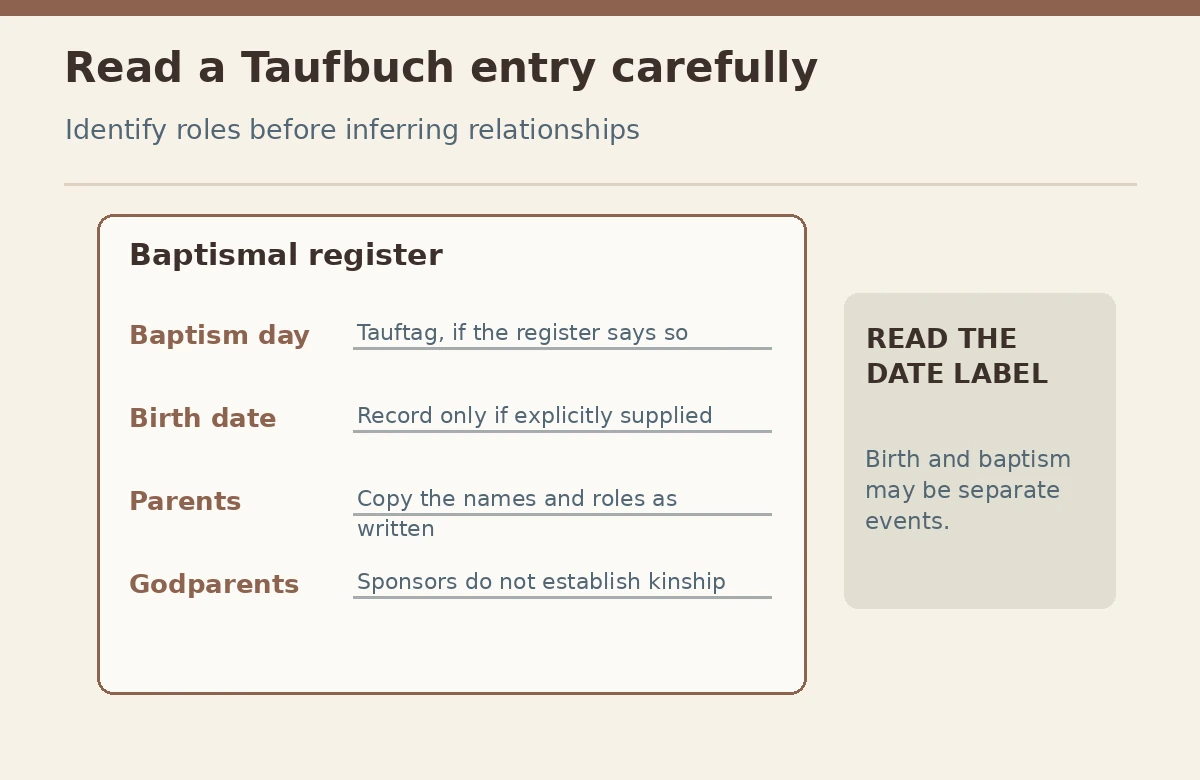
A German register may label baptism Taufe, the register Taufbuch, and the date of birth Geburt. The older entries may only state the baptism date. Do not infer an identical birth date when it is missing. Copy the original date wording, person’s full name and any clearly named parents; set aside ambiguous abbreviations until compared with another entry. Where script is difficult, transcribe the text literally before translating it into modern English.
Godparents or sponsors are often listed, sometimes with an occupation or town. They can support a network hypothesis but not independently prove an aunt, grandparent or blood relationship. Baptism witnesses may be neighbors or employers. Create separate columns for the child, father, mother, sponsor, residence and role exactly as written. When the mother’s maiden name is absent, do not manufacture one from a later tree. A second source may be needed to distinguish households sharing the same father’s name.
Compare baptism evidence with civil registration and later entries
In many German territories, civil status registration became compulsory at different times; the wider German 1876 transition does not mean every parish register ended in that year. Baptisms continue for religious purposes. An official birth act and a baptism register may report different dates because they describe different events. Read the local civil system’s implementation year before treating a civil register as absent. The useful question is which source should preserve the specific event in that specific locality.
For a fictional case, two Johann Müller baptisms occur in neighboring parishes in the same year. One names a father who is a smith and the other a farmer. A later marriage record describes the ancestor’s father as a smith, which strengthens one candidate; it does not settle identity if the place or maternal evidence conflicts. Keep both possibilities, cite the original pages and search for siblings or confirmations to test the link. Do not collapse the candidates based only on the shared first and last name.
Preserve an exact German register citation and search decision
The final research log should contain the modern and historical locality, denomination, responsible church archive, portal, parish, volume title, coverage years, image or page number, exact names and the date consulted. Note which words are certain transcriptions and which are tentative paleographic readings. Where a volume is unavailable digitally, copy the official catalogue description and contact the custodian with a narrow request for the desired entry.
Document limitations in one sentence beside each claim: the record directly reports a baptism, parents are described as written, sponsorship is a recorded role, and later identity remains subject to corroboration. The best German baptism result is not a large pile of surname hits; it is one precisely located entry that another researcher can find again, plus a clear explanation of the next record needed to show that this baptized child became the historical ancestor. For a related choice, see our guide “Prussian Birth Records”.

More Records and Archives Guides
How We Research German Baptismal Registers
We compared the named repository’s current description of its holdings or online search with the other institutional guides cited here, then checked what each source can directly establish. Our examples are hypothetical and never represent an identified real person. A database hit, original record and later inference are treated as different evidence levels. Coverage, copying arrangements and privacy policies can change: verify them at the relevant institution. We have not asserted paid endorsements or affiliate relationships. See our affiliate disclosure.
It means baptismal register; read the event label and entry rather than assuming it is a birth certificate.
No. Finding digital holdings is free; access to many original book images requires a paid pass.
It holds collections supplied by participating archives; check the specific German diocese and parish rather than generalizing.
No. Baptismal sponsorship is evidence of a documented social or religious role, not automatic kinship.
One may be a birth date and the other a baptism date. Transcribe both with their original labels.