
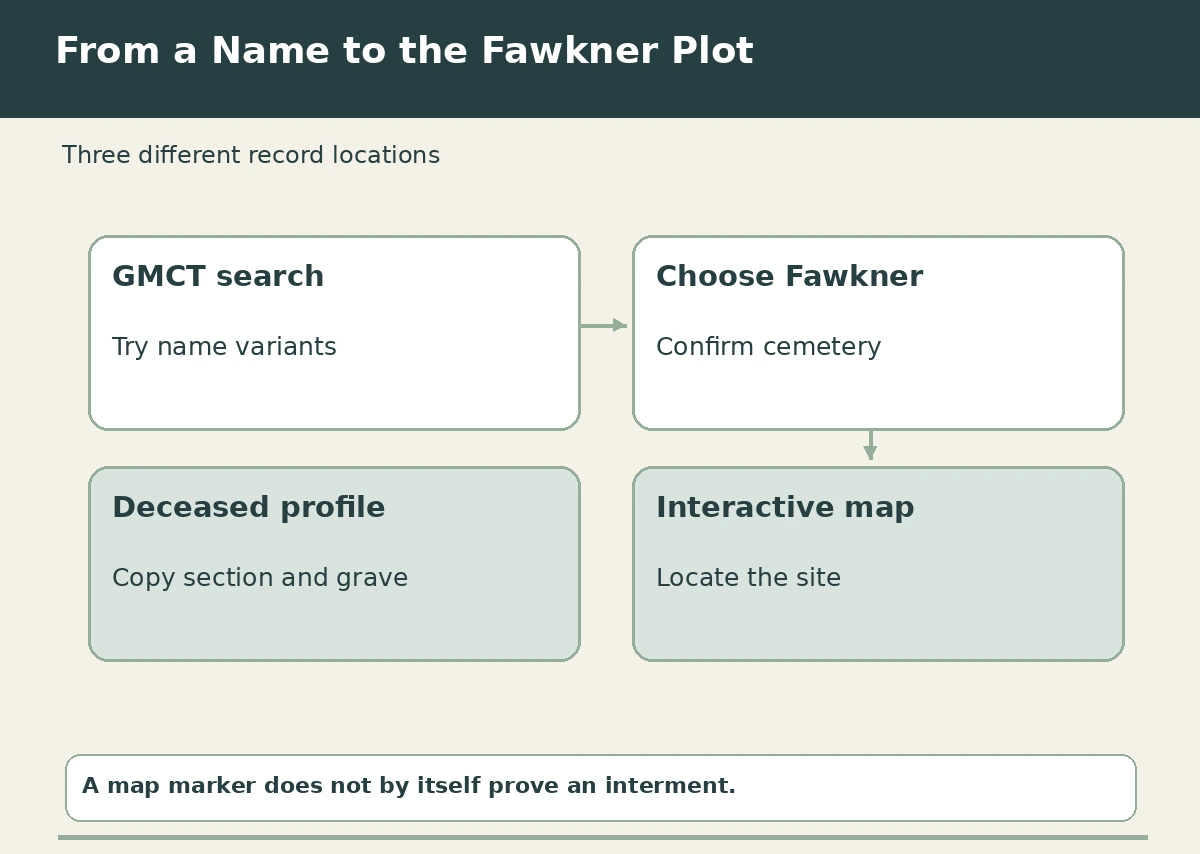
The official way to look for a burial at Fawkner Memorial Park is the Greater Metropolitan Cemeteries Trust (GMCT) Find a Grave service. Start with a surname, narrow by cemetery only when needed, and use the memorial-park map to confirm the exact plot when a record includes one. A service date and a death date are not necessarily the same. The searchable record can identify a burial or cremation context, but it does not prove a family relationship or that the person owned the grave. Follow the original record, not a memorial-tree claim.
Confirm that Fawkner is the right Melbourne cemetery
Fawkner Memorial Park, in Melbourne’s north, was established in 1906 according to GMCT. The operator also manages other cemeteries and memorial parks, so a surname hit in the GMCT database should not automatically be attributed to Fawkner. Before searching, gather a death notice, death registration, funeral announcement or family letter naming the cemetery. If the family used “Fawkner” broadly as a locality, check whether that was the burial site or only a residential suburb. A contemporaneous funeral notice can lead to a particular section, denomination or cremation service even when the modern search form returns multiple people.
Search broadly before adding exact-date filters
GMCT’s official form allows combinations of last, first and middle name, location, date of birth, date of death and service-date ranges. The operator advises leaving uncertain details blank. Begin with surname plus one given-name variant; record the number of results and then add the cemetery filter. Narrow by a well-supported year rather than a guessed full date. Married names, initials, transliteration, historical spellings and clerical errors can suppress a hit if too many filters are applied. Use the interface’s location field to distinguish Fawkner from other GMCT venues, but recheck the cemetery on the actual deceased profile before accepting the match.
Read death and service dates as distinct historical events
A deceased profile may list a date of death and a date of service. A service can follow death by days or longer, and the profile’s birth-date field may be empty. Transcribe these fields under their own headings; do not fill a missing birth date using a calculated age or convert the service date to the death date. A reported “date of service” can help find a funeral notice, but it does not necessarily date the interment of remains in every case. To prove the death event itself, seek the contemporary Victorian civil death record or another independent document and compare name, age, address and relatives.
Move from the deceased result to the cemetery map
GMCT offers an interactive map to search by deceased name or plot location. When a profile shows a location such as a named lawn, denominational section or grave number, copy every element and open the map rather than relying on a vague family recollection about an entrance or roadway. Some cemetery maps contain areas used for cremated remains, vaults or commemorative plaques; being associated with a location does not automatically mean an intact bodily interment there. Use the map for geographic orientation and check the record type to determine whether you found a burial, a cremation reference or a memorial location. Our guide “Woronora Memorial Park” goes into more detail.
Distinguish person, plot and the right to use a grave
A cemetery entry relates a named person to a recorded cemetery event or site. It does not establish legal ownership of land, the holder of burial rights or the identity of every other person interred nearby. A grave can be shared by relatives or by people with no known relationship, depending on cemetery rules and historical arrangements. A monument may mention a person buried elsewhere. Create separate columns for deceased, section, grave number, event date and evidence of a relationship. Only assert a shared family relationship after checking independent documents such as civil registers, funeral notices or probate material.
| Record field | Useful for | Not automatic evidence of |
|---|---|---|
| Death date | Finding civil death evidence | Service or burial date |
| Service date | Searching funeral notices | Exact date of death |
| Plot locator | Finding the cemetery site | Legal plot ownership |
| Names on marker | Reading commemoration | All interments or kinship |
Handle incomplete historical details and corrections responsibly
GMCT warns that some historical records are incomplete or contain small errors because recordkeeping practices changed. A missing birth date, inconsistent initial or misremembered service date is therefore a prompt to inspect alternative sources, not evidence of a different person by itself. If the register appears wrong, GMCT asks for documentary government evidence before making a correction. Preserve the wording as found, note the date you checked it, and place your alternative reading beside it. Do not edit a public genealogy profile to “correct” the cemetery without a traceable source, and avoid exposing information about living relatives unnecessarily. For a related choice, see our guide “St Kilda Cemetery Records”.

Use an independent Victorian death record as the identity test
For each candidate, note a full name, date of death if supplied, any birth date and the plot reference. Compare a Victorian death registration or contemporary funeral notice for age, spouse or parents where those fields exist. A second person with the same initials and year of death may be buried at a different Melbourne cemetery; an identical surname does not resolve that. An illustrated plot map is helpful but is not itself genealogical proof. If only a cemetery index is available, state “probable Fawkner burial” and identify exactly what civil or funeral record would raise that conclusion to a reliable identification.
When the online register has no obvious result
Run a second search without middle names and exact dates, with spelling variants and nearby years. Check whether the person may have been cremated or recorded at another cemetery managed by GMCT. The official database excludes Northcote Cemetery, an important limit if you are searching the broader GMCT network, although Fawkner itself is covered. Write down the date range and filters you used. If evidence says the burial took place at Fawkner yet no result appears, use the trust’s family-history guidance or contact route and provide your documented identifiers. A failed web search is not a negative finding about a historical death. Our guide “Keilor Cemetery Records” covers how to find burial locations and verify the person.

Build a citation that can be checked on the next visit
Capture the name as displayed, GMCT as responsible operator, Fawkner Memorial Park as place, the recorded service or death date, the section and grave locator, and the profile or map link. Save a note identifying which source fields were absent. For a site visit, consult the current official location guidance rather than relying on old visiting-hour screenshots. Photograph markers only where lawful and respectful of other visitors. When a memorial inscription differs from the cemetery register, cite both separately; decide what each observed source actually establishes before merging dates into the family tree. To go further, our guide “Carr Villa Memorial Park Burial Records” shows how to find a Launceston grave.
More Records and Archives Guides
How We Research Fawkner Memorial Park Burial Records
We checked GMCT’s current deceased search, its Fawkner location description and the National Library of Australia’s cemetery-custodian guidance. The burial versus death versus memorial distinction is an analytical safeguard, not a claim that we accessed a private cemetery file. Examples of similarly named people are hypothetical; the figures illustrate questions to ask of a real record.
Official references checked on October 24, 2026: primary archive; secondary archival guide; collection description. Collection pages describe archive scope; they do not mean we examined or verified every individual historical manuscript. This page contains no paid product recommendation. For the site-wide policy consult affiliate disclosure.
Yes. GMCT provides form and map searches for its managed grounds, including Fawkner.
Historical records have varying detail; GMCT warns that some older fields may be incomplete.
No. Record them separately and verify the death against a civil registration or contemporary notice.
No. Same plot or surnames are leads; relationships require independent documentation.
Remove overly narrow filters, check spelling and alternative sites, then contact the custodian with supporting evidence if necessary.